
English
Electromagnetic Flow Meter for Slurry and Filtrate Lines: South Africa Effluent Treatment Case Study
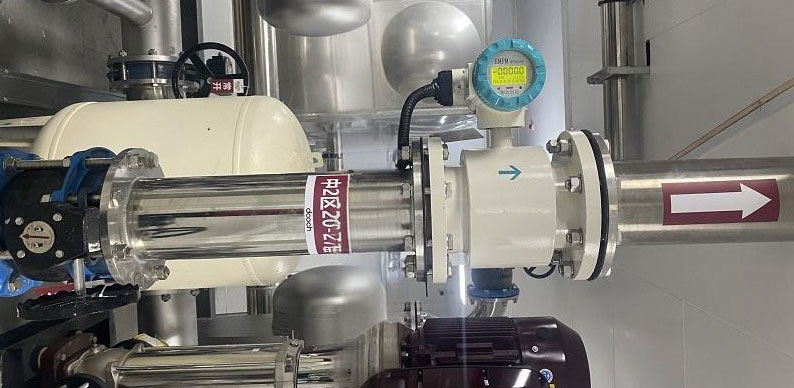
For a slurry line at 50% solids and a clean filtrate line on the same effluent treatment plant, an electromagnetic flow meter is the correct choice for both. Silver Instruments supplied DN200 SHD-SE16 units with tungsten carbide electrodes and a polyurethane rubber liner for the abrasive slurry side, covering 70 to 150 m3/h at 4 barG. No moving parts means no wear from the 1.4 t/m3 slurry density.
| Parameter | Slurry Line / Filtrate Line |
| Pipe size | DN200 (8 inch), flanged |
| Flow range | 70 to 150 m3/h (308 to 660 GPM) |
| Pressure | 4 barG (58 psi) |
| Temperature | 40 degC max (104 degF) |
| Solids content (slurry line) | 50% solids, density 1.4 t/m3 |
| Power supply | 220 Vac |
| Output | 4-20mA, remote mount converter |
| Model selected | Silver Instruments SHD-SE16, DN200, tungsten carbide electrodes, polyurethane rubber liner |
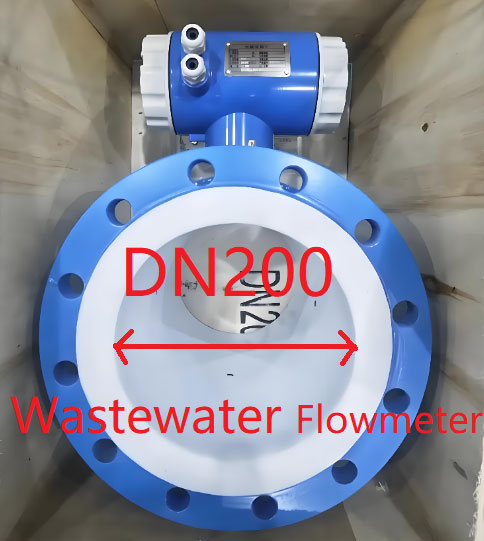
DN200 wastewater Flowmeter
A customer in South Africa runs an effluent treatment plant with two parallel duties on the same skid. The slurry line carries 50% solids by weight, with a slurry density of 1.4 t/m3. The filtrate line, right next to it, runs clean fluid with zero solids. Both lines share the same DN200 pipe size, the same 70 to 150 m3/h flow range, and the same 4 barG, 40 degC process conditions.
That overlap made the project simple on paper but it still needed two different liner and electrode choices, because slurry and filtrate are not the same fluid even if the numbers on the datasheet match.
Vortex meters need a clean, low-viscosity fluid to generate a stable shedding frequency. Fifty percent solids would clog the bluff body within days. We have seen this on customer sites in Southeast Asia too, where vortex meters were pulled out after a few weeks of slurry duty.
Coriolis works on the filtrate line in theory, but at DN200 and 150 m3/h the tube size gets large and expensive, and slurry erosion on the internal tubes is still a risk. Electromagnetic flow meters have no obstruction in the flow path. That is the whole reason they survive abrasive slurry service that wears out mechanical meters in a matter of months.
Slurry line: SHD-SE16, DN200, tungsten carbide electrodes, polyurethane rubber liner, PN16, remote mount converter with 10 meter cable, 4-20mA output, 220 Vac. Polyurethane rubber resists abrasion far better than a hard rubber or PTFE liner under constant particle impact.
Filtrate line: SHD-SE11, DN200, 316L electrodes, PTFE liner, same PN16 rating and same remote converter setup. Because the filtrate side has no solids, a standard 0.5% accuracy electromagnetic flow meter with PTFE lining is sufficient and keeps the cost down compared to specifying tungsten carbide where it is not needed.
Effluent and mineral processing plants across South Africa deal with the same slurry and filtrate split constantly, whether it is a coal wash plant, a gold tailings line, or a municipal wastewater works. Specifying one meter type for both duties usually ends in early failure on the slurry side or overspending on the clean side.
Send us your solids percentage, slurry density, pipe size, flow range, pressure, and temperature for each line, and we will match liner and electrode material before quoting, the same way we did for this project.
Send us the following for each line and we will recommend the correct electrode and liner combination:
Email sales@silverinstruments.com with these parameters and we will turn around a model recommendation and quotation.