English
We offer a variety of micro flow meters for measuring gases, liquids, steam, and more. For example, they can detect gas flow rates as low as 2 sccm, oil flow rates as low as 0.5 ml/min, and liquid flow rates up to 40 g/h.

Made of PPS or PVC, suitable for mildly corrosive liquids such as seawater, dilute sulfuric acid, NAOH, H2O2.,etc. Capable of measuring as low as 1 ml/min flow.
LC-M2,M5 to M25 micro liquid flow meter can detect as low as 0.5ml/min flow. It is a PD flow meter for liquid such as water, fuel, oil, resin. it still keeps 0.5%F.S accuracy.
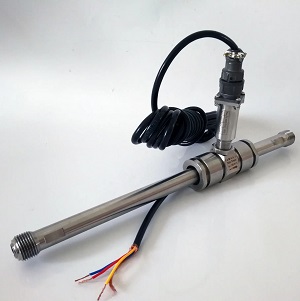
Turbine flow meter can measure clean water at low flow rate starting from 40 L/h. Pulse output and economical solution for water.
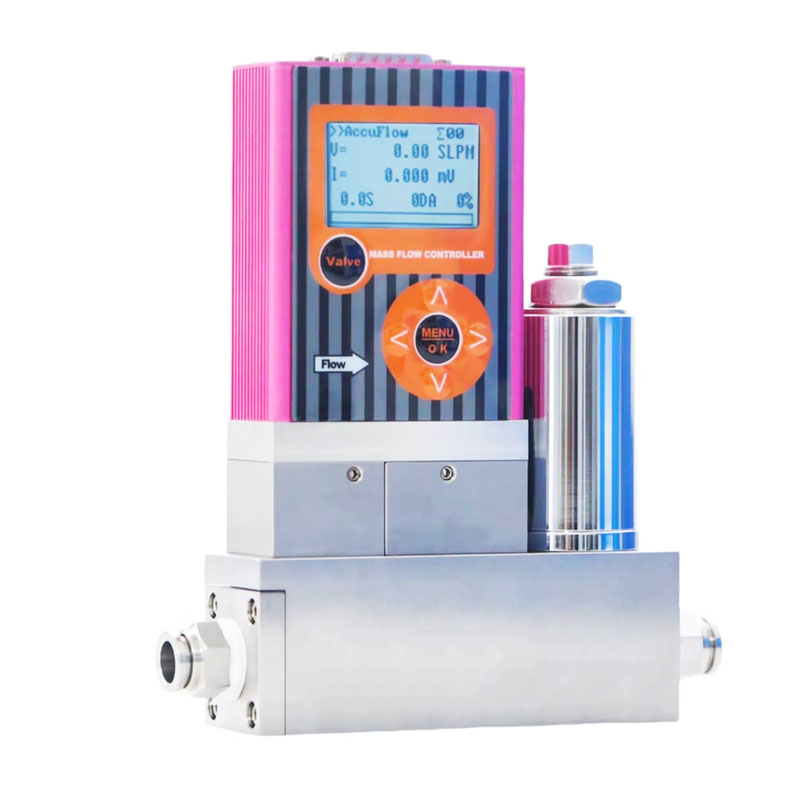
High-precision gas flow meter/controller with accuracy of ±0.5% of full scale. Thermal dispersion principle for gas, air ,CO2,N2,O2,He,HCl,H2 etc. Response time 0.2s.
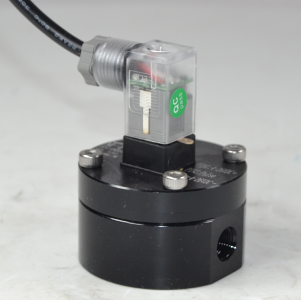
Micro fuel flow meter can detect at least 0.5 ccm flow for fossil fuel, gasoline, petroleum, diesel fuel, ethanol,bio-diesel.,etc.Low cost but reliable working.
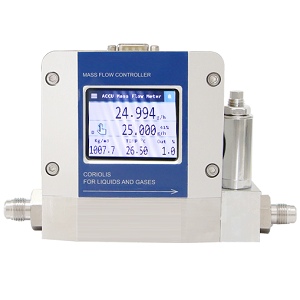
Coriolis principle small flow meter/flow controller, Best accuracy mass flow meter for gas, liquid and steam. It can detect 40 g/h flow or even lower.
For gas ultra low rate as low as 2 sccm (2 ml/min), For air,biogas,natural gas, N2, O2,CO2,etc. 1%F.S accuracy and 2s response time.
Flow meter with wetted parts made of PP or PVDF for corrosive liquid measurement, capable of detecting a minimum flow rate of 13 ml/min.
Micro flow meters provide volume and mass flow . it is for low viscous fluids at low flow rate ,such as steam,solution, water, alcohol, ,air ,gas .,etc
dosing line running at 3 ml/min. A fuel consumption test at 0.5 ccm. A lab gas supply at 2 sccm. Standard flow meters can't measure at these ranges accurately. Small flow meters are built for exactly these conditions.
A small flow meter is a flow measurement instrument purpose-built for low-flow applications, typically covering ranges from as low as 0.01 ml/min up to around 10-20 L/min, where standard flow meters lose accuracy or can't register a reading at all.
They use different sensing principles than full-size instruments and come in compact body sizes to fit tight installations. The right choice depends on your fluid type, required accuracy, flow range, and whether you need volume flow or mass flow output.
Silver Automation Instruments supplies small flow meters in multiple technologies: Coriolis, thermal mass, turbine, positive displacement, and magnetic.
There is no single industry definition, but the following ranges are generally considered low flow:
| Fluid Type | Low Flow Range |
|---|---|
| Liquid | Below 10 L/min, often in ml/min or cc/min |
| Gas | Below 50 L/min, often in sccm or ml/min |
Ultra-low flow starts at the sub-ml/min level. Micro flow meters in this category need highly sensitive sensing elements and tight manufacturing tolerances.
Coriolis meters measure mass flow directly by detecting the deflection of a vibrating tube as fluid passes through it. Small Coriolis meters maintain this principle in a compact body, making them the most accurate option for low flow liquid and gas measurement.

Key specs:
Coriolis meters are the right choice when accuracy is the first priority and fluid properties may vary — for example, custody transfer of specialty chemicals, or dosing lines where fluid density is not constant. They are not affected by changes in viscosity, conductivity, or pressure, which makes them reliable across changing process conditions.
Typical applications: Chemical dosing, pharmaceutical ingredient blending, fuel consumption testing, specialty gas measurement, custody transfer of high-value fluids.
Thermal mass flow meters measure gas by detecting the heat transfer from a heated sensor element to the flowing gas. Because the measurement is based on mass, no temperature or pressure compensation is needed. Output is directly in mass flow units (g/h, sccm, kg/h).
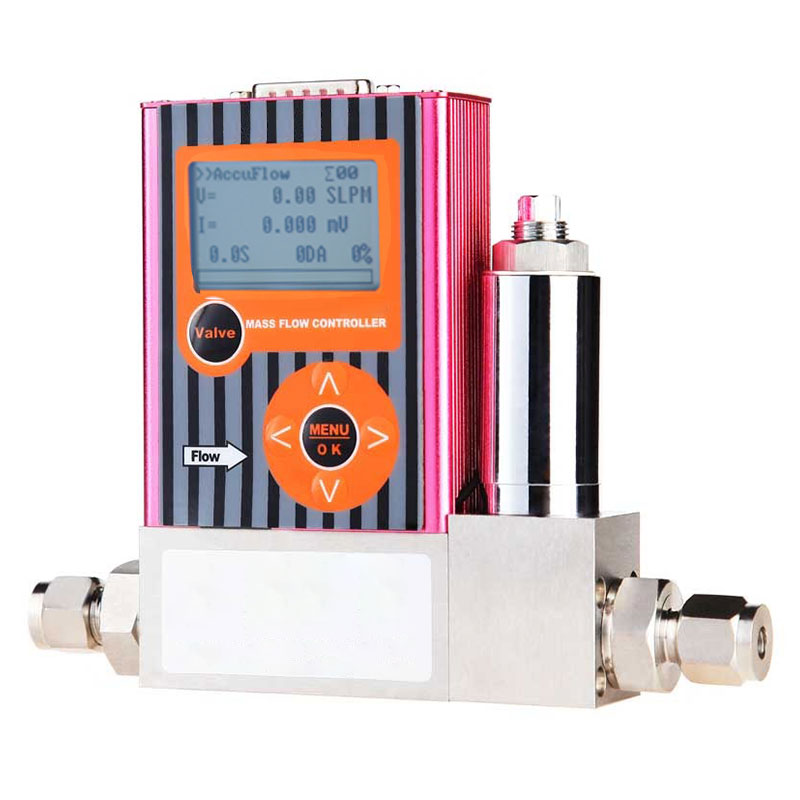
Key specs:
These meters work with air, nitrogen, oxygen, carbon dioxide, biogas, natural gas, and a range of other gases. They are compact enough to install in space-constrained panels or lab benchtops.
Typical applications: Laboratory gas supply, gas blending, combustion testing, environmental monitoring, small-scale biogas measurement.
Turbine flow meters measure volumetric flow by counting the rotations of a rotor placed in the fluid stream. At low flow rates, the rotor needs to be precision-machined and properly sized to the pipe bore to maintain accuracy. Micro turbine meters are designed for exactly this.
Key specs:
These meters are low cost and easy to install. They work best with clean liquids of relatively stable viscosity. Process fluids with suspended solids or high viscosity can affect rotor performance.
Typical applications: Water injection systems, small-scale chemical injection, cooling water monitoring, laboratory fluid dispensing,low flow meter for water .
Positive displacement meters measure volume by trapping and counting discrete volumes of fluid using rotating gears or rotors. Oval gear meters and helical gear meters are common designs. They tolerate high-viscosity fluids better than most other meter types and maintain accuracy without depending on flow velocity profile.

Key specs:
PD meters are one of the most reliable choices for viscous fluids, oils, fuels, resins, corrosion inhibitor and adhesives. They do not require the fluid to be conductive and are not sensitive to upstream flow disturbances.
Typical applications: Fuel consumption measurement, lube oil monitoring, paint and adhesive dispensing, hydraulic fluid measurement, polymer injection.
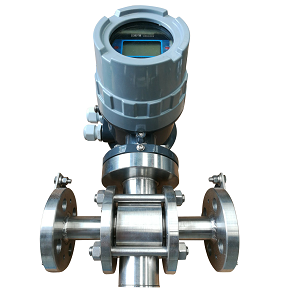
Electromagnetic flow meters measure conductive liquid flow using Faraday's law of induction. A magnetic field is applied across the pipe, and the voltage induced by the moving fluid is proportional to velocity. Mini mag meters bring this technology to small pipe sizes.
Key specs:
Mag meters require the fluid to be electrically conductive. They are a strong choice for chemical injection and fertilizer dosing lines where the fluid may be aggressive and moving parts would be problematic.
Typical applications: Chemical injection, water treatment dosing, fertilizer flow measurement, food-grade liquid measurement (with appropriate liner).
The technology choice depends on several variables. This table summarizes the main selection criteria:
| Meter Type | Fluid | Min Flow | Accuracy | Moving Parts | Notes |
|---|---|---|---|---|---|
| Coriolis | Liquid, gas | 40 g/h | 0.25% FS | No | Best accuracy; measures mass |
| Thermal mass | Gas only | 2 sccm | 1% FS | No | No P/T compensation needed |
| Turbine | Clean liquid | 0.035 L/min | Moderate | Yes | Low cost; no viscous fluids |
| Oval gear / PD | Liquid, viscous | 0.004 L/min | 0.5% | Yes | Best for high-viscosity |
| Mag meter | Conductive liquid | 0.33 LPM | Good | No | Must be conductive fluid |
Additional questions to answer before selecting:
If your application involves multiple fluids or unusual conditions, contact our engineering team with your process data. We can recommend the right meter and confirm the rangeability for your specific flow range.
Selecting a flow meter rated for 1/2" pipe and trying to use it at 5 ml/min typically does not work. Velocity at very low flow rates in a standard pipe bore is too low for most sensing principles to detect reliably.
Small flow meters solve this by either using a much smaller bore (matching pipe ID to the flow range) or by using a sensing principle that does not depend on velocity, such as Coriolis or positive displacement.
If you are retrofitting a low flow meter into an existing line, confirm the pipe bore, the maximum flow rate, and the minimum flow rate you need to measure. Many low flow applications require a reducer to bring the pipe down to the meter bore, with a reducer installed on each side.
Most small flow meters from Silver Automation Instruments are available with:
Some Coriolis and thermal mass models also support batch control functions, allowing the meter to trigger a valve or pump at a set total volume.
Silver Automation Instruments manufactures and stocks small flow meters for standard configurations. Non-standard materials, special process connections, or customer-specific calibration requirements are available on request. Lead times vary by product type and configuration.
To request a quote or confirm specifications for your application, send your process data to sales@silverinstruments.com or use the inquiry form on this page.
we will contact you within 24 hours..