English
Choosing the right level sensor depends on your medium, tank conditions and required output. Our range covers ultrasonic, radar, hydrostatic and capacitance level transmitters, suitable for water, oil, chemicals, sewage and bulk solids. Tell us your application and we will recommend the most suitable type and help you avoid common selection mistakes.
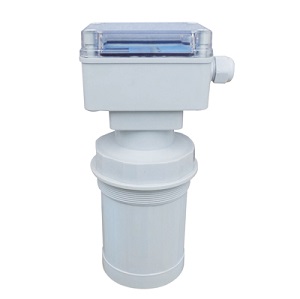
We are always doing our best to supply ultrasonic level transmitter at low price cost, robust quality and excellent performance from China ultrasonic level sensor manufacture. We sell separate or inte...
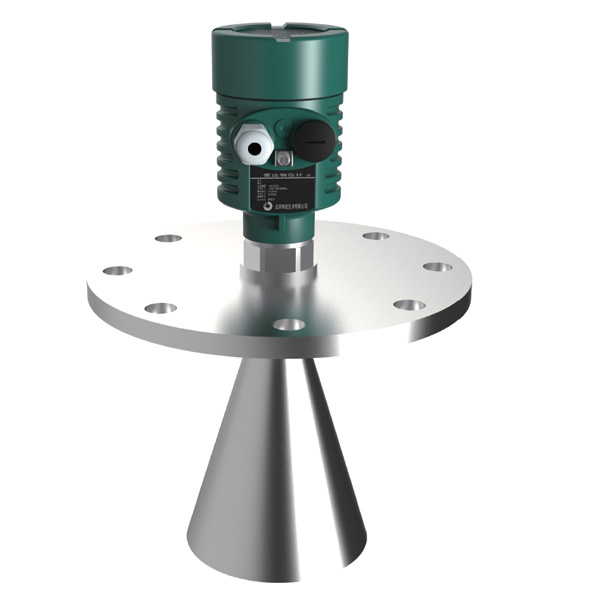
Radar level transmitter is a device usedfor the measurement of liquid levels. Due to their high precision and accuracy,these radar type level transmitters are widely used commercially.Working principl...
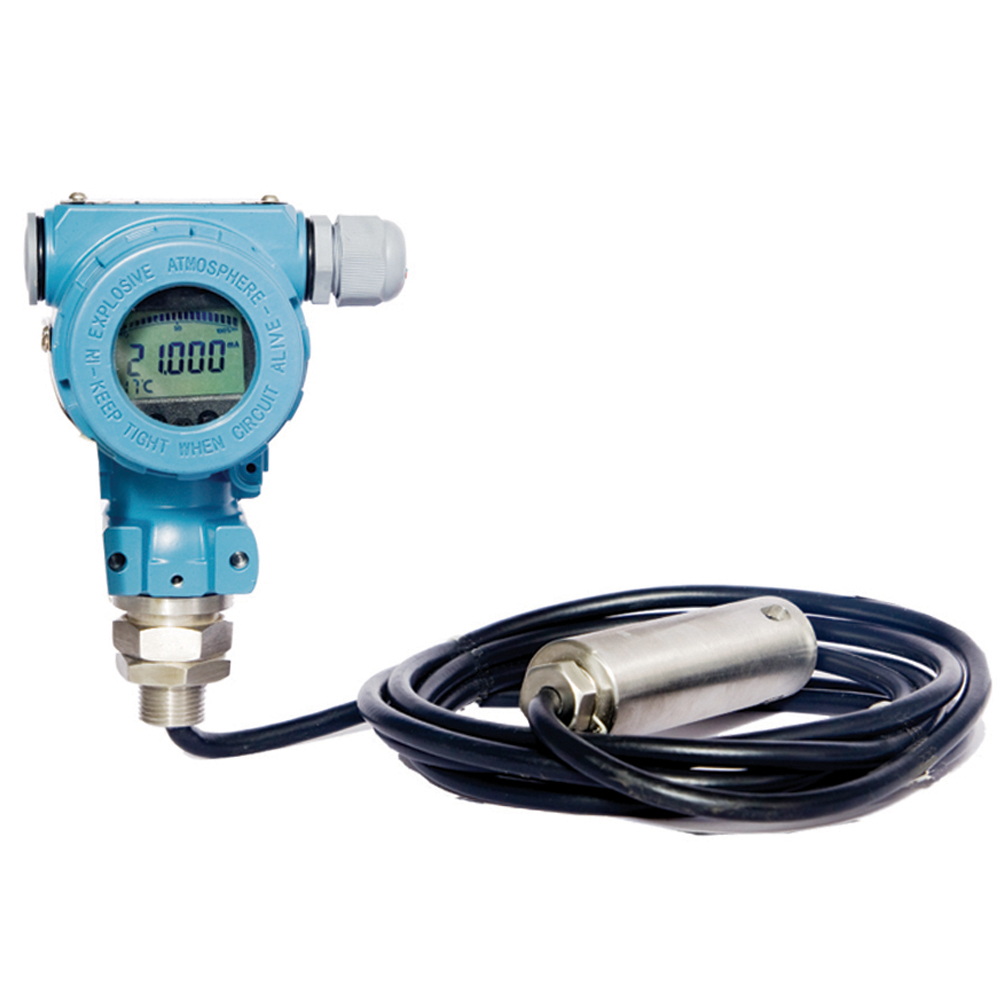
Hydrostatic level transmitter; For water, oil or corrosive liquid level measurement; Range: 0-100 m level; 4-20mA,HART ,Modbus;
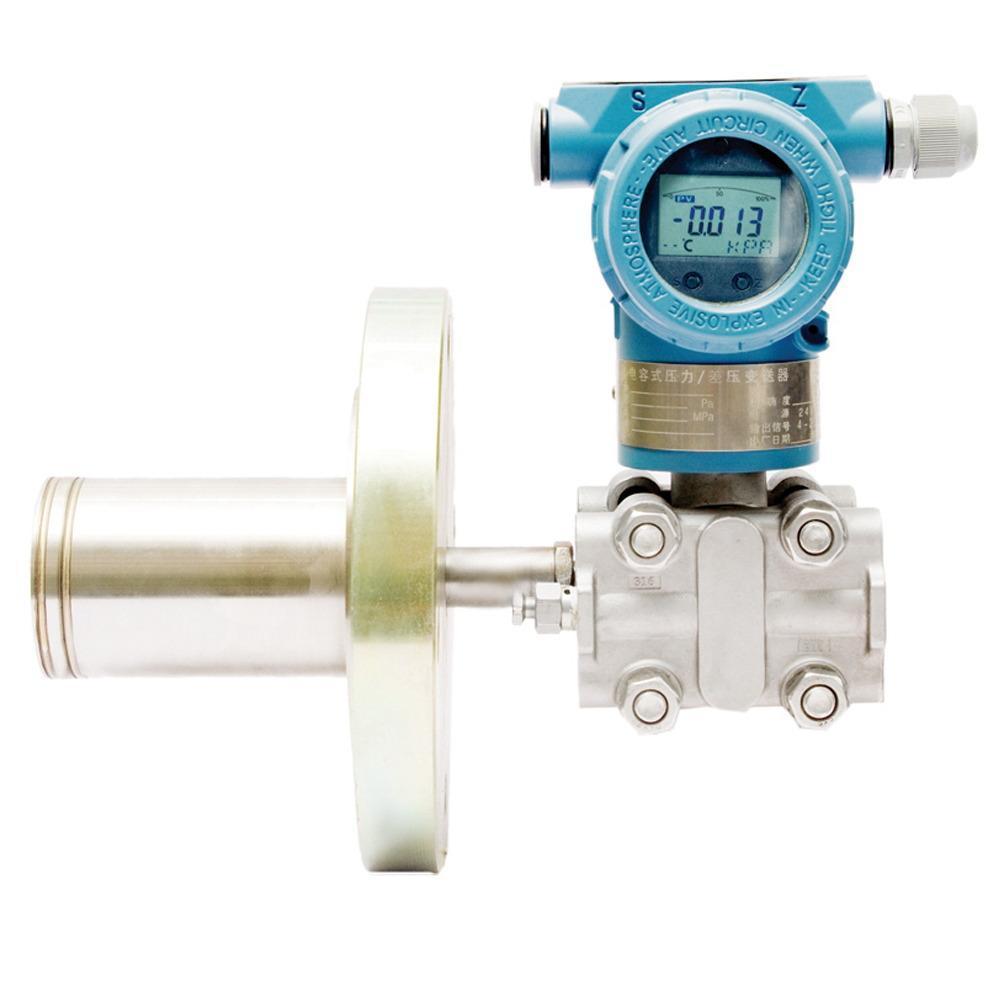
SHLT (smart) flange type capacitive level transmitter can carry on accurate measurement of level and density for all kinds of containers. It is a kind of pressure level sensor .Flush flange and extend...
Level Measurement Instruments: A Practical Guide to Choosing the Right Sensor
Quick AnswerSilver Automation Instruments builds five families of level instruments: non-contact radar (26 GHz and 80 GHz), guided wave radar, ultrasonic, hydrostatic (submersible) pressure transmitters, and pressure or differential pressure transmitters for closed and pressurized tanks. Non-contact radar works best for dusty silos, high pressure vessels, and corrosive liquids. Guided wave radar handles foam, turbulence, and low dielectric media. Ultrasonic level meter suits open tanks and sumps on a tight budget. Hydrostatic level transmitters measure water, wastewater, and fuel level through a submersible probe, and pressure or differential pressure transmitters measure level in sealed, pressurized, or vacuum vessels where a probe cannot be submerged. |
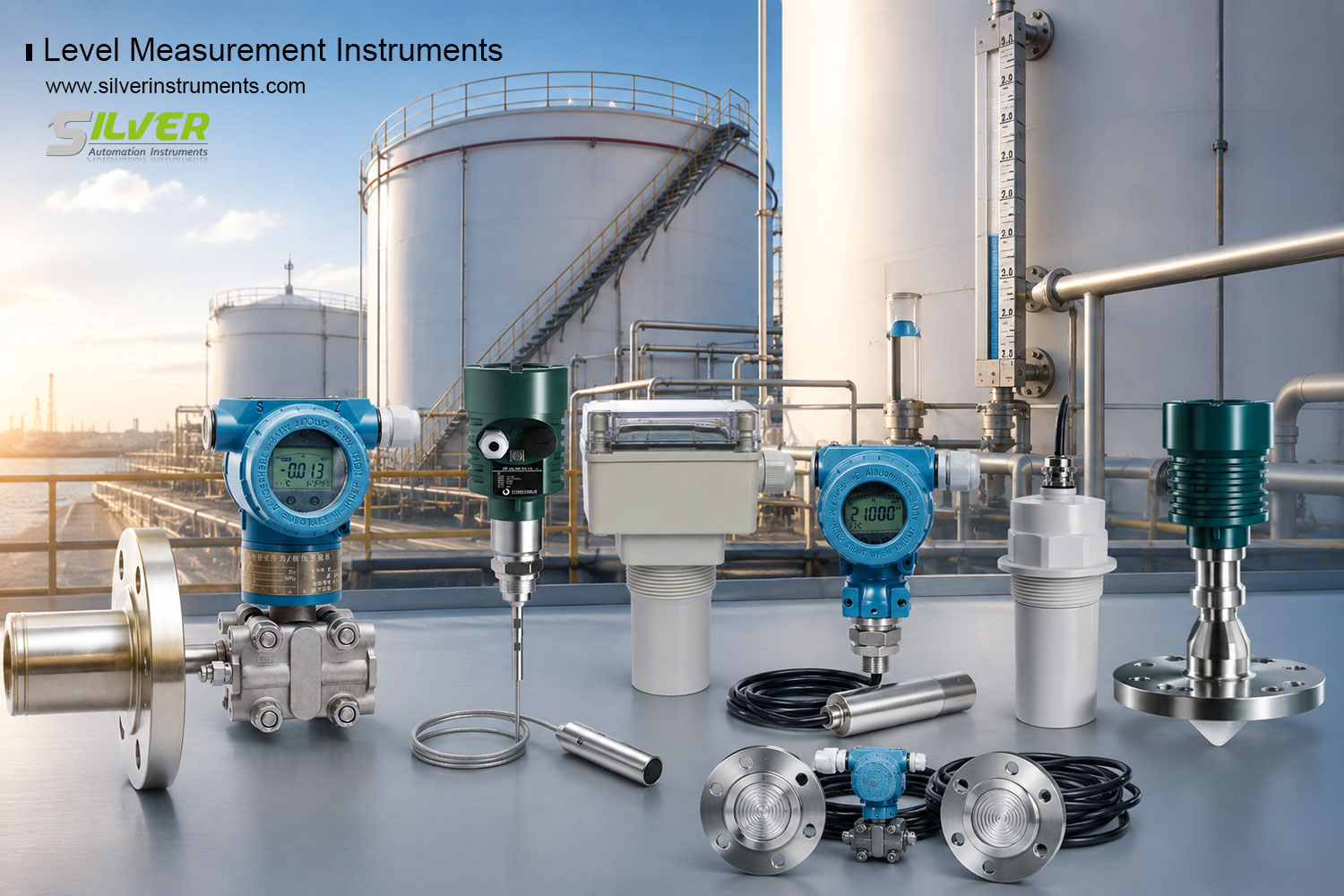
Silver Automation Instruments supplies five core technologies of level measurement: non-contact radar level meter, guided wave radar meter, ultrasonic level transmitter, hydrostatic (submersible) pressure transmitters, and pressure or differential pressure transmitters for closed and pressurized tanks. Customers in Southeast Asia, the Middle East, Australia, South America, and Africa order across all five, often for the same plant. A palm oil refinery might run 80 GHz radar level meter on the storage tanks, guided wave radar sensor on the deaerator, a differential pressure transmitter on a pressurized bleaching vessel, and a simple hydrostatic level meter on the wastewater sump. Here's the thing: there is rarely one correct answer for an entire site. There is a correct answer for each vessel.
This guide walks through what each technology does well, where it struggles, and which model fits which job. We also link out to deeper technical articles and application notes throughout, so you can dig into price information, selection method, wiring diagrams, mounting distances, or a specific chemical compatibility question once you know which level sensor you exact need.
Before delving deeper into the topic, here is the short version most engineers actually want.
| Technology | Best for | Avoid when | Typical range |
| Radar (26 GHz / 80 GHz) | Solids, dusty silos, narrow nozzles, high pressure or corrosive tanks | Extremely low budget projects on simple open tanks | Up to 120 m |
| Guided wave radar level meter | Foam, turbulence, low dielectric constant liquids | Sticky or crystallizing media | 6 to 30 m |
| Ultrasonic level meter | Open tanks, sumps, water and wastewater | Vacuum, high temperature, heavy vapor | 4 to 40 m |
| Hydrostatic pressure (submersible) | Wells, wet wells, tanks needing a submersible probe | Tanks with changing specific gravity | 0.5 to 200 m |
| Pressure / differential pressure transmitter | Closed, pressurized, or vacuum tanks; boilers | Tanks with changing specific gravity | Depends on vessel height |
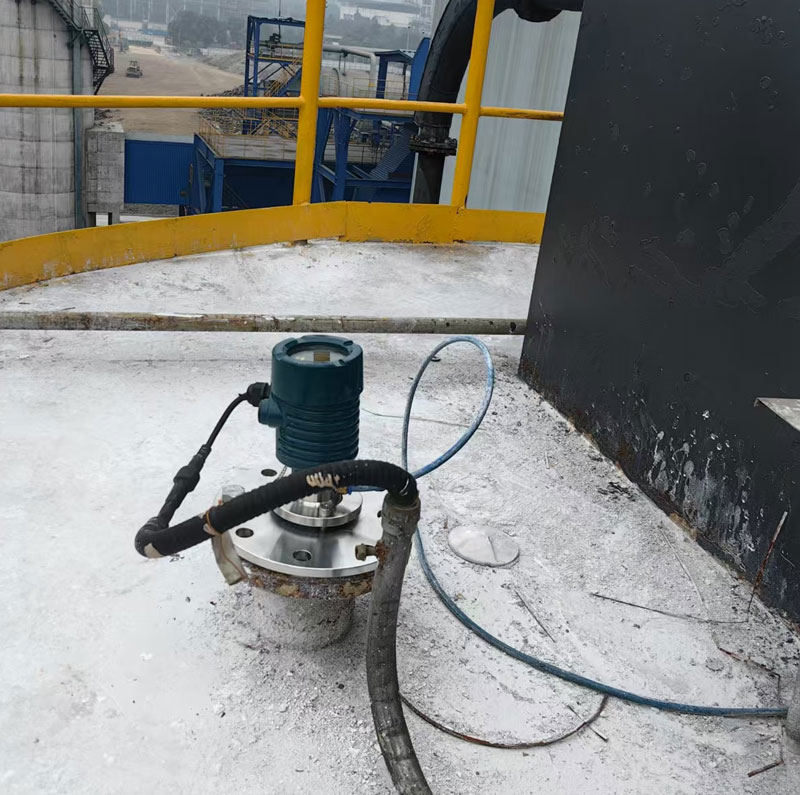
Non-contact radar level sensor is a continuous level sensor that sends a microwave pulse down toward the medium and times the reflection. Nothing touches the product, so there is no wear, no fouling risk from the probe itself, and no moving parts to service. That is why it has become the default choice for tanks that are hard to access, corrosive, or under pressure. Silver Automation Instruments builds two frequency families: 26 GHz pulse radar and 80 GHz FMCW radar. The choice between them comes down mostly to beam angle: a narrower beam clears crowded internals and smaller nozzles, at a higher unit cost.
Related:
The SKRD90 series 26G radar level meter covers six variants (SKRD91 through SKRD96), each tuned for a different application. SKRD91 handles highly erosive liquids up to 20 m with a PTFE antenna. SKRD92 covers general liquid service to 30 m at up to 250°C. SKRD93 and SKRD94 target dusty, dew-prone solids up to 70 m, the kind of environment you find in cement silos or mineral storage. SKRD95 is built for powders and solid particles, and SKRD96 uses a flanged, hygienic connection for sanitary liquids.
In practice, the 26 GHz range covers a wide spread of media: acids and mildly corrosive process liquids on SKRD91, water, oils, and general chemicals on SKRD92, cement, lime, ore, and other dusty bulk solids on SKRD93 and SKRD94, plastic pellets and fine powders on SKRD95, and sanitary liquids such as syrup or dairy product on SKRD96. That spread is why the series works across such different plants, a cement terminal, a mineral processing site, and a beverage plant can each find a matching variant without moving up to 80 GHz.
All six run on 4 to 20 mA with HART, or RS485 Modbus RTU on request. Accuracy ranges from ±3 mm on the liquid-focused models to ±15 mm on the solids models, which is normal since solid surfaces are rarely flat. Every SKRD90 variant carries an intrinsically safe or flameproof option (Exib IIC T6 Gb), so they fit Zone 1 tanks in refineries and grain terminals alike. Silver Automation Instruments have ATEX Approved Radar Level Meter.
A recurring project pattern we see with SKRD93 and SKRD94 involves cement and mineral storage silos in Southeast Asia and South America, where dust and dew inside the silo would confuse an ultrasonic sensor but leave a 26 GHz beam largely unaffected. Another common pattern comes from process plants in the Middle East ordering SKRD91 for acid or caustic dosing tanks, where a PTFE antenna avoids any wetted metal contact and the wide beam tolerates a certain amount of turbulence during dosing.
Mounting matters more than most buyers expect. The antenna needs to sit at 1/4 to 1/6 of the tank diameter from the center, with at least 250 mm clearance from the wall, and it should never sit directly above the fill stream. We cover the full set of do's and don'ts, including stockpile geometry and reflector plates for tanks with internal obstacles, in our 26 GHz radar mounting requirement guide and the companion 26 GHz radar wiring reference.
| Model | Application | Max. range | Process temp. | Accuracy |
| SKRD91 | Highly erosive liquids | 20 m | -40 to 120°C | ±5 mm |
| SKRD92 | General and mildly erosive liquids | 30 m | -40 to 250°C | ±3 mm |
| SKRD93 | Strong dew, dust, crystal solids | 70 m | -40 to 120°C | ±15 mm |
| SKRD94 | Strong dew, dust, crystal solids | 70 m | -40 to 240°C | ±15 mm |
| SKRD95 | Solid particles, powder | 30 m | -40 to 250°C | ±10 mm |
| SKRD96 | Sanitary, strong erosive liquids | 20 m | -40 to 150°C | ±3 mm |
Move up to 80 GHz and the beam angle narrows dramatically. A smaller beam angle means the signal focuses on a tighter cone, which lets you install the radar level sensor in smaller nozzles, closer to tank walls, and in vessels crowded with agitators or ladders. The trade-off is a higher unit cost, so we generally recommend 80 GHz when tank geometry is difficult or when the customer needs the extra accuracy.
The SDRD8x family spans SDRD81 through SDRD88. SDRD81 is the general-purpose liquid model, rated to 90 to 250°C depending on antenna choice, with a range up to 100 m. SDRD82 is built for strongly corrosive liquids. SDRD83 handles pressure-resistant and corrosive service in the same housing. SDRD85 uses a hygienic clamp connection for food and beverage tanks. SDRD87 is the workhorse for solids and dusty occasions, rated to 120 m, and it is the model we point customers to most often for large storage silos. SDRD88 uses a PFA flange for aggressive liquid and solid mixes at IP68.
Media across the 80 GHz range is broader than the numbers suggest. SDRD81 and SDRD82 see everything from water and diesel to concentrated acids. SDRD85 is the one customers order for milk, syrup, and other sanitary liquids where the clamp connection makes cleaning-in-place straightforward. SDRD87 and SDRD88 cover wheat and flour, cement, ore, and other free-flowing solids, along with viscous or aggressive liquid and solid mixes.
One detail that trips up first-time buyers: RS485 Modbus RTU is a option choice across the SDRD8x range, but Modbus TCP/IP is not supported on the standard electronics. If a customer's SCADA integration specifically requires Modbus TCP/IP, that needs a gateway converter on the customer side, not a different meter.
A recurring pattern we see with SDRD87 involves grain cooperatives and flour mills in Australia and Southeast Asia, where the narrow beam reaches the bottom of a tall, narrow silo without picking up interference from support legs or ladders inside the vessel. On the liquid side, edible oil and palm oil terminals frequently specify SDRD81 or SDRD82 for refined product storage tanks, where accuracy at the top of the range matters for custody transfer and overfill protection.
| Model | Application | Max. range | Process pressure | Antenna material |
| SDRD81 | Liquid, general service | 30 m / 100 m | -0.1 to 0.3 / 2.5 MPa | PP or 316L+PTFE/PFA |
| SDRD82 | Strongly corrosive liquid | 30 m | -0.1 to 2.5 MPa | 316L+PTFE/PFA |
| SDRD83 | Corrosive or pressure resistant liquid | 10 m | -0.1 to 4.0 MPa | PFA / 316L+PTFE |
| SDRD85 | Hygienic liquid, clamp connection | 30 m | -0.1 to 4.0 MPa | PTFE |
| SDRD87 | Solid or liquid, dusty occasions | 120 m | See datasheet | 316L+PTFE/PEEK |
| SDRD88 | Solid or liquid, flanged | 120 m | -0.1 to 0.3 MPa | PFA |
Case Share :
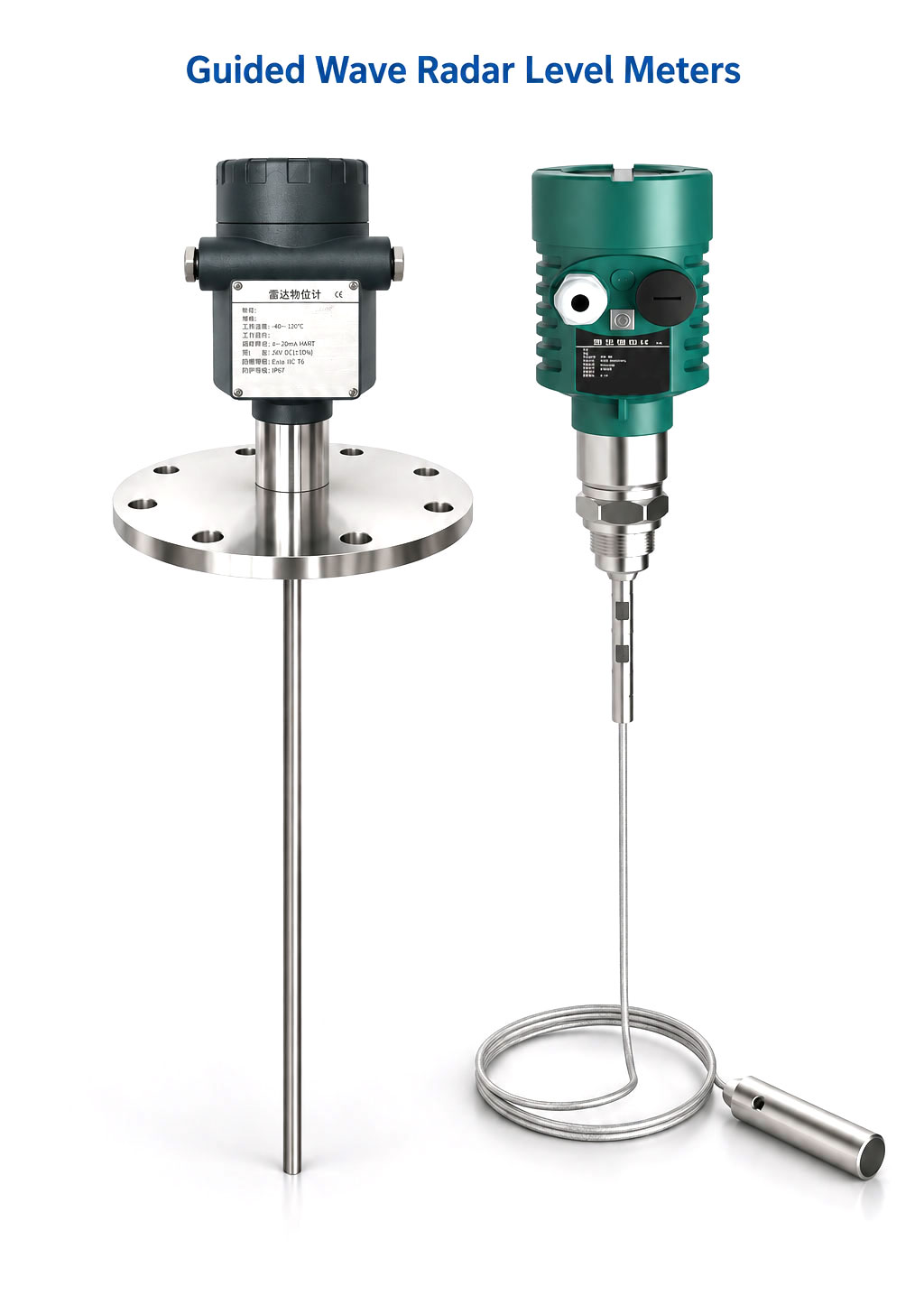
Guided wave radar (GWR) sends the same type of microwave pulse as non-contact radar, but it travels down a probe, either a steel rope, a rigid rod, or a coaxial pipe, instead of through open air. That probe concentrates the signal, so GWR keeps working reliably in situations that confuse non-contact radar: foam, heavy turbulence, low dielectric constant media, and narrow or crowded vessels.
The SKRD30 series covers six probe styles. SKRD31 uses a single rope probe for liquid or solids up to 30 m. SKRD32 is a rod probe for liquid up to 6 m. SKRD33 uses double rope probes for solids powder or liquid with a small dielectric constant. SKRD34 is rated for high temperature and high pressure service, up to 400°C and 40 MPa, with rod or coaxial pipe probes. SKRD35 adds a PTFE coating to the rod for corrosive liquid. SKRD36 uses a coaxial pipe probe, the right choice for liquids with a very small dielectric constant or a surface that will not stop moving.
A dielectric constant table is genuinely useful here, because GWR selection often comes down to how strongly the medium reflects a microwave signal. Media with a dielectric constant below 1.9 (think LPG, solvents, or light hydrocarbons) generally need the rod or coaxial probe rather than the rope, and the measuring range shrinks as the dielectric constant drops. Rod probes measure medium with a dielectric constant down to about 1.9, and coaxial probes push that down to about 1.6, at the cost of a shorter maximum probe length (6 m).
Mounting rules for GWR are stricter than they look. The guided level probe needs to sit at least 300 mm from the tank wall (500 mm for concrete tanks), the end of the probe needs at least 50 mm clearance from the tank bottom, and thread-mounted probes should not exceed 100 mm of connection pipe height unless the rope is fixed at the bottom. If you're specifying a DN200 or larger socket, the socket face itself can generate an echo that throws off accuracy on low dielectric products, and a horn-shaped connection adapter is usually the fix.
| Model | Probe type | Application | Range | Process temp. |
| SKRD31 | Single rope | Liquid or solids level | 30 m | -40 to 250°C |
| SKRD32 | Rod | Liquid level | 6 m | -40 to 250°C |
| SKRD33 | Double rope | Solids powder, low dielectric liquid | 30 m | -40 to 250°C |
| SKRD34 | Rod or coaxial | High temp, high pressure liquid | 6 m | -200 to 400°C |
| SKRD35 | PTFE coated rod | Corrosive liquid | 6 m | -40 to 180°C |
| SKRD36 | Coaxial pipe | Low dielectric or vibrating liquid surface | 6 m | -40 to 250°C |
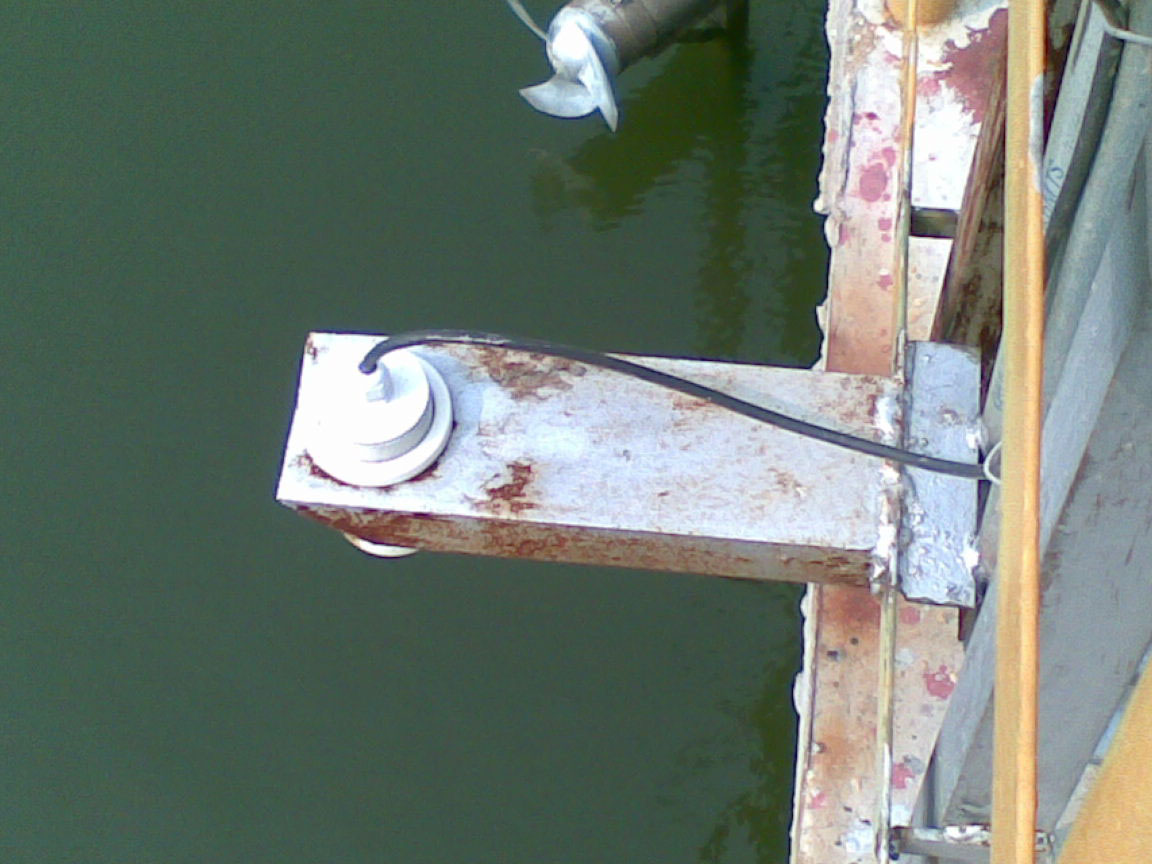
Ultrasonic level transducer is a proven, budget-friendly non-contact measurement technology that's a great fit for open tanks, sumps, and channels where cost matters most. The HL series spans a full industrial ultrasonic level sensor lineup down to a simple two-wire ultrasonic fluid level sensor for a single tank. It works by sending a sound pulse toward the surface and timing the echo, correcting automatically for temperature-driven changes in the speed of sound. It comes in nine construction types: 2-wire, 3-wire, 4-wire, an intrinsically safe 2-wire version (HLT1), a remote-display standard version (HLF), a multi-functional version with up to six relays (HLM), and three no-display compact versions (HLVT, HLVT-T with Bluetooth configuration, and HLVR with RS485 Modbus RTU); a Profibus DP version is also available for plants standardizing on that protocol.
Range options run from 4 m up to 40 m, with blanking distance scaling from 0.20 m on the shortest range to 1.5 m on the 40 m version — the dead zone right under the sensor face where an echo cannot be reliably evaluated, and the single most common source of 'my level reading stops changing near full' support calls we get.
Ultrasonic is not the right call for every tank. It struggles with heavy vapor, foam, dust, and vacuum service, and its accuracy (0.2 percent of span) will not match radar on demanding applications. Where it does well is water, wastewater, and other tanks with a stable, non-splashing surface — the low unit cost outweighs the accuracy gap for open channels, sumps, and general liquid storage where a millimeter or two doesn't matter.
Related:
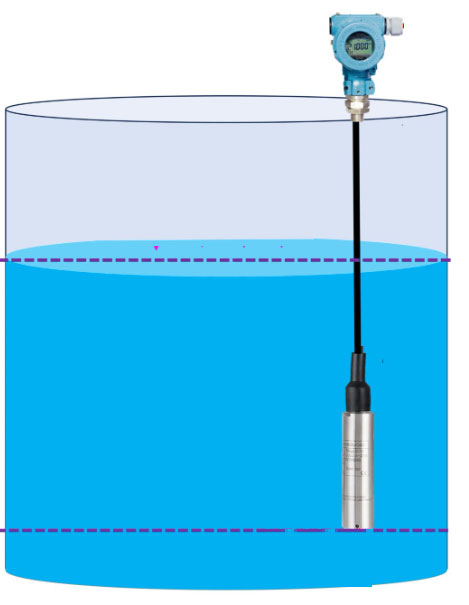
Hydrostatic level measurement takes a different approach entirely. Instead of timing a wave, a diffusive silicon sensor sits at a known depth and measures the pressure of the liquid column above it. Because pressure and liquid height are linearly related for a given specific gravity, the SHLT02 submersible pressure sensor converts that pressure reading directly into level, volume, or weight.
The SHLT02 hydrostatic level meter measures from 0.5 m up to 200 m of water column, with 0.5 percent or 0.25 percent accuracy depending on whether you choose the standard 4 to 20 mA output or the HART version. A Modbus RS485 output is also available. It is rated IP68 on the submersible sensor itself and IP65 or IP67 on the transmitter housing, which is what makes it the natural choice for deep wells, wet wells, and tanks where a radar or ultrasonic sensor simply has nowhere to mount.
The one condition worth flagging clearly: hydrostatic level measurement assumes a stable specific gravity. If a tank's product density shifts significantly, for example a crude oil blend that varies batch to batch, the level reading will drift even though the pressure reading is accurate. For that reason we generally recommend hydrostatic transmitters for water, wastewater, and consistent single-product tanks, and radar or ultrasonic for anything where density is not guaranteed, including deep well and formation water cases.
Related:
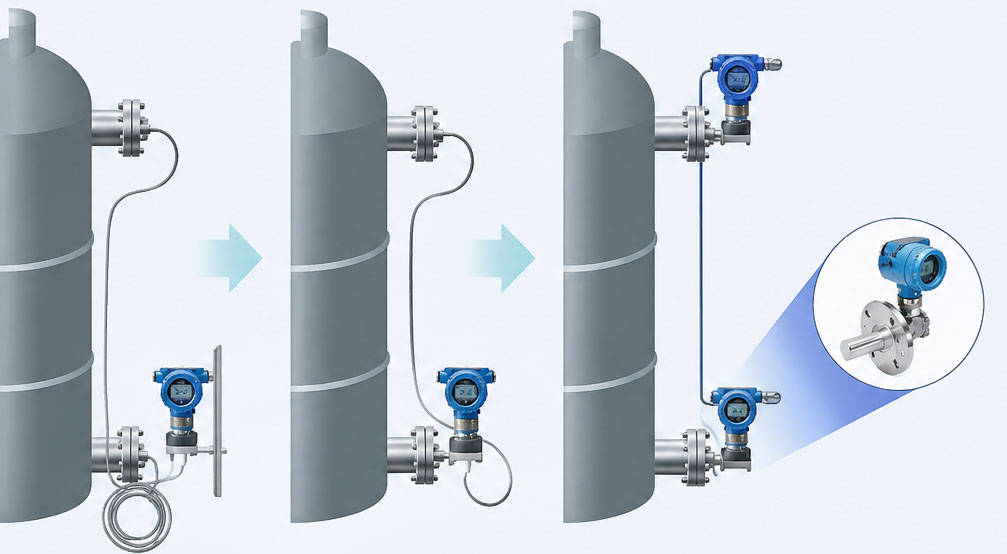
A submersible hydrostatic probe only works when you can actually lower a sensor into the vessel. Closed, pressurized, or vacuum-rated tanks, along with boilers and jacketed reactors, need a different approach: a pressure or differential pressure (DP) transmitter mounted externally on process connections, calculating level from the pressure the liquid column exerts rather than from a wave or a submerged probe.
On an open or vented tank, a single gauge pressure transmitter mounted at the bottom tap is often enough, since atmospheric pressure at the top of the tank is constant and cancels out. On a closed or pressurized vessel, the vapor space above the liquid also pushes down with its own pressure, so a single bottom-mounted transmitter would read tank pressure plus liquid head, not liquid head alone. A differential pressure transmitter solves this by measuring the pressure at the bottom tap against a second reference tap at the top of the vessel, so the vapor space pressure cancels out and what remains is the true liquid head.
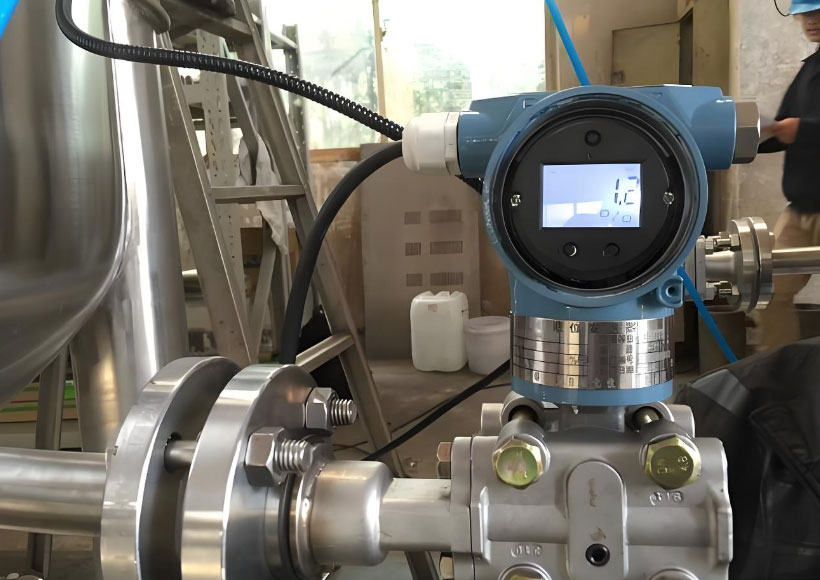
We build pressure and differential pressure transmitters, with several mounting configurations depending on the process: direct flange or thread mounting for clean liquids, a capillary and diaphragm seal for viscous, crystallizing, or high-temperature media where the process fluid should never enter the transmitter body, and remote seal pairs for true DP service across two tank connections. Boiler drum level, distillation column level, and any tank running hot condensate or steam typically call for a diaphragm seal rather than a direct wetted connection, since a direct connection would expose the transmitter to steam temperature and pressure cycling.
Like hydrostatic measurement, pressure and DP level sensing assumes a known, stable specific gravity to convert pressure into a level reading, so the same caution applies: if product density shifts significantly during the process, the calculated level will drift even though the pressure reading is accurate. For boiler drum level and other steam-side applications, exact transmitter range, seal fill fluid, and capillary length depend on operating pressure and temperature, so we confirm those against the specific vessel drawing rather than quoting a generic figure. Send us the tap-to-tap distance, operating pressure, and process temperature and we will size the transmitter and seal configuration accordingly.
Every one of the five technologies above does something well and something poorly. Picking the right one for a specific tank comes down to four questions, roughly in order of how often they eliminate options outright:
What's the medium?
This is usually the first filter. Corrosive or high-purity liquids push you toward non-contact radar, since nothing touches the product. Foaming or turbulent surfaces rule out non-contact radar and point to guided wave radar instead, since the probe cuts through surface noise. Dusty, low-dielectric solids need enough microwave power to get a usable reflection, which is a 26 GHz vs. 80 GHz decision, not a yes/no on radar itself.
Looking for support with one of these medium? We've got you covered:
What's the tank geometry?
Open or vented tanks keep hydrostatic on the table; closed, pressurized, or vacuum-rated vessels take it off, since there's nowhere to lower a probe, and push you toward DP transmitters instead. Tall, narrow, or crowded vessels with internal obstacles favor a tighter beam (80 GHz or GWR) over a wide one.
What's the process condition?
High temperature, high pressure, or steam service usually means a diaphragm seal or capillary system rather than a direct wetted connection, regardless of which underlying technology you pick. Vacuum service eliminates ultrasonic outright.
What's the budget?
This is the last filter, not the first — it decides between two technologies that already both work, not which one is technically correct. Ultrasonic is cheaper for atmospheric tanks with a clean, stable surface; once the atmosphere or geometry rules it out, cost no longer matters. For the tightest budgets, a cheap level transmitter can trim the cost even further, and simple contact methods like a bubble level transmitter are worth considering too, as long as neither foam nor vapor is a concern.
Here's how that plays out in practice, by region:
A palm oil terminal in Southeast Asia runs 80 GHz radar on refined storage tanks, since radar is always the best choice there and going cheaper just wastes money on bad data. The effluent ponds are a different story, since there's no accuracy requirement, so ultrasonic gets the job done for less.
A Middle Eastern desalination plant runs hydrostatic on its wet wells and reservoirs because it's cheap, open, and simple, and it works fine there. But once a tank holds a corrosive dosing chemical, it switches to guided wave radar, since you can no longer put a probe anywhere near that liquid.
An Australian grain cooperative runs radar on every silo, because the tanks are tall and narrow with grain constantly shifting inside, and nothing else holds up under those conditions.
A South American mining operation ends up with two different answers on the same site: guided wave radar on the flotation cells because they foam, and hydrostatic on the tailings ponds because they don't. What's inside the tank decides everything, even within the same plant.
Regardless of which technology you choose, three installation habits prevent most of the support tickets we see.
First, keep the sensor away from the fill stream. Every radar, guided wave, and ultrasonic datasheet we publish repeats this because a sensor aimed at falling product, not the settled surface, will report false levels.
Second, respect the blanking or dead zone distance and make sure the highest expected product level never enters it.
Third, for any explosion-proof or intrinsically safe installation, match the barrier or isolator to the certified parameters on the nameplate, not a generic spec sheet; using the wrong barrier is the most common reason a certified installation fails inspection.
Every tank is a little different, and the fastest way to get the right model is to send us the actual operating conditions rather than guess from a catalog. Email sales@silverinstruments.com with:
We will come back with a specific model number, not just a product family, along with a datasheet and a budgetary quote.