
English
An electromagnetic flow meter is the correct choice for sewer and kitchen wastewater on a 4-inch (DN100) line. It handles solids, grease, food particles, and variable conductivity without clogging or performance loss. No moving parts means no maintenance overhead from debris fouling.
Silver Instruments supplies DN100 electromagnetic flow meters with PTFE (polytetrafluoroethylene) liners for sewer and kitchen wastewater duty.
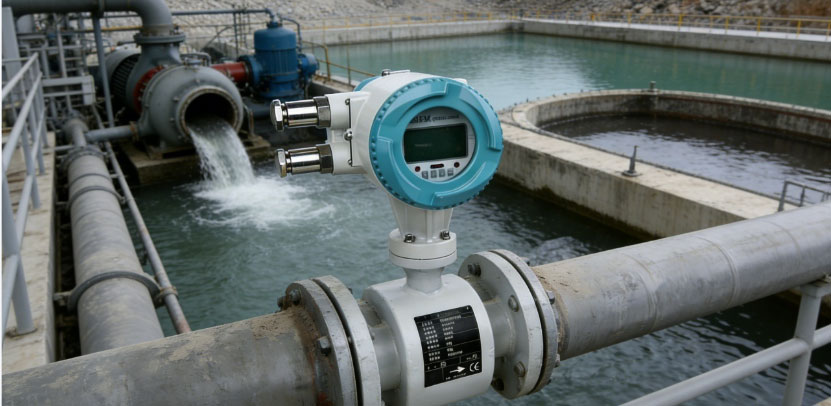
Sewer water and kitchen wastewater are not clean fluids. A commercial kitchen produces effluent with suspended food solids, cooking grease, detergent residue, and variable pH depending on the cleaning cycle running at any given moment. Sewer lines carry all of that plus grit, fibrous material, and occasional high-flow surges when multiple drains discharge simultaneously.
Most flow technologies fail here for straightforward reasons. Turbine meters clog on fibrous material. Oval gear meters seize on grease and solids. Vortex meters lose signal in aerated or multiphase flow, which wastewater often is. Ultrasonic clamp-on meters struggle with solids content above roughly 2% and with gas bubbles disrupting the acoustic path.
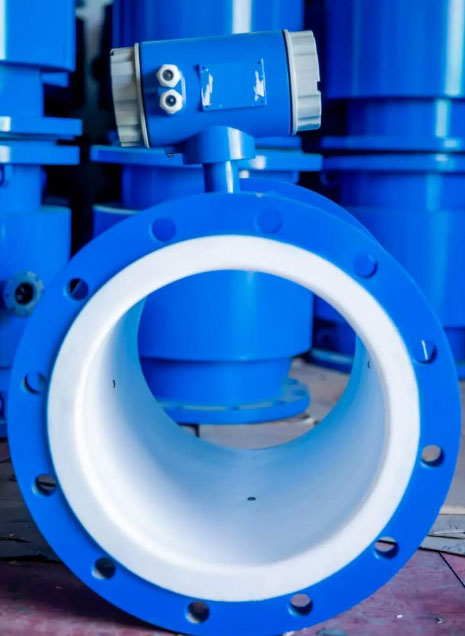
Full bore DN100 flow meter for waste water
Electromagnetic flow meters have none of these failure modes. The bore is completely open, identical to a plain pipe section. There is no bluff body, no rotor, nothing for solids to catch on. The measurement principle relies only on the fluid being conductive, and wastewater conductivity typically runs between 200 and 2,000 µS/cm, well above the 5 µS/cm minimum the meter needs.
DN100 Specification for Sewer and Kitchen Waste Service
| Parameter | Specification |
| Pipe size | DN100 (4 inch) |
| Flow range | 0.8 to 220 m3/h (3.5 to 970 GPH) |
| Typical kitchen / sewer flow | 5 to 80 m3/h |
| Liner material | PTFE (polytetrafluoroethylene) -- recommended for sewer and kitchen wastewater |
| Electrode material | 316L stainless steel (standard); Hastelloy C for high-chloride environments |
| Fluid conductivity | 5 µS/cm minimum; wastewater typically 200 to 2,000 µS/cm |
| Fluid temperature | 0 to 80 degC |
| Process pressure | PN10 / PN16 flanged (ANSI 150 lb available) |
| Accuracy | +/- 0.5% of reading |
| Output signal | 4-20 mA + pulse; RS485 Modbus RTU optional |
| Protection rating | IP67 standard; IP68 for submerged or pit installation |
| Mounting | Integral (transmitter on sensor) or remote (up to 30 m cable) |
PTFE is our standard liner recommendation for sewer and kitchen wastewater on DN100 lines. The material is chemically inert across the full pH range from strong acid to strong alkali, which matters in kitchen waste service where cleaning agents and food residues produce wide pH swings throughout the day. PTFE also resists grease and detergent adhesion better than rubber-based liners, which keeps the bore cleaner over time and reduces maintenance frequency.
PTFE handles temperatures up to 130 degC, which covers even the hottest dishwasher discharge that enters the collection line. Hard rubber tops out around 90 degC and polyurethane around 50 degC. For a kitchen waste application that mixes high-temperature rinse water with ambient drain flow, PTFE is the only liner material that covers the full temperature range without qualification.
The one practical note on PTFE: it is a softer material than hard rubber under mechanical stress, so avoid installations where significant water hammer or surge pressure is expected without a surge mitigation measure upstream. For standard gravity-fed kitchen and sewer collection lines, this is not a concern.
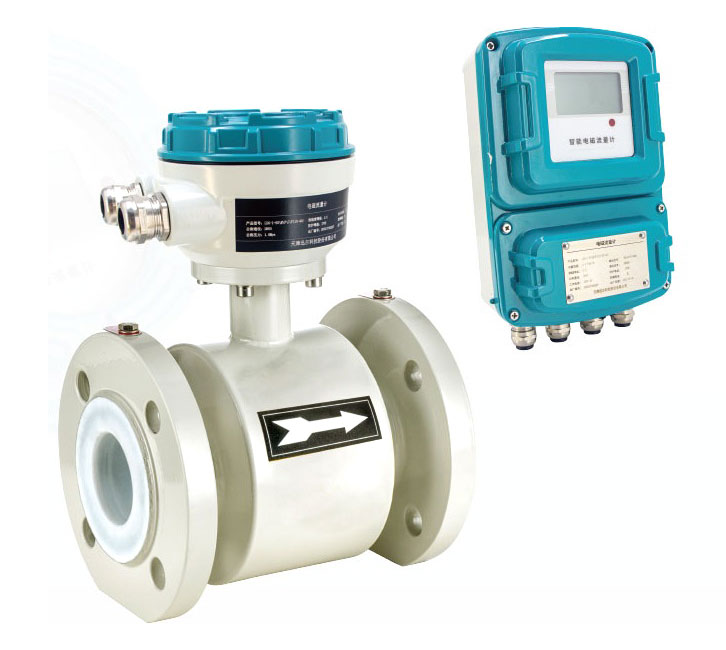
Remote display DN100 sewer flow meter
Most DN100 wastewater installations in basements, pits, or below-floor sewer channels benefit from remote-mount configuration. The sensor goes in the pipe, the transmitter mounts on a wall bracket 2 to 10 meters away where it is accessible for reading and parameter adjustment. This keeps the transmitter out of the splash zone and makes it easier to read the display without kneeling in a wet pit.
Integral mount works fine in above-ground installations where the pipe is accessible and the environment is reasonably dry. It reduces wiring cost and simplifies installation when both locations are acceptable.
A facility management company asked us recently: what flow meters measure sewer and kitchen wastewater on a 4-inch line? Their building has a commercial kitchen on the third floor draining into a common 100mm sewer riser, and they needed to sub-meter the kitchen discharge separately for a water utility rebate program.
We recommended a DN100 electromagnetic meter with PTFE liner, 316L electrodes, IP67 rating, and remote transmitter mounting. The transmitter was installed at 1.5 m height on a nearby wall, connected via 5 m signal cable to the sensor in the sewer riser. Output was 4-20 mA to the building management system, with pulse output for daily totalizing. Standard configuration, delivered and installed within two weeks of order.
Contact Silver Automation Instruments Expert via Email sales@silverinstruments.com with:
Installation location: above ground / pit / basement
we will contact you within 24 hours..