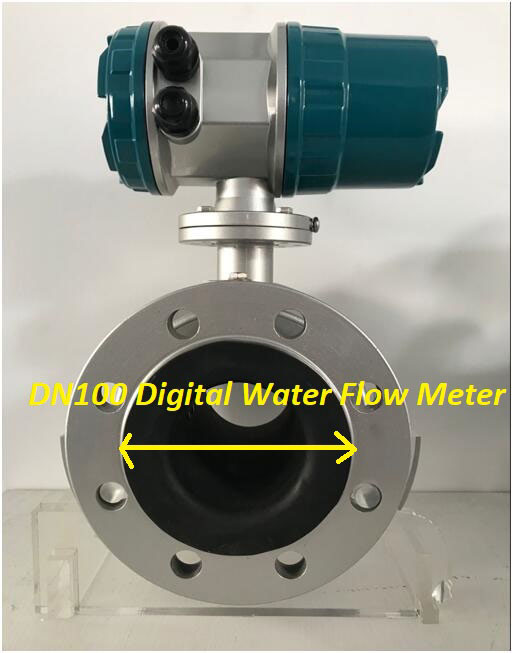
A 4 inch digital water flow meter is an electronic flow measurement instrument for DN100 (4") pipe carrying clean water, raw water, treated water, or wastewater. The typical flow range is 11 to 226 m³/h (50 to 1000 GPM). Silver Instruments supplies 4 inch digital water flow meters with affordable low price, with 4-20 mA output, pulse output, RS-485 Modbus or HART, IP65 or IP68 weatherproof housing, and an integral LCD that shows instantaneous flow and totalized volume. Electromagnetic is the default choice for water on DN100, with ultrasonic clamp-on as a non-invasive alternative for existing pipes.
What is a 4 inch digital water flow meter?
A 4 inch digital water flow meter measures the flow rate of water in a DN100 (4-inch nominal bore) pipe and outputs the reading as a digital signal. The meter pairs a primary sensor (the wetted body that sits in the pipeline) with a digital converter (the transmitter that processes the signal, drives the LCD, and sends the output to a PLC, SCADA, or data logger). Most 4 inch digital water meters give two readings on the local display: instantaneous flow rate in m³/h, L/s, or GPM, and accumulated total volume in m³ or gallons.
"Digital" means two things at once. First, the local display is digital, usually a backlit LCD that reads down to 0.01 m³/h. Second, the output is digital-capable, so the meter talks to control systems through 4-20 mA HART, RS-485 Modbus RTU, or Profibus DP, not just a mechanical pointer or pulse contact.
Flow range and pipe match for DN100
A 4 inch pipe has an inner diameter of about 102 mm. The recommended water velocity for a magnetic flow meter is 0.5 to 5 m/s, which translates to a flow range of:
Minimum reliable flow: 11 m³/h (50 GPM)
Optimum mid-range: 60 to 100 m³/h (260 to 440 GPM)
Maximum continuous flow: 226 m³/h (1000 GPM)
Turndown: 20:1 to 50:1 depending on the meter accuracy class
If your flow sits below 11 m³/h, drop one pipe size to 3 inch (DN80). If it sits above 226 m³/h, go up to 6 inch (DN150). Oversizing a flow meter to "play safe" is the most common reason for poor accuracy on water lines. A meter running at 5% of its range has the same percentage error as one running at 95%, but the absolute number gets buried in noise.
Five flow technologies that work on 4 inch water lines
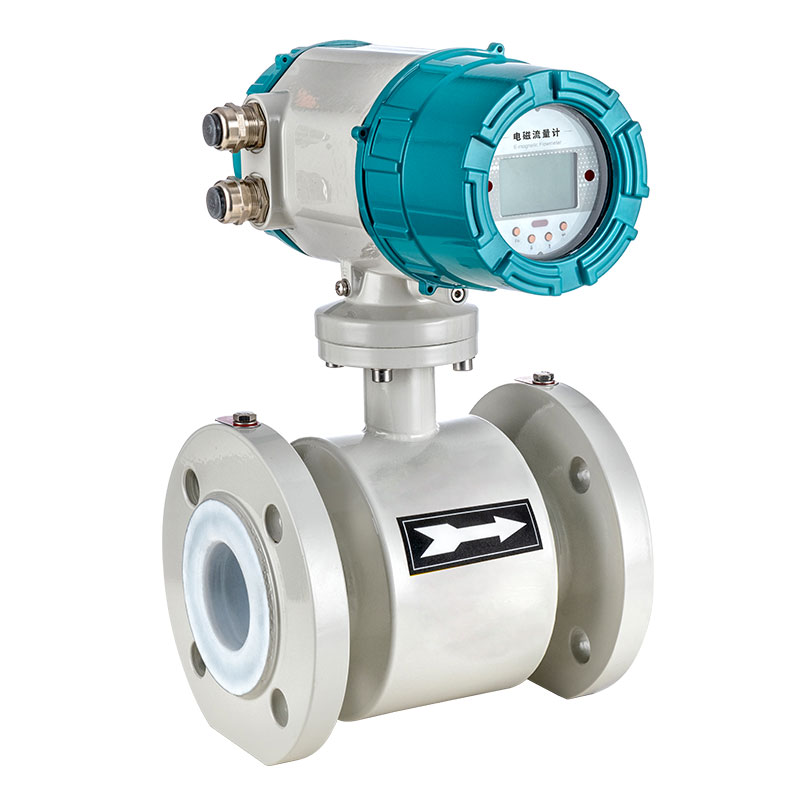
1. 4 inches Electromagnetic flow meter (the default choice)
An electromagnetic flow meter uses Faraday's law: water passing through a magnetic field generates a voltage proportional to velocity. No moving parts, no pressure drop, no straight pipe penalty as severe as turbine or vortex. Works on any water with conductivity above 5 µS/cm, which covers tap water, river water, well water, seawater, treated wastewater, slurry, and most chemicals.
For a 4 inch line, the SHD electromagnetic flow meter can offer:
Accuracy: 0.5% of reading (0.2% on the high-accuracy version)
Liner: PTFE for clean water, hard rubber for slurry and wastewater, polyurethane for abrasive duty
Electrodes: 316L stainless steel standard, Hastelloy C for chlorides, tantalum for strong acid
Flange: DIN PN10/PN16, ANSI 150 lb, JIS 10K (specify at order)
Output: 4-20 mA + pulse, with HART, RS-485 Modbus, or Profibus DP options
Power: 24 V DC, 220 V AC, or battery (lithium, 6-year life)
Protection: IP65 standard, IP68 for buried or submerged installation
Price: USD 480 to 850 for the standard SHD-100, depending on liner, electrode, and communication.
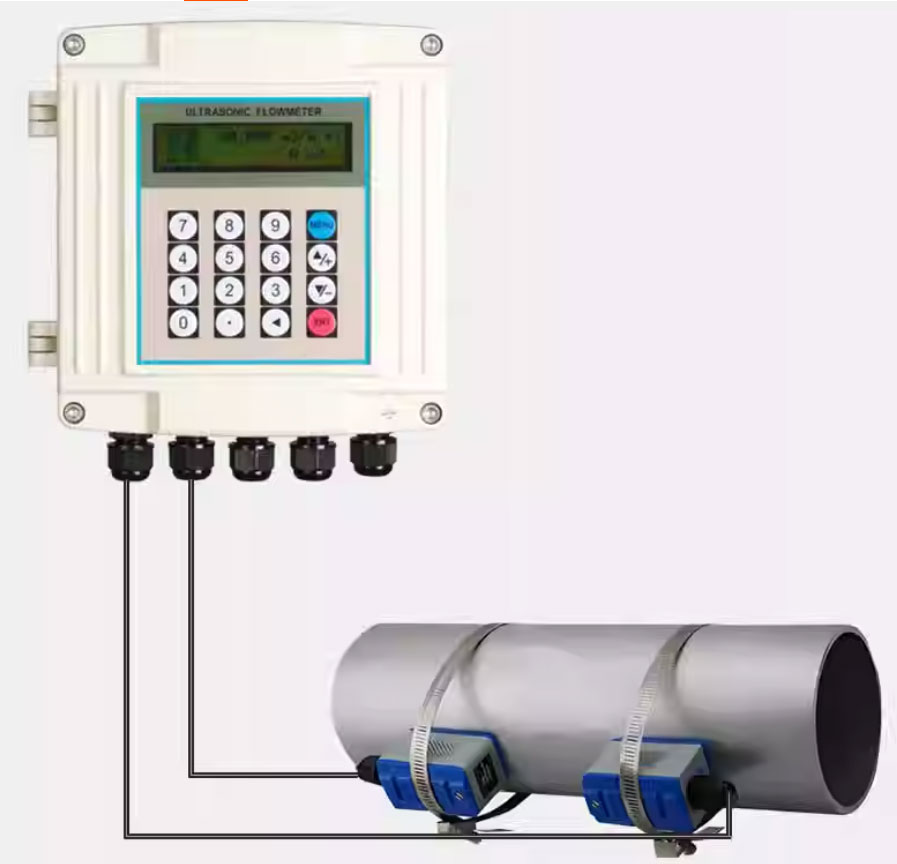
2. DN100 Ultrasonic clamp-on (for retrofit on existing pipes)
An ultrasonic clamp-on flow meter mounts on the outside of the pipe. No cutting, no welding, no shutdown. Two transducers strap onto the pipe and measure flow by timing ultrasonic pulses upstream and downstream. The transit-time difference is proportional to flow velocity.
This is the right tool when the line is already in service and you cannot drain it for an inline install. Common cases: municipal water audits, irrigation network surveys, energy efficiency checks on chiller water loops. The trade-off is accuracy (±1 to ±2% of reading versus ±0.5% for magnetic) and the requirement that the water is clean. Aerated water or water with high solids breaks the ultrasonic signal.
Price: USD 950 to 1,500 for a portable clamp-on; USD 700 to 1,200 for a permanent fixed installation.
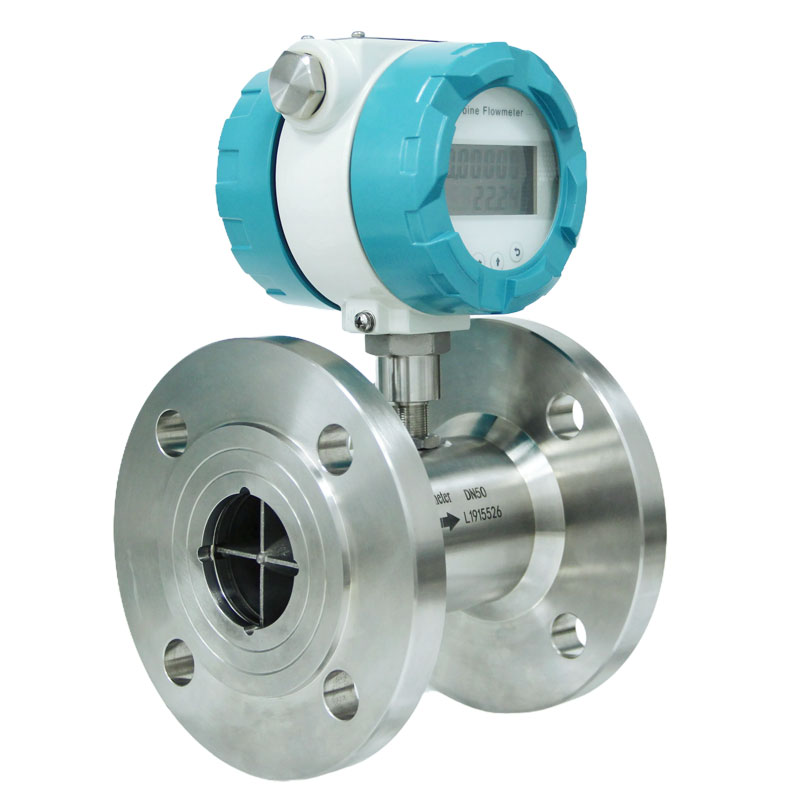
3. 4 inches Turbine flow meter (lower cost for clean water at steady flow)
A turbine flow meter has a freely spinning rotor inside the pipe. Flow turns the rotor, a magnetic pickup counts blade passages, and pulse rate is proportional to flow. Works well on clean water, low viscosity, steady flow rates above 3 m/s velocity.
For DN100 water at 60 m³/h, a turbine meter delivers:
Accuracy: 0.5% of reading
Pulse output direct to a PLC counter input
4-20 mA option with a digital indicator head
Wet parts: 316L stainless steel rotor and body
Price: USD 320 to 550,
The trade-off: turbine meters do not like dirty water, air pockets, or pulsating flow. The rotor bearings wear over years of service and need replacement. For municipal water billing or any line that runs 24/7, electromagnetic is the better long-term choice. For batch transfer of clean water (filling tanks, dosing operations) turbine is fine and costs less.
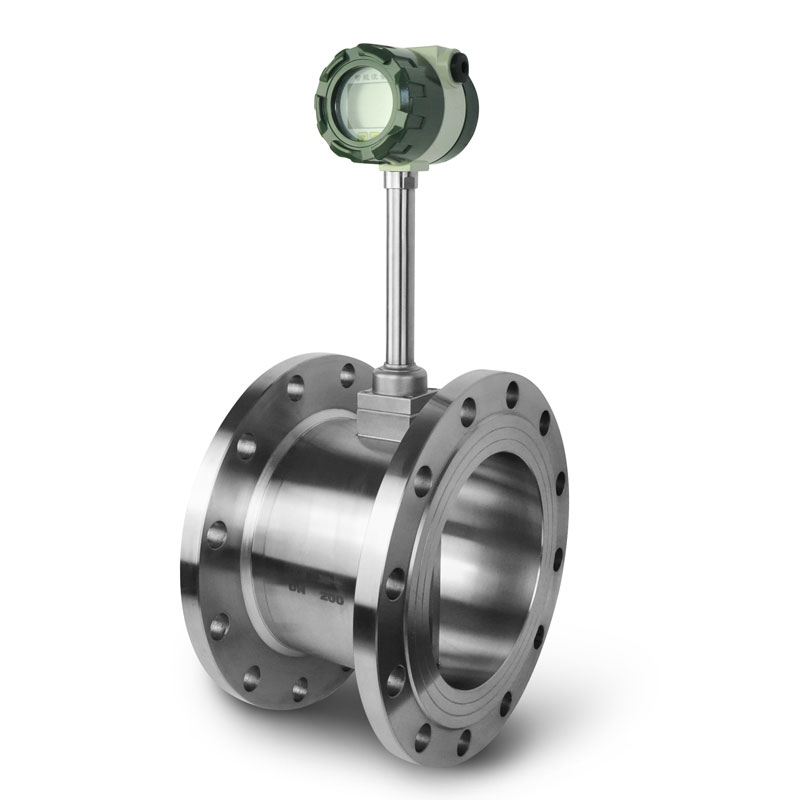
4. DN100 Vortex flow meter (for hot water, condensate, and HVAC loops)
A vortex flow meter has a bluff body inside the pipe. Flow past the body sheds Karman vortices alternately from each side, and the shedding frequency is linear with velocity. No moving parts, tolerant of high temperature, and it gives you a 4-20 mA or pulse output direct from the sensor.
On DN100 water lines, vortex earns its place in two situations: hot water above 80 °C (where magnetic meter PTFE liners start to degrade over time), and HVAC chilled or condenser water loops where a built-in temperature sensor lets the same meter calculate energy in kW or BTU/h. The SBL vortex flow meter for a 4 inch line gives:
Accuracy: 1.0% of reading for clean water
Flow range: 14 to 280 m³/h (60 to 1230 GPM) at DN100
Turndown: 10:1, narrower than magnetic
Temperature: -40 to 250 °C standard, up to 350 °C for steam versions
Pressure: PN16 to PN40 standard, higher on request
Wet parts: 304 or 316L stainless steel
Output: 4-20 mA, pulse, RS-485 Modbus, HART
Built-in temperature and pressure compensation option for energy metering
Two things to watch. First, vortex meters need at least 10D upstream straight pipe, more than magnetic. Second, the minimum velocity is around 0.5 m/s for water (about 14 m³/h on DN100). Below that, no stable vortex shedding and the output drops to zero. If your flow varies widely from low to high, magnetic is a safer pick.
Price: USD 580 to 880 for a 4 inch SBL vortex, depending on temperature class and output.
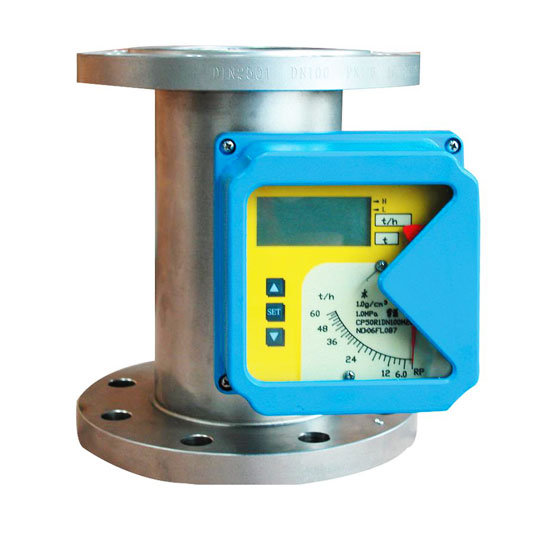
5. DN100 Metal tube rotameter with 4-20 mA output (for low flow and local display without external power)
A metal tube rotameter, also called a variable area (VA) flow meter, has a float that rises inside a tapered metal tube as flow increases. The float position maps directly to flow rate, readable on a local scale. The modern version pairs the mechanical float with a magnetic coupling that drives a 4-20 mA transmitter, so you get a local indicator that still works during a power cut, plus a digital signal to the PLC when power is on.
The metal tube rotameter is the right tool for three water duties on DN100:
Chemical dosing skids feeding a 4 inch water main (chlorine, coagulant, antiscalant)
RO permeate or demineralized water lines where conductivity is too low for a magnetic meter (below 5 µS/cm)
Remote sites where the operator wants a glance-readable scale and the 4-20 mA only goes to a local PLC
The LZ-series metal tube rotameter for 4 inch water delivers:
Accuracy: 1.5% of full scale standard, 1.0% on the high-accuracy version
Flow range: tunable at the factory between 4 and 100 m³/h on DN100 (specify your working range at order)
Turndown: 10:1
Wet parts: 304 or 316L stainless steel, PTFE-lined option for chemicals
Output: local pointer scale + 4-20 mA, with HART or RS-485 Modbus options
Power: 24 V DC loop-powered (the local scale needs no power at all)
Pressure: up to 4.0 MPa standard, higher on request
Temperature: -40 to 200 °C
Explosion-proof and intrinsically safe options for Zone 1 and Zone 2
Where rotameters lose: clean water only (slurry or debris jams the float), and accuracy is referenced to full scale, not reading. At 10% of full scale, 1.5% F.S. equals 15% of reading. Size the rotameter so your normal flow sits between 30% and 90% of full scale.
Price: USD 420 to 680 for a 4 inch metal tube rotameter with 4-20 mA output. Explosion-proof adds USD 80 to 150.
Output, communication, and what your PLC actually needs
Most customers ask for "4-20 mA" without specifying what they need on top of it. Here is what each option means in practice:
4-20 mA analog only: simplest wiring, two wires to the PLC analog input. Use this if the meter just needs to send live rate to one control point.
4-20 mA + pulse: the pulse output feeds a counter for cumulative total. Use this for billing, batching, or any application where mass or volume total matters more than the rate.
4-20 mA + HART: HART overlays digital diagnostics on the 4-20 mA loop. You get the same analog signal plus configuration, calibration, and fault information on the same two wires. Standard in oil and gas, useful for any plant with HART-capable instrument benches.
RS-485 Modbus RTU: digital-only, one cable can carry data from up to 32 meters in a daisy chain. Best for SCADA networks, irrigation district monitoring, and any site with many meters spread out.
Profibus DP: legacy industrial fieldbus, still common in European and Middle East process plants. Specify only if your control system uses it.
If you do not know what your PLC needs, ask your automation engineer for the input card model number. We can match the meter output to the card without trial and error.
Installation rules that decide accuracy
The meter is only as good as the install. For a 4 inch water line:
Straight pipe: 5 pipe diameters (5D = 500 mm) upstream and 2D (200 mm) downstream for a magnetic meter. Turbine and vortex need 10D upstream. Less straight pipe means worse accuracy.
Full pipe: the meter must run with the pipe completely full. Air pockets are the single largest source of error on water lines. Mount the meter on a vertical-up section if there is any risk of partial filling.
Grounding: magnetic flow meters need two grounding rings or grounding electrodes bonded to the pipe. Without them, stray currents in the pipe will swamp the signal and the reading drifts.
Isolation: install shut-off valves both sides and a small bypass. Cleaning and recalibration become 30 minute jobs instead of plant shutdowns.
IP68 for buried duty: if the meter sits in a chamber that floods, specify IP68 and use the remote transmitter option. Standard IP65 will fail after a few flooding cycles.
Which industries buy 4 inch water flow meters from us
Municipal water: distribution mains, district metering areas, water audit programs
Irrigation: main lines feeding center pivots and drip networks, especially in Australia, Saudi Arabia, and Egypt
Wastewater: treatment plant inlet and outlet metering, sludge transfer lines
Food and beverage: CIP cleaning water, process water, cooling tower makeup
HVAC: chilled water and condenser water loops on commercial buildings and data centers
Mining: process water, slurry transfer (with hard rubber or polyurethane liner), tailings
Power generation: cooling water, demineralized water, boiler feedwater
FAQ
1. Can a 4 inch digital water flow meter measure both forward and reverse flow?
Yes. The standard SHD electromagnetic flow meter is bidirectional. The transmitter shows forward total and reverse total separately on the LCD, and the 4-20 mA output can be configured for split-range (12 mA = zero, 4 mA = full reverse, 20 mA = full forward) or absolute (4 mA = zero, 20 mA = full forward or reverse). Useful for tank fill-and-drain lines or pumped storage applications.
2. How accurate is a 4 inch digital water flow meter at low flow?
Magnetic flow meters maintain 0.5% of reading down to about 5% of the meter's maximum velocity (around 0.25 m/s on DN100, which is about 7 m³/h). Below that, accuracy degrades to 1 to 2% of reading. If your normal operating flow is below 11 m³/h, drop to a 3 inch DN80 meter, where the same flow sits in the linear part of the range.
3. Do I need power at the meter location or can it run on battery?
Both options are available. 24 V DC or 220 V AC powered meters give you live output, alarms, and remote communication. Battery-powered meters use a 3.6 V or 7.2 V lithium pack with 6-year life, intended for water utility billing where 24/7 communication is not needed. Battery meters log totals and can be read locally on the LCD or by a handheld reader. We can also supply a hybrid version: battery for the transmitter, 4-20 mA loop power for the analog output, useful for solar-powered SCADA sites.
4. What is the difference between IP65 and IP68 on a 4 inch water flow meter?
IP65 is dust-tight and resistant to water jets, suitable for indoor or sheltered outdoor mounting. IP68 is rated for continuous immersion, needed for meters installed in below-grade chambers that flood during heavy rain, or for direct buried installations. Specify IP68 if there is any doubt. The cost difference is small (around USD 40 to 60 per meter) and field replacement of a flooded meter costs far more.
5. Can the same 4 inch meter measure seawater, raw river water, and treated drinking water?
One sensor body can handle all three if the liner and electrodes are specified for the harshest fluid in the set. For seawater, use a hard rubber or polyurethane liner with Hastelloy C or titanium electrodes to resist chloride corrosion. The same meter will then work happily on river water and drinking water without modification. If you only ever measure clean drinking water, PTFE liner with 316L electrodes is cheaper and gives the same accuracy.
6. How do I get a quote and what information do you need?
Send us the application details and we reply with a model code, price, and lead time within one working day. We need: pipe size and material, fluid type (clean water, wastewater, slurry, seawater), flow range in m³/h or GPM, temperature, pressure, output signal required, power supply available, flange standard (DIN, ANSI, JIS), and country of installation for shipping and certification.
Send us your water flow application
If you are sizing a 4 inch digital water flow meter for a new project or a retrofit, send us:
Pipe size (confirm 4 inch / DN100) and pipe material (carbon steel, stainless, HDPE, ductile iron)
Water type (drinking, raw, treated, seawater, wastewater, slurry, RO permeate)
Flow range: minimum, normal, and maximum in m³/h or GPM
Operating temperature (°C) and pressure (bar)
Flange standard: DIN PN10/16/40, ANSI 150/300 lb, or JIS 10K
Installation: indoor, outdoor, buried, submerged (decides IP65 versus IP68)
Shipping destination (for DDP quote)
For applications beyond DN100, see our 2 inch digital water flow meter, 3 inch flow meter, 6 inch DN150, 8 inch DN200, and 12 inch DN300 options. For hot water and HVAC energy metering, see our vortex flow meter with built-in temperature compensation. For chemical dosing and RO permeate lines, see our metal tube rotameter with 4-20 mA output. For dirty or aerated water, ask about Doppler ultrasonic. For high-accuracy mass measurement, see our Coriolis mass flow meter for water.