
English
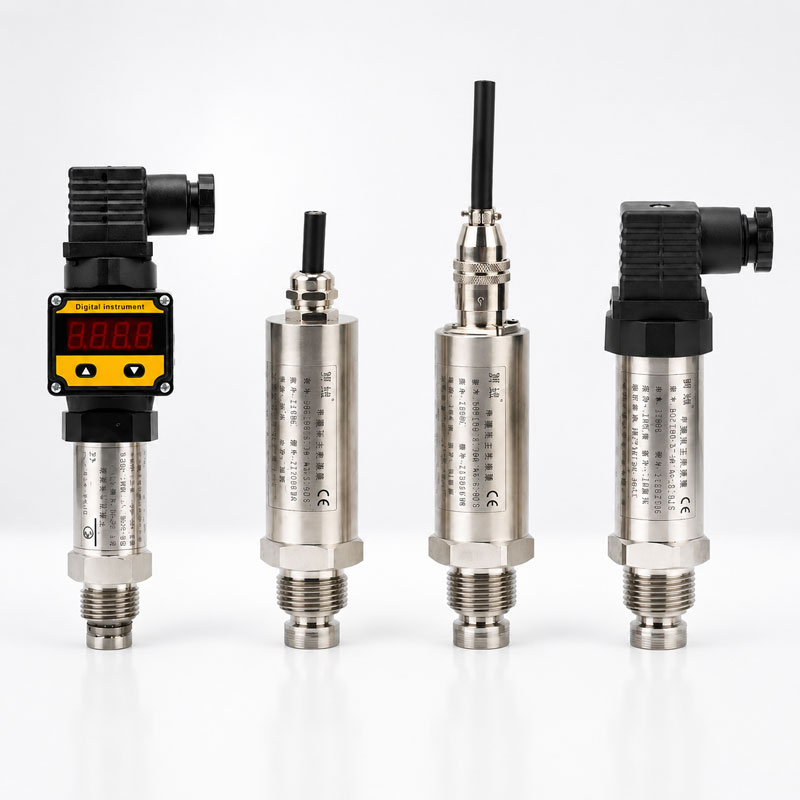

Low pressure transmitter :16-60 mbar .
High accuracy: ±0.1~0.5%
Hart Protocol, 4-20mA ouput.
Digital display mbar,psi,pa.
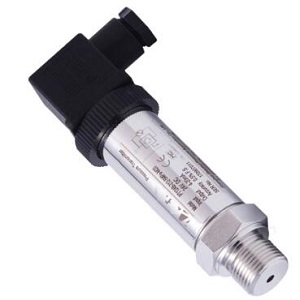
Low cost Pressure sensor.
Piezoresistive sensor.
Compact design.
Pressure sensor with 4-20mA.
For gauge,absolute or negative pressure.
Silver Automation Instruments manufactures the SH316 series, pencil type, a compact stainless steel pressure transmitter built for panels, hydraulic manifolds, and OEM skids where a full size flanged transmitter simply will not fit.
The SH316 series is a compact pencil type pressure transmitter with a silicon piezoresistive sensor housed in stainless steel. The standard threaded body covers 0 to 7 kPa (about 1 psi) up to 0 to 70 MPa (10,000 psi / 700 bar), with accuracy of ±0.2% or ±0.5% FSO and output options of 4-20 mA, 4-20 mA with HART, Modbus RS485 RTU, 0-5V, or 0-10V.
Beyond the standard thread, the series also ships as four special builds on the same sensor platform: tri-clamp connection for sanitary lines, a high temperature radiator (150/250/350°C) for hot media, a flush membrane diaphragm for thick or fibrous fluids, and a flanged diaphragm seal for corrosive or crystallizing service.
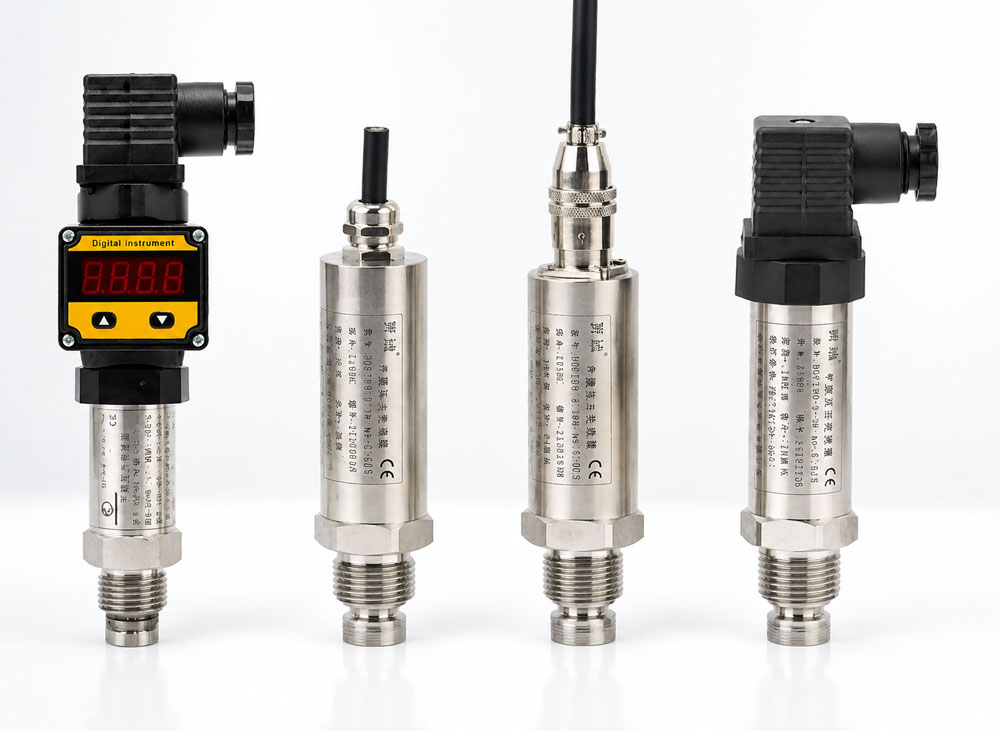
In the trade, a pencil type pressure transmitter usually means a small diameter, screw in body that mounts straight into the process port, without a capillary, remote seal, or bulky housing. Buyers also search for the same product as a compact pressure transmitter, an OEM pressure transmitter, or a miniature pressure sensor. All four terms point to the same idea: a slim stainless body, a threaded process connection, and no wasted space around it.
The SH316 series fits this category. The sensing element and electronics sit inside a stainless steel housing with a hex flat for wrench tightening, and the overall length runs from about 72 mm to 153 mm depending on which electrical connection you pick. That is short enough to drop into a hydraulic block or a control panel where a G1/2 flanged transmitter would collide with neighboring components.
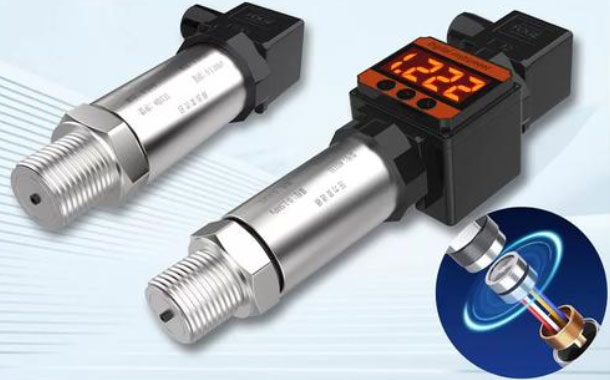
Inside the housing sits a silicon piezoresistive sensor. Process pressure deflects a diaphragm, the deflection changes resistance across a bridge circuit on the silicon chip, and the signal conditioning electronics convert that change into a linear 4-20 mA, voltage, or digital output. Because the sensing element is solid state, response time is fast at 0.25 seconds, which matters when you are protecting a pump from a pressure spike or catching a pulsation in a hydraulic line.
Accuracy comes in at ±0.2% or ±0.5% of full scale output, with long term stability of ±0.2% of upper range limit over 12 months. Temperature drift stays under ±0.2% of full scale per 10°C, and the unit is temperature compensated across 0 to 50°C. Overload capacity reaches 200% of the upper range limit, so a brief surge past the set range will not damage the sensor. If the instrument itself fails, the diagnostic function pushes the output to an alarm current, which is a small detail that saves a lot of troubleshooting time on a busy plant.
The table below covers the standard threaded body. Special configurations further down keep the same sensor and accuracy, and only change the process connection or diaphragm interface.
| Parameter | Value |
| Sensor type | Silicon piezoresistive sensor |
| Pressure type | Gauge, absolute, or sealed gauge (also used for negative pressure) |
| Measuring range | 0 to 7 kPa (1 psi) up to 0 to 70 MPa (10,000 psi / 700 bar) |
| Accuracy | ±0.2% or ±0.5% FSO |
| Stability | ≤±0.2% of URL over 12 months |
| Temperature drift | ≤±0.2% F.S. per 10°C |
| Response time | 0.25 s |
| Overload capacity | 200% of URL |
| Negative pressure range | -100 kPa to 0 (-14.5 psi to 0) |
| Compensated temperature | 0 to 50°C (32 to 122°F) |
| Ambient temperature | -40 to +60°C (-40 to +140°F) |
| Storage temperature | -40 to +85°C (-40 to +185°F) |
| Humidity | ≤ 95% RH, non-condensing |
| Output | 4-20 mA, 4-20 mA with HART, Modbus RS485 RTU, 0-5V, 0-10V |
| Power supply | 10-32 VDC (HART ≥18.5 VDC, Modbus RS485 variant 9-30 VDC) |
| Display units | Pa, kPa, MPa, bar, mbar, %, psi, mmH2O |
| Diaphragm material | SUS316L standard, Hastelloy C-276, tantalum, or titanium |
| Sealing material | Fluororubber |
| Process connection material | SUS304 standard, SUS316L optional |
| Process connections | G1/4, G1/2, M20x1.5, 1/4 NPT, G1/4(F) |
| Electrical connection | Hirschmann PG9 (standard), PG7, cable outlet (IP67), M12x1 4-pin (IP65) |
Most pencil type pressure transmitters in the field run standard 4-20 mA, two wire loop powered, because it drops straight into an existing PLC analog input card without extra configuration. Where a technician needs to check zero and span from a handheld communicator without climbing to the transmitter, the 4-20 mA plus HART version is the better fit.
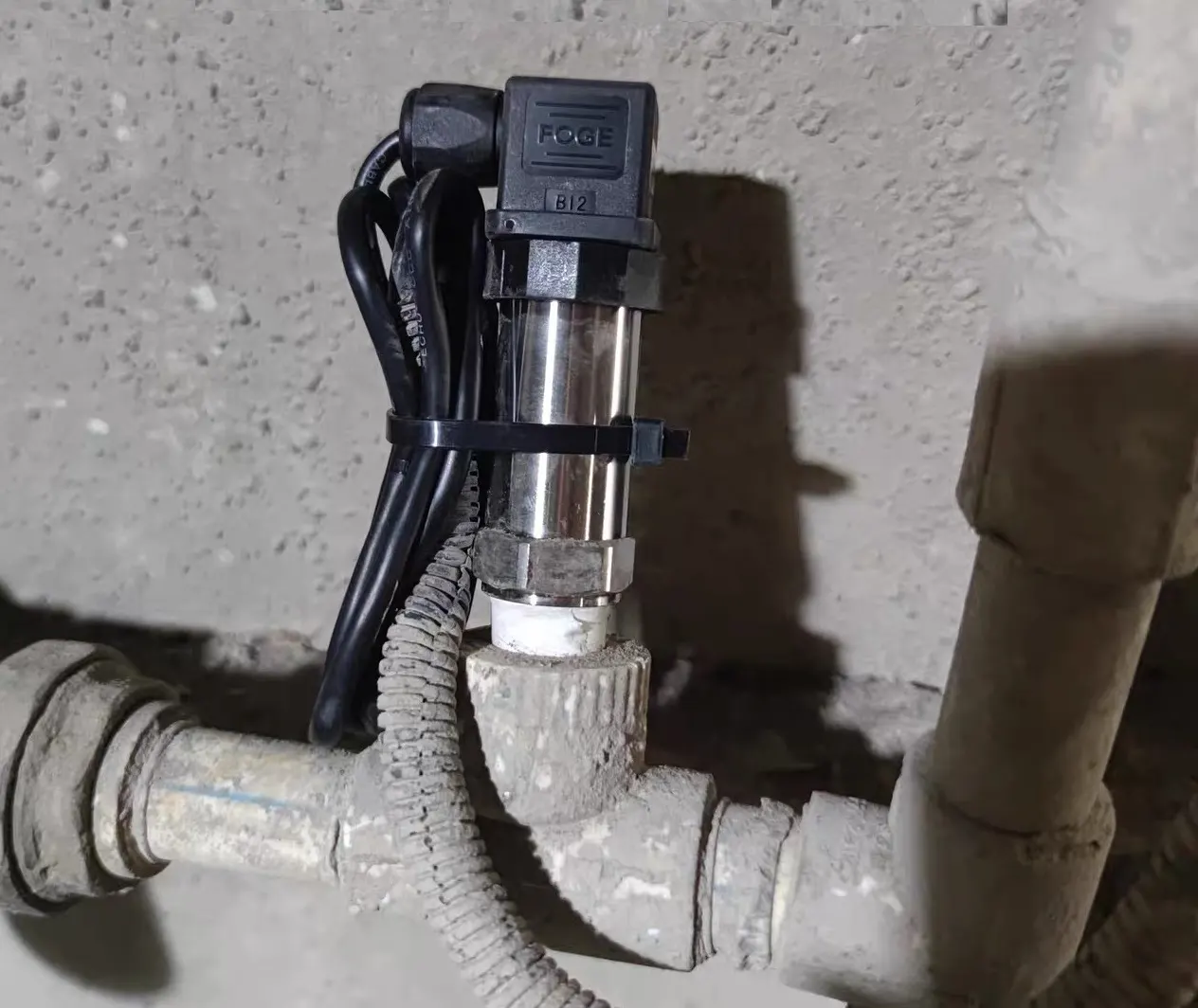
Pencil type pressure transmitter with 4-20mA output
For plants moving toward direct digital integration, the Modbus RS485 RTU output lets the transmitter talk straight to a PLC or RTU over a two wire serial bus, cutting down on analog input cards. We only offer Modbus RS485 RTU on this line, not Modbus TCP/IP, so confirm your master device supports RTU over RS485 before specifying it. Power supply is 10-32 VDC for the standard and voltage output versions, at least 18.5 VDC for HART, and 9-30 VDC for the RS485 version.
Standard diaphragm material is SUS316L, which covers most water, air, hydraulic oil, and mild chemical duties. For media that attacks 316L, such as certain acids or chloride rich brines, Hastelloy C-276, tantalum, or titanium diaphragms are available on the same compact body, so the footprint does not change even when the wetted material does. Sealing is fluororubber (FKM), and process connection material is SUS304 as standard with SUS316L as an option. Note that this pencil type transmitter is a non-explosion proof design per the standard catalog, so for ATEX or IECEx hazardous area work, ask us for the ATEX certified pressure transmitter rather than assuming this model qualifies.
The standard threaded SH316 works well on clean gas, water, and hydraulic oil. Four special builds extend the same sensor platform to sanitary, hot, thick, and corrosive media without switching to a different transmitter family, so accuracy, response time, and lead time all stay close to the standard unit.
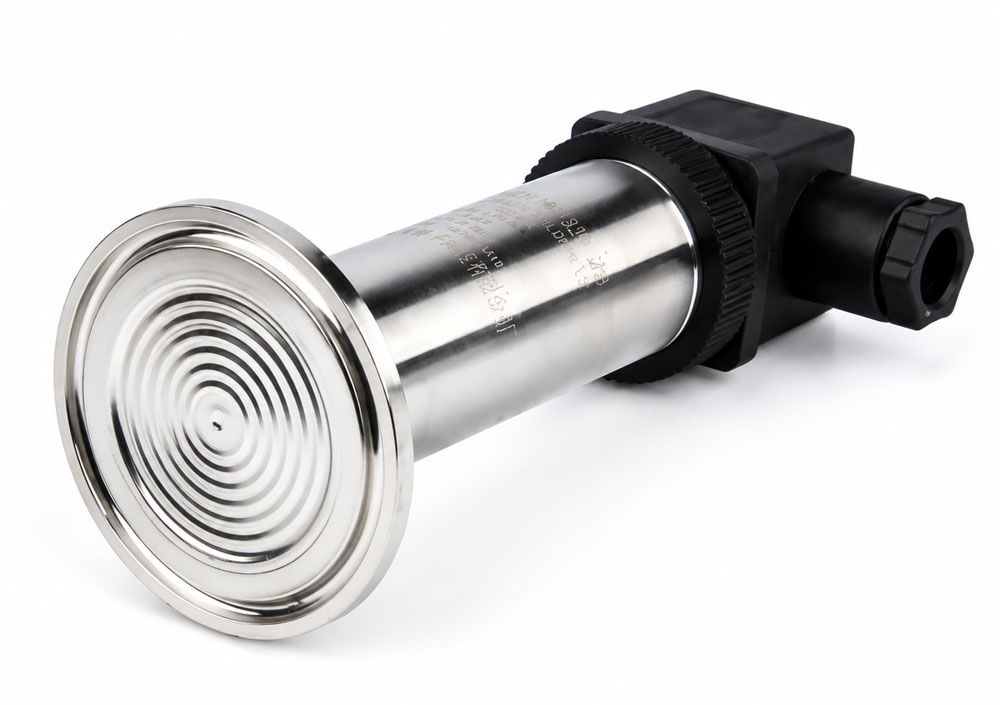
Tri-clamp pencil type pressure transmitter
This version replaces the G1/4 or NPT thread with a sanitary tri-clamp fitting, so the transmitter can be pulled off in seconds for cleaning or swapped between vessels without tools. Clamp size is not fixed in the standard catalog, so tell us the size, for example 1.5 inch or 2 inch, when you inquire. Applications: dairy and beverage CIP lines, brewing and fermentation tanks, cosmetics mixing vessels, and pharmaceutical intermediate storage. This is a tri-clamp mechanical connection, not a certified hygienic design on its own, so confirm any 3-A or EHEDG requirement with us before specifying it for a validated process.
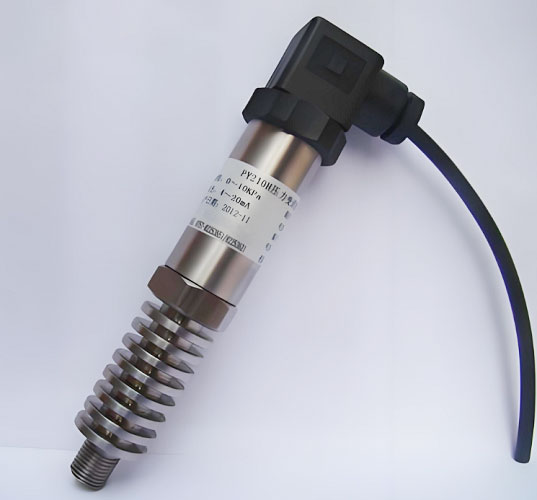
The standard electronics are only rated for a 0 to 50°C compensated range, so a process running much hotter than that would cook the circuit board if the sensor sat right at the process face. The high temperature radiator adds a finned extension tube between the process connection and the electronics housing, letting heat radiate away before it reaches the sensing element. Three grades are available: R1 for media up to 150°C, R2 up to 250°C, and R3 up to 350°C. Applications: saturated steam headers, thermal oil heating loops, autoclave and sterilizer chambers, hot water boiler feed lines, and asphalt or bitumen transfer piping.
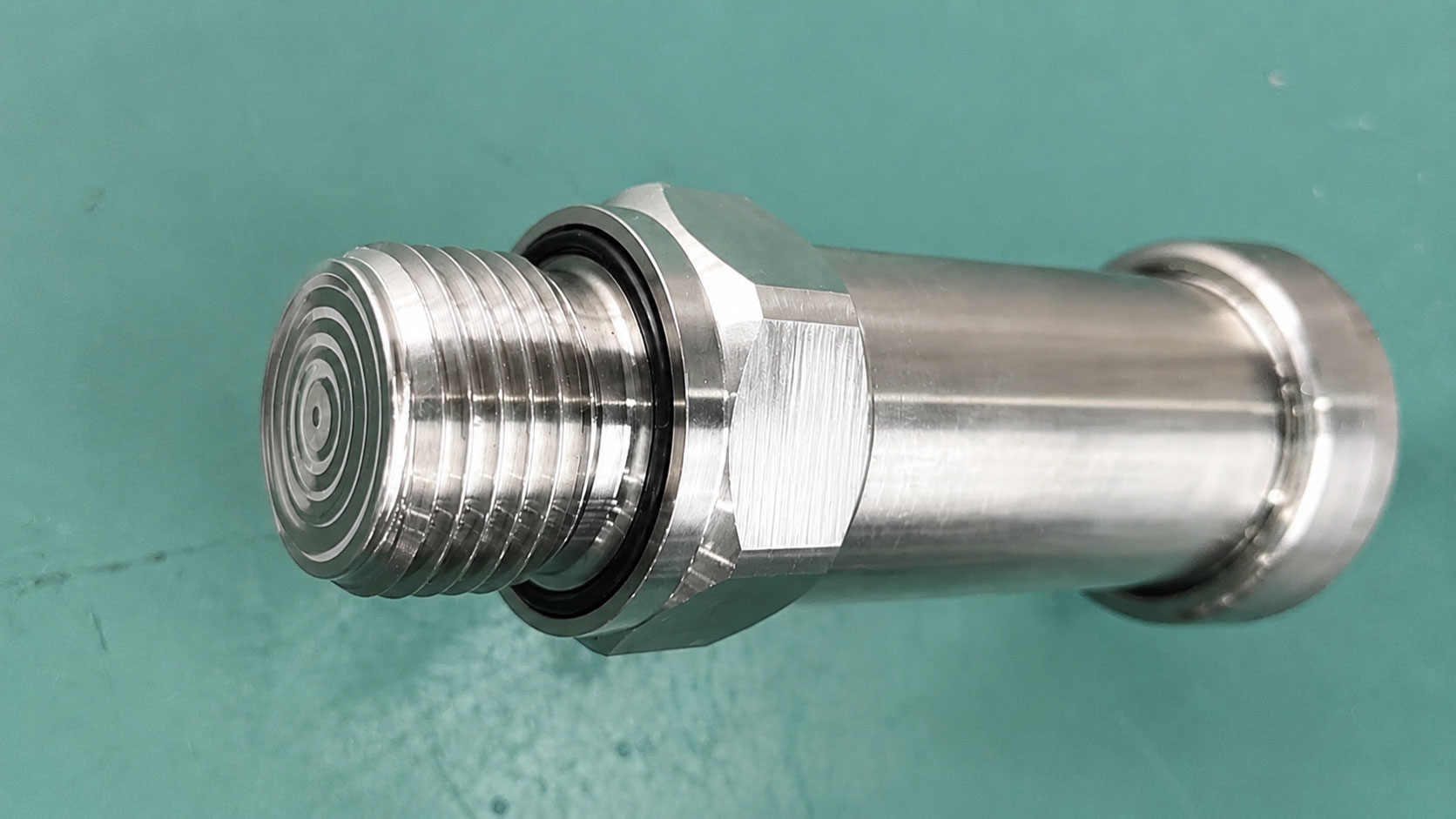
A standard diaphragm sits slightly recessed inside the process connection thread. On thick, sticky, or fibrous media, that small recess is enough to trap product, which slows response time and, on food or pharma lines, becomes a cleaning problem. The flush membrane design mounts the diaphragm level with the face of the fitting, so there is no pocket for material to sit in. It is offered together with the tri-clamp connection or the flanged diaphragm seal, since both expose the diaphragm at the process boundary. Applications: food purees and sauces, wastewater sludge and thickened slurry, pulp and paper stock, and viscous adhesive or resin mixing tanks.
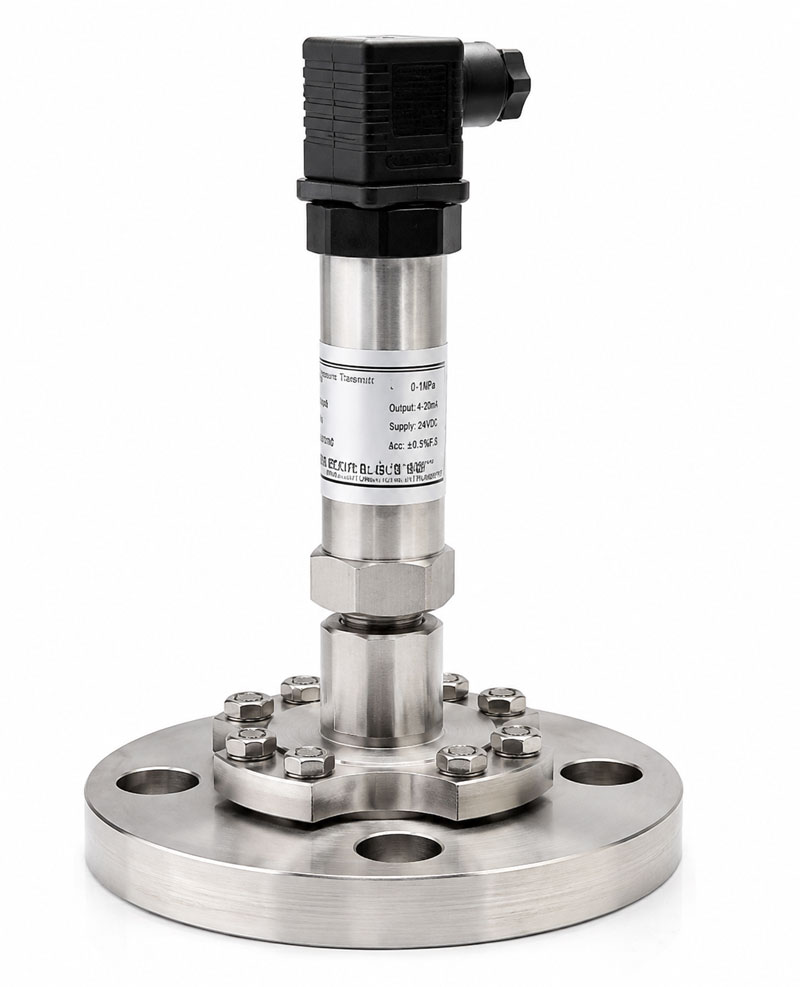
For media that would attack the standard SUS316L diaphragm outright, or that crystallizes and would jam a small port, the diaphragm seal option isolates the sensor behind a secondary diaphragm and a fill fluid, connected through a flanged or threaded seal assembly rather than a direct thread. Seal size, flange rating, and fill fluid are not fixed in the standard catalog, so specify them when you inquire, along with whether you need a direct mounted seal or a capillary remote mounted version. Applications: reactor vessels and agitated tanks in chemical plants, molten sulfur and crystallizing brine service, high viscosity polymer melt lines, and tanks holding concentrated acids where an exotic wetted alloy is needed only at the seal.
| Configuration | Solves | Typical Media |
| Tri-clamp (T) | Fast disconnect for cleaning | Milk, beer wort, syrups, cosmetic bases |
| High temp radiator (R1/R2/R3) | Process heat above 50°C at the sensor | Steam, thermal oil, hot water, asphalt |
| Flush membrane | Dead cavity buildup and slow response | Purees, sludge, slurry, adhesives |
| Diaphragm seal, flanged (D) | Corrosive or crystallizing media damaging a direct diaphragm | Acids, molten sulfur, polymer melt |
We see this size and style specified most often by machine builders in Southeast Asia fitting hydraulic presses and injection molding equipment, by pump OEMs in Australia and New Zealand who need a transmitter that ships inside the pump housing, and by mobile equipment manufacturers in the Middle East and South America building compact hydraulic power units for construction and mining fleets. The special configurations above cover the same regions for food, beverage, and chemical processing lines where the standard threaded body is not enough.
Here is the practical case for it. First, the compact body solves a real mounting problem: bulky flanged transmitters do not thread into a G1/4 port on a hydraulic manifold, and this one does. Second, one product family spans 70 mbar up to 700 bar, so an OEM purchasing team can standardize on a single transmitter platform across several equipment ranges instead of stocking five different brands.
Third, the 200% overload rating and 0.25 second response give real protection against the pressure spikes that show up on hydraulic and pump applications, not just steady state readings on a bench test. Fourth, because the diaphragm material, connection, and even the diaphragm profile can change without changing the housing, a design engineer can spec the same sensor platform for a water application, a hot steam line, and a sanitary CIP tank. Last, the selectable output, 4-20 mA, HART, Modbus RS485, or voltage, means the same physical transmitter serves an old analog panel and a new digital SCADA project without redesigning the mounting.
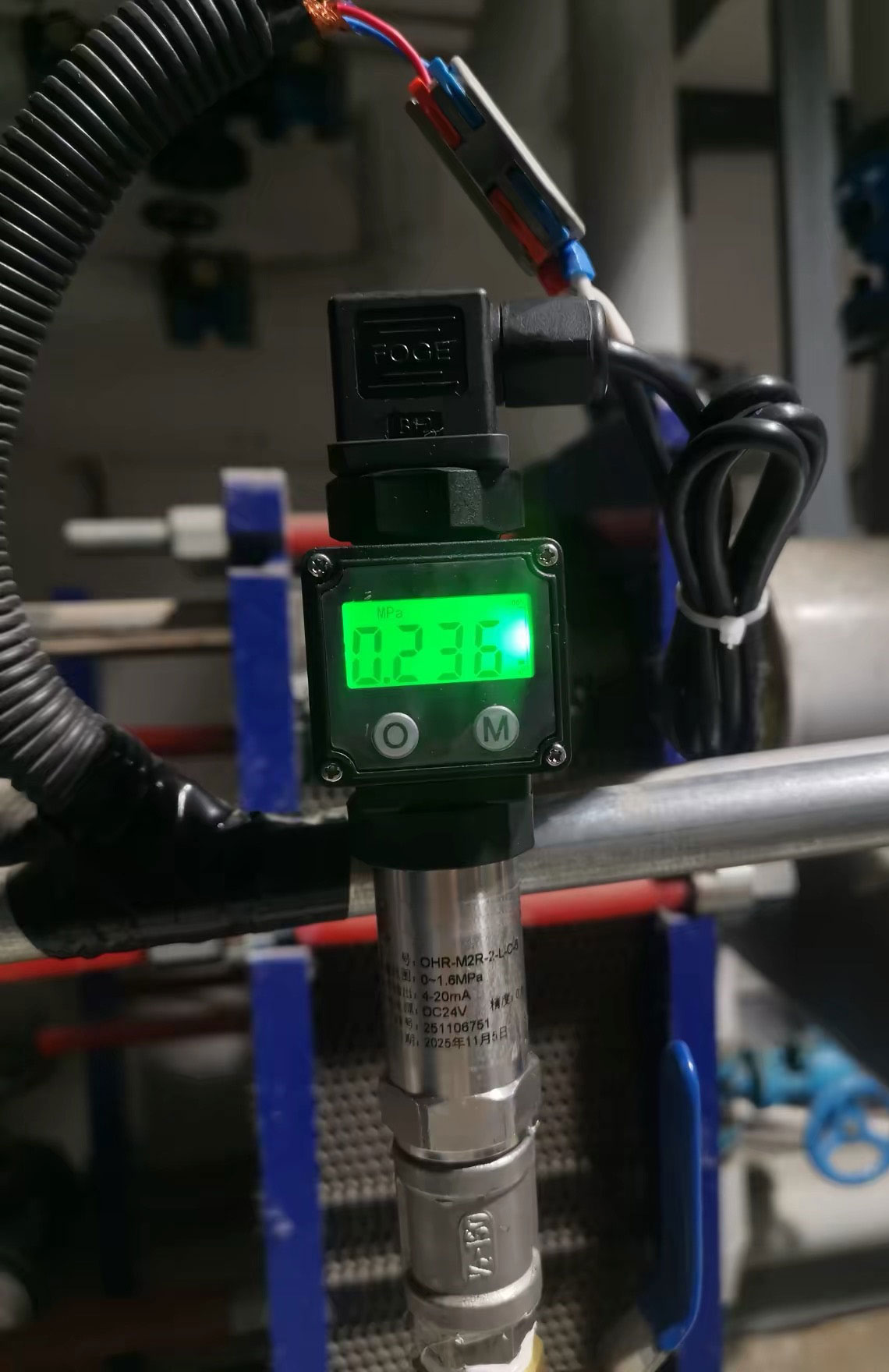
A common request we get from hydraulic equipment builders: an OEM needs a pressure transmitter that fits inside a manifold block with less than 30 mm of clearance around the port, has to survive pressure spikes from a piston pump, and still needs to feed a PLC without an extra signal converter. In that situation we typically recommend the SH316 in a 0 to 35 MPa range, SUS316L diaphragm, G1/2 process connection, and 4-20 mA output, sized so the accuracy band covers the working pressure with margin left inside the 200% overload rating.
On the special configuration side, a typical request from a beverage or dairy plant asks for a tri-clamp version with a flush membrane, since the transmitter sits directly in a CIP loop and cannot have a recess where residue collects. A thermal oil or steam plant, by contrast, usually asks for the R2 high temperature radiator paired with a standard 4-20 mA output, since the panel already runs analog wiring and the only real problem to solve is keeping the sensor cool.
Get a Quote for pencil type pressure transmitter
Send your pressure range (kPa, MPa, or bar), pressure type (gauge, absolute, or sealed gauge), process connection (G1/4, G1/2, M20x1.5, 1/4 NPT, tri-clamp size, or diaphragm seal size), output signal (4-20 mA, HART, Modbus RS485, or voltage), diaphragm material, and any special configuration needed (tri-clamp, high temperature radiator grade, flush membrane, or diaphragm seal) to sales@silverinstruments.com. Include your ambient and process temperature and enclosure rating requirement, and we will come back with a model code and lead time..
we will contact you within 24 hours..