English
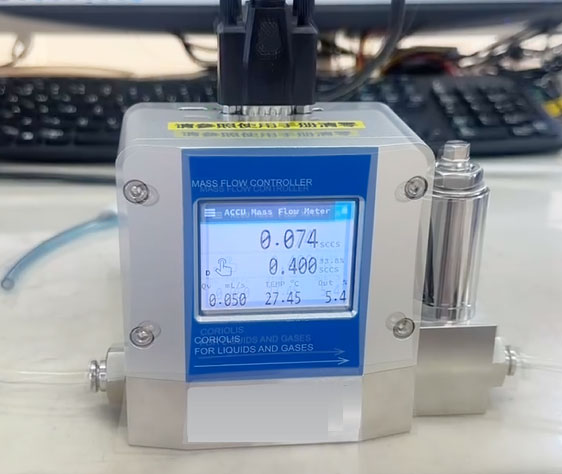
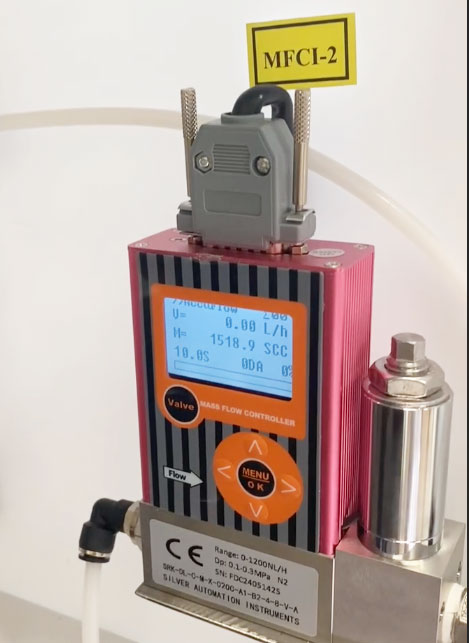
For laboratory air or gas flow between 0.02 and 2 SCCM, a micro thermal mass flow controller is the right choice. Silver Instruments SFM (meter) and SFC (controller) series cover this range with ±1% F.S. accuracy, 100:1 turndown, 0.2 to 2 second response, local digital display, and 6 mm push-fit fittings. The reliable lower detection limit is 0.02 SCCM. If your target is below 0.02 SCCM, a micro Coriolis flow meter is the better tool.
A common request we get from research labs sounds something like this. An Australian pharmaceutical research laboratory contacted us recently with the following criteria for a gas flow device:
This is a typical lab brief. Synchrotron beamline gas delivery, catalyst test rigs, drug formulation studies, fuel cell research, and microreactor work all sit in this 0.01 to 10 SCCM band. The numbers are small, but the consequences of a wrong reading are not. A 20% error on a 0.5 SCCM reactant feed can scrap a week of experimental data.
0.02 SCCM is 0.02 standard cubic centimetres per minute. That is 20 microlitres of gas at standard conditions every 60 seconds. To picture it: imagine a single small drop of water. Now imagine that volume of air, spread across a full minute, moving through a tube the diameter of a pencil. That is the flow rate we are asked to measure.
Most flow technologies cannot see this. Turbine meters need at least 2 m³/h. Variable area rotameters typically bottom out around 50 L/h. Even standard thermal mass flow meters start to lose accuracy below 5 SCCM. Below that, the laws of physics start to push back.
A thermal mass flow sensor measures heat transfer. A small heater warms the gas stream by a few degrees, and two temperature sensors on either side detect the temperature difference. That difference is directly proportional to mass flow. Because it is mass, not volume, you do not need separate pressure or temperature compensation, which matters in a lab where ambient conditions shift through the day.
Other advantages for lab use:
Here is the honest answer. Our SFM and SFC series have a 100:1 turndown ratio, with full scale options from 2 SCCM upward. At 2 SCCM full scale, the reliable lower limit is 0.02 SCCM. Some suppliers will quote 0.01 SCCM on a datasheet, but the actual repeatability at that point is often ±50% or worse, because the thermal sensor signal drops into the noise floor. We prefer to publish what we can deliver.
If your process truly needs to measure or control flow below 0.02 SCCM, a thermal mass flow meter is the wrong tool. Two paths work better:
1. Re-examine the process. In many lab setups the 0.01 SCCM target is a "nice to have," and the experiment runs fine at 0.02 to 0.05 SCCM with a slightly larger sample size or longer run time. Talk to the chemist or process engineer before specifying the meter.
2. For genuine sub-0.02 SCCM measurement with controlled accuracy, a micro Coriolis flow meter is the right tool. It measures true mass flow regardless of gas type, and can reach lower limits. The trade-off is cost (three to four times higher) and slower response time.
For lab work in the 0.02 to 2 SCCM range, the SFM / SFC thermal series is the practical answer.
For the 0.01 to 1.00 SCCM request, we suggest the SFM series mass flow meter with 0 to 2 SCCM full scale, local digital display, 6 mm push-fit gas connections, 4-20 mA output, RS-485 Modbus RTU, and N2 calibration with a published gas conversion factor table for air, He, O2, CO2, and other common gases.
Key specs:
If the lab later needs to control the flow rather than just measure it, the same body can be ordered as SFC with an integrated proportional valve. Switching from meter to controller does not change the fittings or the panel layout.
If you have a low flow gas application, send us:
We will come back with a recommended model, calibration plan, price, and lead time within one working day. For applications below 0.02 SCCM, tell us the target range and we will advise whether thermal mass flow or micro Coriolis is the right path. See our SFM / SFC low flow mass flow meter and controller for full configuration options.
we will contact you within 24 hours..