
English
For liquid fertilizer stock solutions in a fertigation pump shed, an electromagnetic (mag) flow meter is the standard choice. Use titanium electrodes with PTFE liner for general fertilizers including UAN-32, KTS, CAN-17, NPK blends, and chelated micronutrients. Use tantalum electrodes with a PTFE liner for lines carrying phosphoric acid or sulfuric acid. Both configurations support pulse and 4-20mA output for dosing controller or PLC integration.
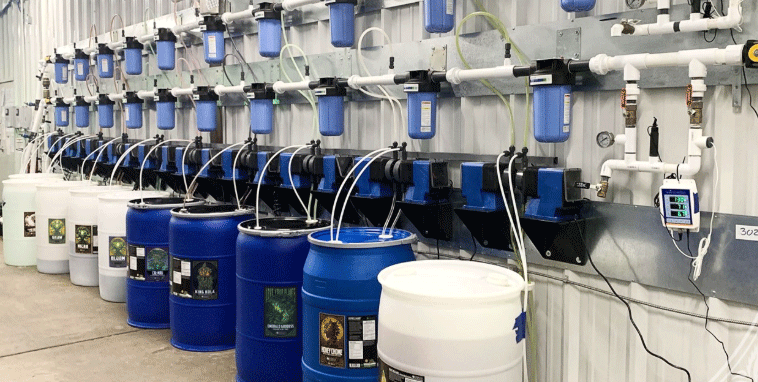
Liquid fertilizer stock solutions are not clean water. Before dilution into the main irrigation line, concentrations are high, pH can swing from under 2 (phosphoric acid) to above 11 (potassium carbonate), and salt content is aggressive enough to destroy the wrong meter in a season. Getting the wetted materials right is more important than getting the flow range right.
This article covers how to select a fertilizer flow meter for concentrated stock lines, what materials to specify for common fertigation chemicals, and when a single larger meter makes more sense than multiple smaller units.
The key detail most engineers miss: the meter is measuring concentrated stock solution before dilution, not the diluted water in the main line. A UAN-32 stock tank delivers 32% nitrogen solution directly to the meter. That is a very different environment from the 0.1% nitrogen solution the plants receive at the end of the drip line.
Based on typical almond fertigation programs in southern Australia, the chemicals a pump shed meter is likely to see include:
| Chemical / Product | Key Components | pH (concentrate) | Electrode | Liner / Seals |
| UAN-32 (Urea Ammonium Nitrate) | Urea, Ammonium Nitrate | 6.5 - 7.5 | Titanium | Hard rubber or EPDM |
| CAN-17 (Calcium Ammonium Nitrate) | Calcium Nitrate, Ammonium Nitrate | 5.5 - 6.5 | Titanium | Hard rubber or EPDM |
| KTS (Potassium Thiosulfate) | Potassium Thiosulfate | 7.0 - 8.5 | Titanium | Hard rubber or EPDM |
| Potassium Carbonate Solution | K2CO3 | 11 - 12 | Titanium | PTFE liner, EPDM seals |
| NPK Liquid Blends | Urea/AN + Phosphates + K salts | 4 - 9 | Titanium | PTFE liner recommended |
| Zinc Chelate (Zn-EDTA) | Zinc EDTA | 6 - 8 | Titanium | Hard rubber or EPDM |
| Boron Solution | Boric Acid / Sodium Borate | 6 - 9 | Titanium | Hard rubber or EPDM |
| Phosphoric Acid (52-85% H3PO4) | Orthophosphoric Acid | < 2 | Tantalum | PTFE liner, PTFE seals |
| Sulfuric Acid (for pH control) | H2SO4 | < 2 | Tantalum | PTFE liner, PTFE seals |
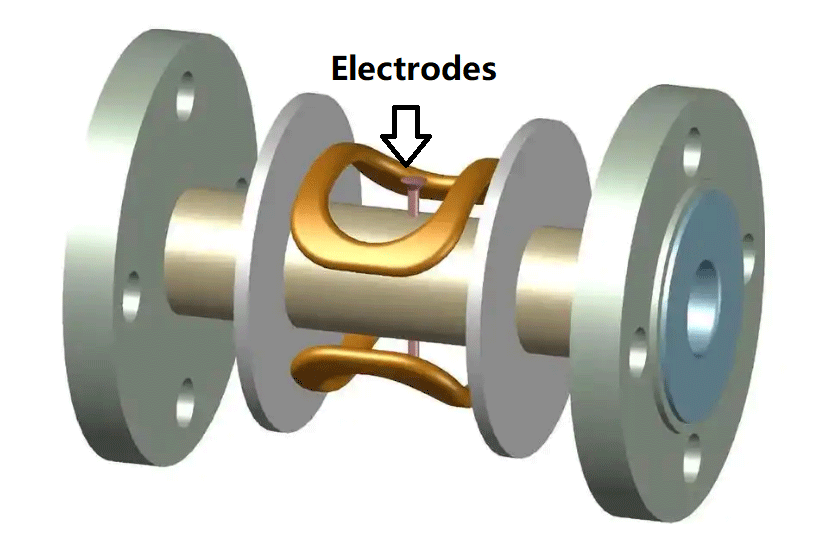
Eletrodes of magnetic flow meter
Titanium electrodes cover the full range of neutral-to-alkaline fertilizers and moderate-pH blends. They are significantly more corrosion-resistant than 316L stainless steel in high-salt, ammonium-containing solutions, and the cost premium over 316L SS at these pipe sizes is modest.
Tantalum electrodes are specified for the acid lines. Tantalum has broad resistance to both phosphoric acid and sulfuric acid at concentrated levels, where titanium would corrode. PTFE liner and PTFE seals complete the acid-resistant configuration. If the same physical meter must handle acid injection on some days and neutral fertilizers on others, specify tantalum and PTFE throughout rather than trying to run two separate wetted-material sets.
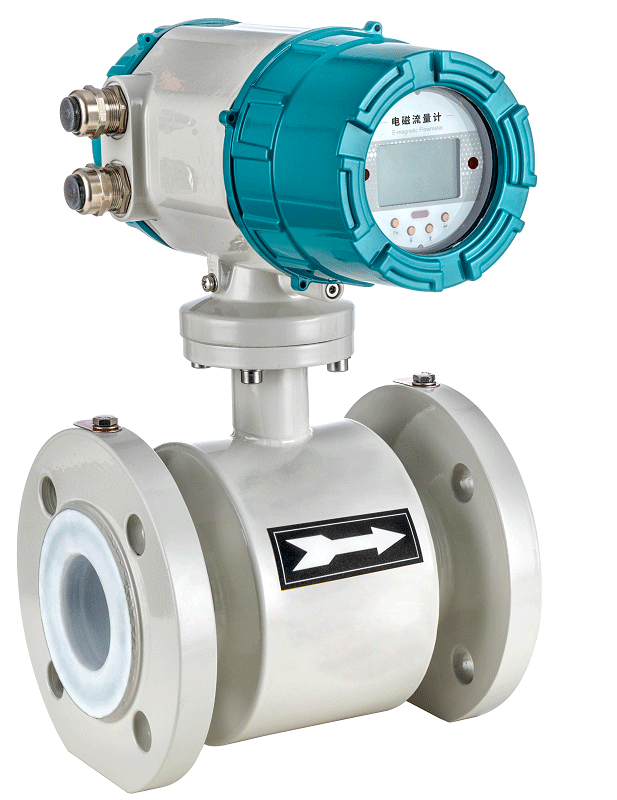
Magnetic flow meter for Fertilizer
Fertilizer stock solutions are conductive. Most liquid fertilizers have conductivity well above 50 µS/cm, which is the minimum threshold for electromagnetic flow meters. In practice, UAN-32 and KTS run at several thousand µS/cm. Mag meters work well here.
There are no moving parts, no pressure drop beyond the pipe bore, and no minimum flow velocity requirement that matters at these flow rates. The meter body is a straight section of lined pipe with two electrodes. Nothing in the flow path wears out or clogs.
Turbine meters are sometimes used in fertigation. They work on clean, low-viscosity liquids but the rotor bearings are exposed to the fertilizer solution. Concentrated ammonium nitrate solutions cause bearing corrosion over time, and crystallization of UAN-32 during cold nights can mechanically jam the rotor. We see this failure mode regularly on Australian sites where overnight temperatures drop below 5°C in winter.
Oval gear meters handle higher viscosity fluids well, but concentrated fertilizer blends at typical injection temperatures are not viscous enough to require positive displacement metering. Oval gear meters also have tighter internal clearances that are vulnerable to particulate in the solution.
Both configurations deliver the same total throughput. The choice depends on how many independent injection lines need to be monitored separately.
Nine smaller meters (DN25 to DN40, 5 m3/hr each) give individual flow readings for each injection point. That matters if different blocks or zones receive different fertilizer programs on separate schedules. Each meter can feed its own pulse output to a zone controller.
Three larger meters (DN50 to DN65, 15 m3/hr each) reduce installed cost, valve manifold complexity, and the number of pulse output signals to manage. This works if multiple injection points can be grouped into three circuits that always run the same program simultaneously.
At 5 m3/hr, a DN25 mag meter sees about 1.8 m/s, which is in the middle of the operating range. At 15 m3/hr in a DN50 pipe, velocity is about 2.1 m/s. Both are fine. There is no accuracy advantage to either configuration from a metering standpoint.
Recommended Specification for a Fertigation Pump Shed Mag Meter
| Parameter | General Fertilizers (Ti electrode) | Phosphoric / Sulfuric Acid (Ta electrode) |
| Meter type | Electromagnetic | Electromagnetic |
| Electrode material | Titanium | Tantalum |
| Liner material | PTFE | PTFE |
| Seals | PTFE | PTFE |
| Output signal | 4-20mA + pulse | 4-20mA + pulse |
| Power supply | 24V DC or 85-265V AC | 24V DC or 85-265V AC |
| Protection rating | IP67 (outdoor pump shed) | IP67 |
| Pipe size for 5 m3/hr | DN25 to DN32 | DN25 to DN32 |
| Pipe size for 15 m3/hr | DN50 to DN65 | DN50 to DN65 |
One practical note on UAN-32 in cold climates: if overnight temperatures fall below 5-10°C, the meter body and upstream pipework can accumulate crystallized ammonium nitrate at low-flow or no-flow periods. A heat trace on the meter section, or at minimum a drain point to flush the line after each injection event, prevents this.
Silver Automation Instruments supplies electromagnetic flow meters for fertilizer injection and fertigation applications. To prepare a quotation, send the following to sales@silverinstruments.com:
See the electromagnetic flow meter range at silverinstruments.com for liner and electrode options, dimensional drawings, and model selection.