
English
Compressed Air Flow Meter Baseline Measurement: Turning Idle-Period Flow into an ROI Number
A compressed air flow meter installed on the main line, read during a scheduled shutdown, gives you the total system leakage rate in one number. Multiply that flow by your compressor's specific energy consumption and your electricity tariff, and you get an annual cost figure you can take to management before spending money on repairs. Silver Instruments' SRK-100 thermal mass flow meter covers this down to 0.05 Nm/s is low enough to catch a nearly idle line.
Compressed air is metered, then billed by nobody. Most plants pay for compressor kWh but never break down where the air actually goes. A baseline flow reading fixes that gap in about the time it takes to run one weekend shift.
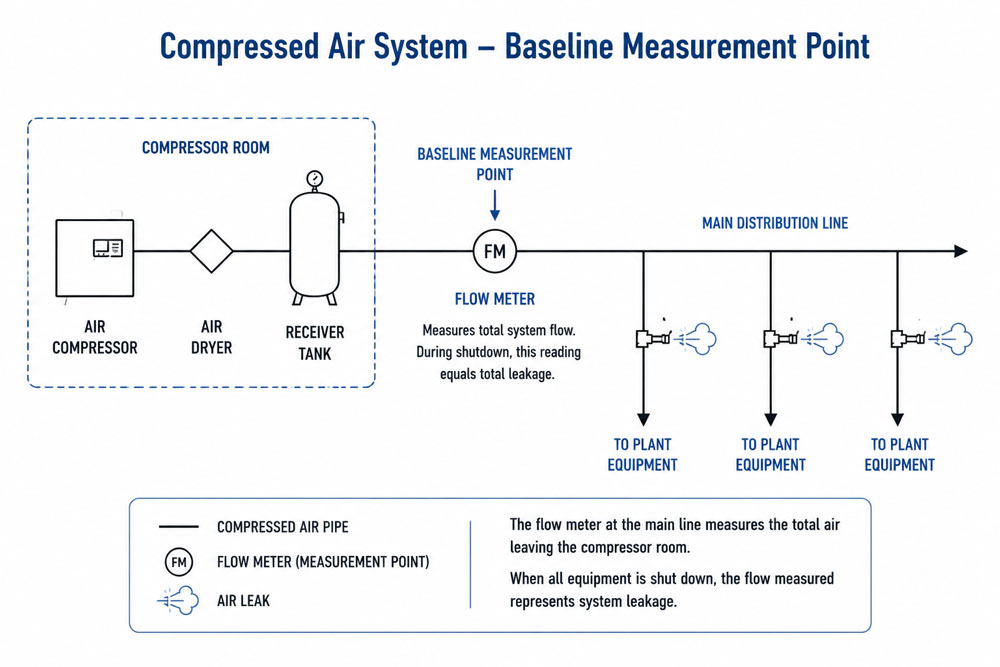
Here's the logic. Shut down every air tool, cylinder, and pneumatic valve on the line. No production, no cleaning cycles, nothing pulling air on purpose. Whatever flow the meter still reads at that point isn't going anywhere useful. It's leaking out through fittings, hose connections, and worn seals.
This isn't a leak-locating method. It won't tell you which joint is bad, that's a job for a handheld ultrasonic detector working the same zone afterward. What it gives you is a single, defensible number for how much air (and money) the whole system is losing before anyone touches a wrench.
Industry surveys, including figures published by the U.S. Department of Energy, commonly put unrepaired compressed air leakage at 20 to 30% of total system output. That range is a general industry benchmark, not a number we've measured ourselves, and actual leakage varies a lot by plant age and maintenance history. Treat it as a reason to test your own system, not as a number to plug into your report.
Three points, in order of priority.
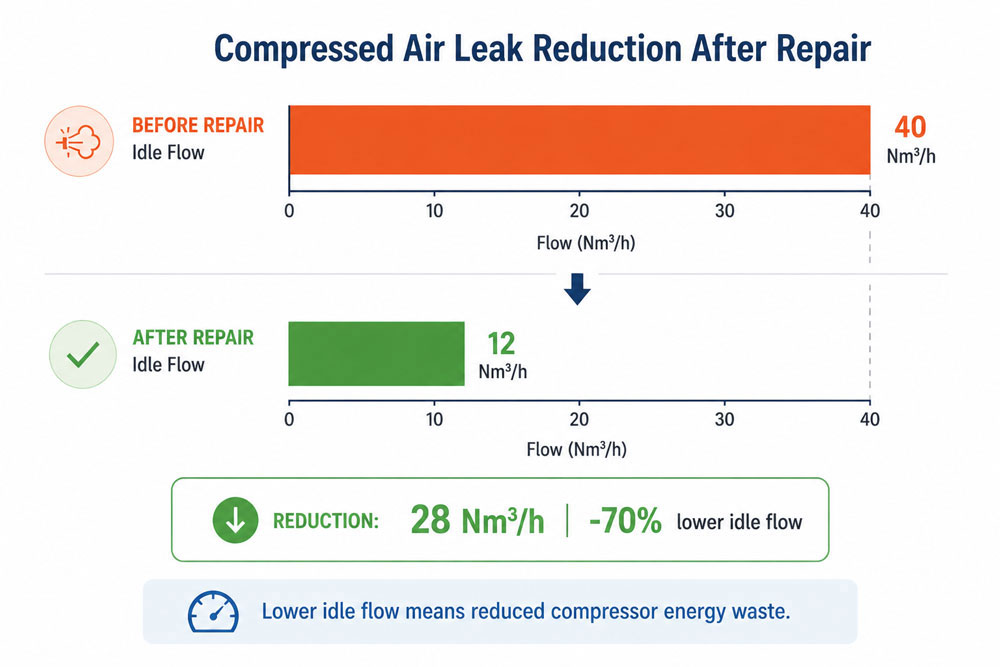
To show the calculation, not to represent an actual project: take a plant with a main line reading 40 Nm³/h during a weekend shutdown. The site's compressor has a specific energy consumption (SEC) of roughly 0.11 kWh per Nm³, a typical figure for a screw compressor running at 7 bar, though this varies by machine and should be confirmed from your own compressor's test report or nameplate rather than assumed.
Annual leakage cost = idle flow x SEC x annual operating hours x electricity tariff.
40 Nm³/h x 0.11 kWh/Nm³ x 8,760 hours x your local tariff per kWh.
That works out to roughly 3,854 kWh per year at that flow rate, before you've even applied a tariff. In markets with higher industrial electricity rates, this single number is often enough to justify a leak repair program on its own, without needing to locate a single fitting first.
Run the same test again after repairs. A drop from 40 Nm³/h to 12 Nm³/h at idle is a documented, repeatable result you can show to a plant manager or an ISO 50001 auditor. No estimate, no survey guesswork, just two flow meter readings taken the same way.
A few things matter more here than in a general compressed air flow meter application.
Low-end sensitivity. Idle leakage flow is a fraction of full production flow. A meter with a narrow turndown ratio reads zero or near-zero at idle and misses the number you actually need. The Silver Instruments SRK-100 thermal mass flow meter has a turndown ratio of 100:1 and a lower measurable limit of 0.05 Nm/s, which keeps it responsive well below normal production flow.
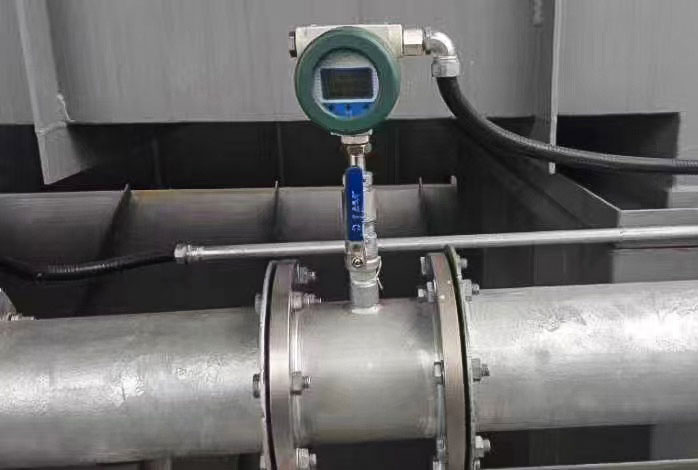
Accuracy across the range, not just at full scale. The SRK-100 thermal mass flow meter is rated at ±1% of reading or ±0.5% of full range, whichever applies. For baseline work specifically, ask for the reading-based accuracy figure. A meter that's accurate at 80 Nm³/h but drifts at 4 Nm³/h will understate your leakage cost.
Data logging or a stable output for repeat testing. You'll run this test more than once. A 4-20 mA or RS485 Modbus RTU output lets you log the shutdown period automatically, instead of sending someone to read a local display at 2 a.m. on a Saturday.
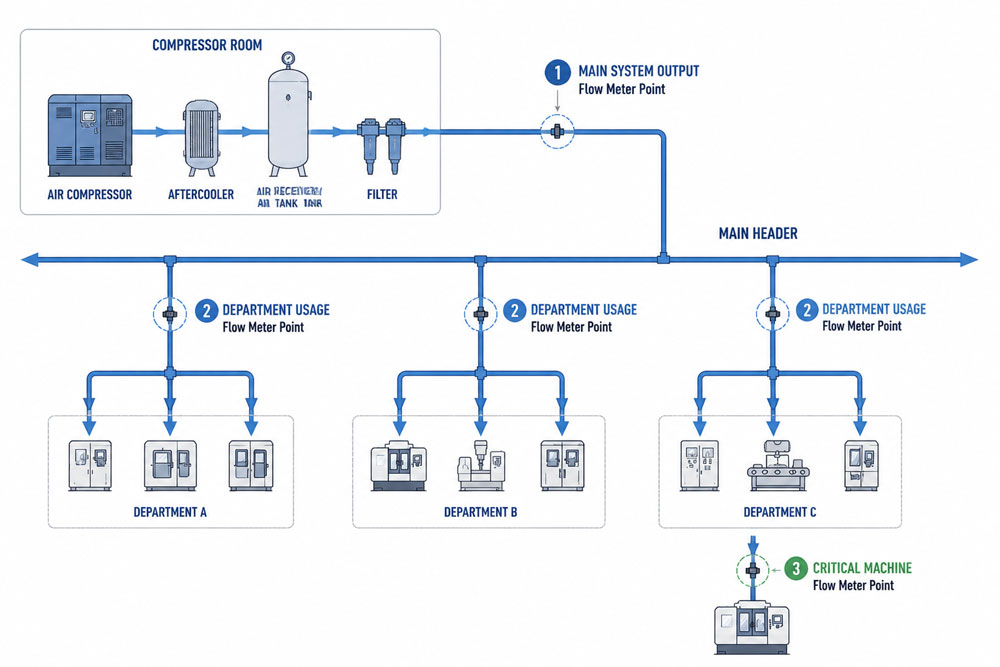
In practice, most plants running this kind of program don't need continuous flow monitoring everywhere. A portable or semi-permanent insertion-type meter at the compressor room discharge, moved between department headers over a few weekends, gets you the same data without instrumenting the whole plant on day one.
Send us your main compressed air pipe size (DN), operating pressure (bar), and your normal flow rate range (Nm³/h), and we'll help you size a flow meter for baseline measurement..
Email: sales@silverinstruments.com