
English
If a flow meter reads zero while fluid is still moving, the instrument may be oversized, operating below its specified range, or affected by a configuration or installation issue. The first step is to distinguish a genuine minimum-range limitation from a low-flow cutoff setting. This guide explains how to diagnose the problem, compare technologies for small liquid and gas flows, and identify suitable low-flow meters from Silver Automation Instruments.
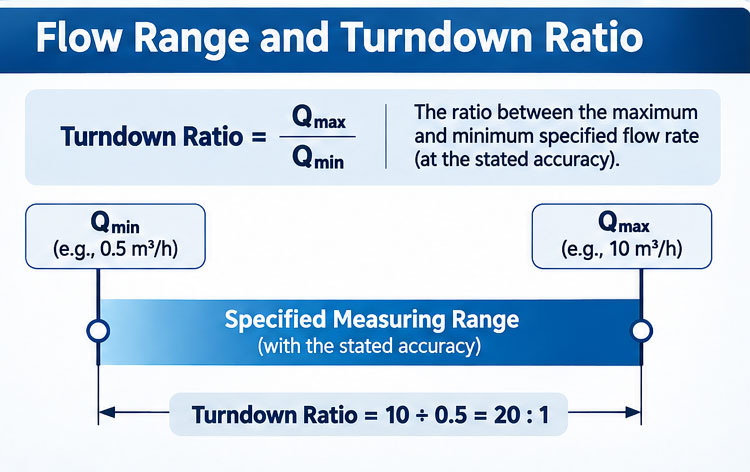
A flow meter is specified for a measuring range, usually shown as a minimum and maximum flow rate. For example, a meter may be specified for 0.5 to 10 m³/h. Within its stated range and under the specified operating conditions, the manufacturer provides performance limits such as accuracy and repeatability.
The minimum range should not be treated as a universal physical switch. A meter may still produce an output below its specified minimum, but the reading may no longer meet the published performance specification. Depending on the measuring principle and signal processing, the output may become unstable, drift, or remain at zero.
The turndown ratio describes the relationship between the maximum and minimum specified flow rates. A 20:1 turndown ratio means the maximum specified flow is 20 times the minimum specified flow. Always check the actual flow range for the selected meter size and configuration; a headline turndown ratio alone does not establish the usable minimum flow.
There are two different situations to separate. First, the real flow may be below the meter’s specified measuring range. Second, the flow may be measurable, but a low-flow cutoff setting may force the output to zero below a configured threshold. These problems require different checks.
A meter is sometimes selected to match the pipeline diameter rather than the minimum and maximum flow rates. This can leave a large-bore meter operating at very low velocity. For example, a 50 mm electromagnetic meter may be unsuitable for a small trickle if the resulting velocity is below the range specified for that meter. The correct solution may be a smaller meter bore or a suitable reduced-bore arrangement, provided the pressure loss and process requirements remain acceptable.
Gravity drainage, partially filled pipes and intermittent draining can introduce air pockets or expose the measuring section to an incomplete liquid column. Many liquid flow meters require a full pipe for reliable measurement. Check the installation location, pipe routing and operating sequence before assuming that the instrument itself has failed.
Short dosing pulses can be missed or averaged by a meter or control system that is configured for continuous flow. The displayed instantaneous rate may therefore be much lower than the pulse peak, and the totalizer may not capture every pulse if the response time or pulse resolution is unsuitable. Check the pump cycle, meter response time, pulse output resolution and totalization method.
An electromagnetic flow meter requires an electrically conductive liquid. It is not suitable for gas or a non-conductive liquid. A turbine meter also needs enough fluid force to overcome mechanical resistance and maintain rotor movement. Confirm the fluid properties and the meter’s operating principle before changing settings.
A low-flow cutoff is a configured threshold below which the transmitter forces the displayed or transmitted flow to zero. It helps suppress noise when the pipe is static or when the signal is too small to distinguish reliably from noise. If the threshold is set above the actual process flow, a real low flow can be hidden. Lowering the cutoff does not improve the sensor’s underlying measuring capability; it only changes the point at which the output is suppressed.
The best technology depends on whether the fluid is a liquid or gas, the required flow range, fluid properties, pressure and temperature, and the required measurement accuracy. The practical lower limit is model- and configuration-dependent.
| Technology | Typical service | Low-flow characteristics | Key selection point |
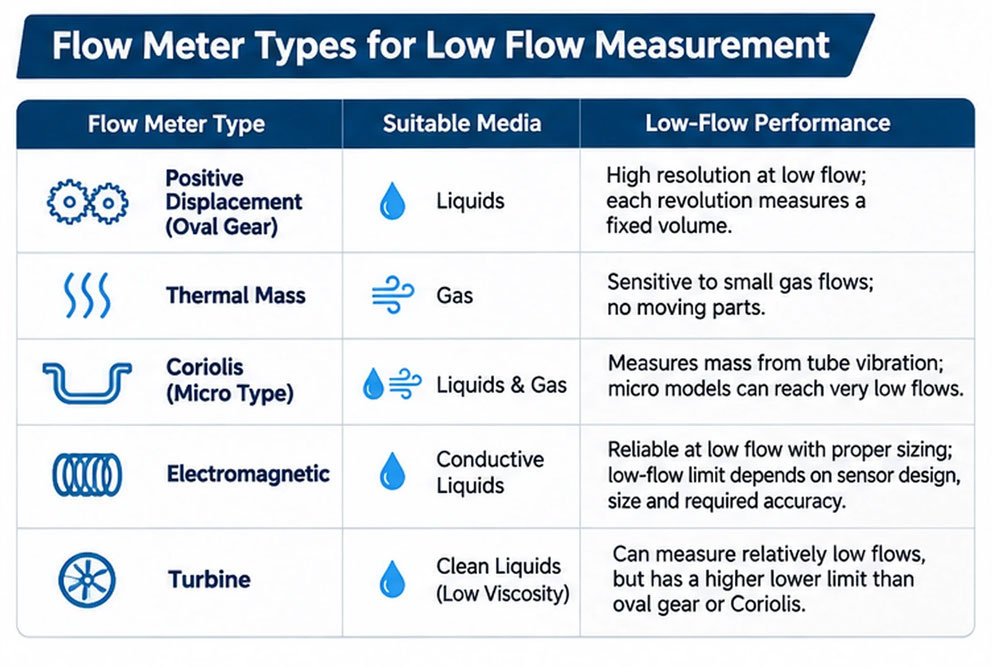
| Positive displacement (oval gear) | Liquids | Suitable for small liquid volumes; model options can extend into mL/min ranges. | Check viscosity, material compatibility, pressure drop and the exact model range. |
| Thermal mass | Gases | Micro thermal designs can measure gas flow from a few SCCM, depending on model and gas calibration. | Confirm gas composition, calibration gas, pressure, temperature and selected full-scale range. |
| Coriolis (including micro models) | Liquids and selected gas applications | Micro Coriolis models can measure low mass flow, with ranges depending on model and configuration. | Confirm the specific medium, density/phase conditions, pressure rating and accuracy specification. |
| Electromagnetic | Conductive liquids | Can measure low flow when the resulting velocity remains within the selected meter’s specified range. | Check conductivity, meter bore, velocity range and the manufacturer’s sizing table. |
| Turbine | Liquids or gases, depending on design | The rotor needs sufficient flow to overcome mechanical resistance; the lower limit depends on meter design. | Check start-up flow, viscosity, bearing design and the published minimum range. |
An oval gear meter measures a series of defined volumes as its rotors turn. This positive-displacement principle makes it useful for small liquid flows, including dosing and additive injection, when the fluid and materials are compatible.
A thermal mass flow meter measures gas mass flow from the heat transfer between the sensor and the flowing gas. Micro thermal designs can cover very small gas flows. Because gas properties affect the thermal response, the gas type and calibration must be confirmed for the intended application.
A Coriolis meter measures mass flow from the effect of fluid movement on vibrating measuring tubes. Micro Coriolis designs extend this principle to low mass flow applications. The usable range and accuracy depend on the selected model and the medium being measured.
An electromagnetic flow meter measures conductive liquid flow using electromagnetic induction. Its performance depends on the flow velocity and the meter’s specified range. Do not treat 0.5 m/s as a universal minimum for every electromagnetic meter. Silver’s SHD selection data provide velocity-based range options, including a low-velocity range shown as 0–0.5 m/s for specified sizes; the exact model selection table should be used for sizing.
A turbine meter uses a rotor driven by the moving fluid. At very low flow, the rotor may not turn consistently enough to provide a reliable signal. The actual lower limit depends on the meter design and process conditions.
Silver Automation Instruments manufactures and supplies meters in each of the categories above, and the smallest models are made for the dosing, laboratory and pilot-plant lines where a standard meter falls below its minimum. The three ranges below cover the low end, from millilitres per minute for liquid down to a few sccm for gas.
| Model | Fluid | Flow range options from our selection tables |
|---|---|---|
| LC-M micro oval gear | Liquid | 0.5–150 mL/min; 1–400 mL/min; 1–800 mL/min; 0.5–100 L/h; 6–600 L/h; 0.3–30 L/min; 0.5–100 L/min |
| SRK-DL micro thermal mass | Gas | 2–500 SCCM full scale, and 1–30 SLM full scale |
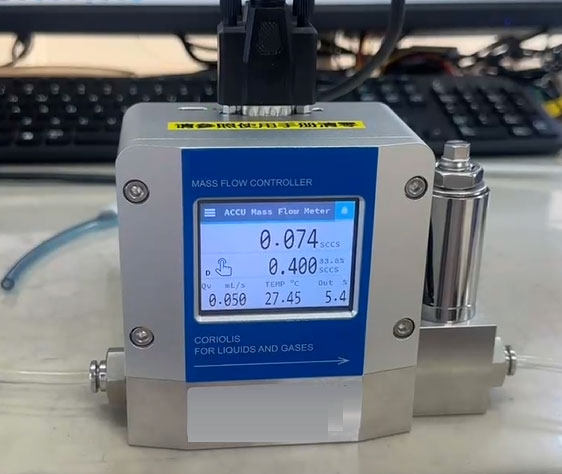
| SH-CMF-FE micro coriolis | Liquid (and gas) | 40 g/h to 50 kg/h at 1.0% F.S accuracy; larger full scales to 300–1000 kg/h |
The LC-M positive-displacement flow meter is suitable for very low flow rates and precise chemical dosing. It requires no straight pipe run upstream and offers pulse resolution down to 0.055 mL per pulse. Available configurations include SS316L or aluminium bodies, with SS316L, PPS or aluminium gears, and pressure ratings from 1.6 to 5 MPa. Typical applications include dosing amine solvents and coagulants such as polyaluminium chloride in water treatment.

The SRK-DL micro thermal mass flow meter measures gas flows down to a few sccm, making it suitable for applications requiring stable measurement at very low flow rates. It has no moving parts and offers 4-20 mA, 0-5 V or RS485/RS232 outputs, with pressure ratings of 3 MPa or 10 MPa. Typical applications include laboratory gas measurement, compressed air monitoring and low-flow gas processes.
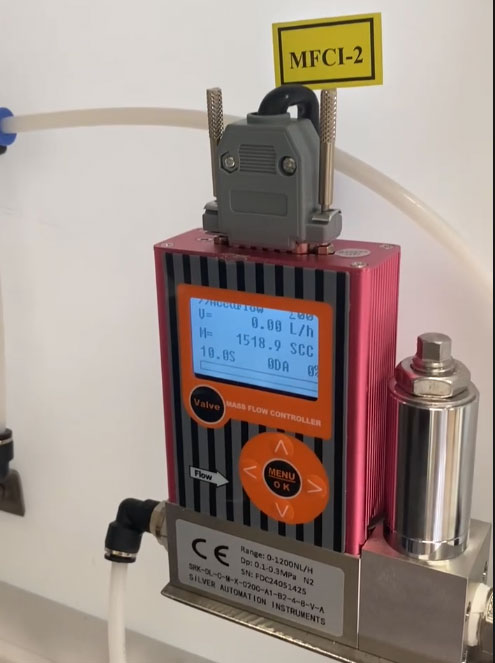
The SH-CMF-FE micro Coriolis flow meter provides direct mass flow measurement for both liquids and gases. It is suitable for precision dosing of expensive chemicals and solvents, such as dodecane, and for measuring fluorinated specialty gases where mass flow data is required. It features 8, 10 or 12 mm process connections, pressure ratings of 3 MPa or 10 MPa, and a fluid temperature range of 0 to 70 °C.
The following examples are based on applications we have actually supplied. Customer identities are not disclosed.
Amine solvent for a university research group. A university research group measuring an amine solvent needed a meter that could stand up to the chemical. We supplied an LC-M5.1 micro oval gear meter with an SS316L body and gear, a 1/4" NPT connection, a 1–800 mL/min range and a 0.25 mL-per-pulse output, plus a remote 4–20 mA display. The solvent was under 50 cP, inside the meter's -40 to 150 °C and 1.6 MPa limits.
Low-flow air for a system integrator. A system integrator measuring compressed air needed a meter for 0 to 37 L/min. We supplied a low flow gas flow meter on a 1/4" compression fitting with a 4–20 mA output.
Very low hydrocarbon gas flow for an oil and gas project. A hydrocarbon gas stream was measured down to 25 mL/min by a micro thermal mass meter on a 1/8" inlet and a 1/16" outlet, operating at 25 to 40 °C with an inlet pressure up to 2 bar and about 0.5 bar at the outlet.
Send Silver Automation Instruments the following information so our engineers can review the application:
We reply within 24 hours. Contact our engineers for a recommendation and a quotation.
 Low flow gas Flow Meter/Mass Flow Controller
For gas ultra low rate as low as 2 sccm (2 ml/min), For air,biogas,natural gas, N2, O2,CO2,etc. 1%F.S accuracy and 2s response time.
VIEW
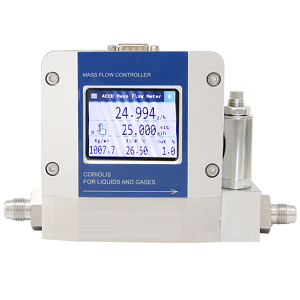 Small Coriolis flow meter/mass flow controller
Coriolis principle small flow meter/flow controller, Best accuracy mass flow meter for gas, liquid and steam. It can detect 40 g/h flow or even lower.
VIEW
 Low flow liquid flow meter
LC-M2,M5 to M25 micro liquid flow meter can detect as low as 0.5ml/min flow. It is a PD flow meter for liquid such as water, fuel, oil, resin. it still keeps 0.5%F.S accuracy.
VIEW
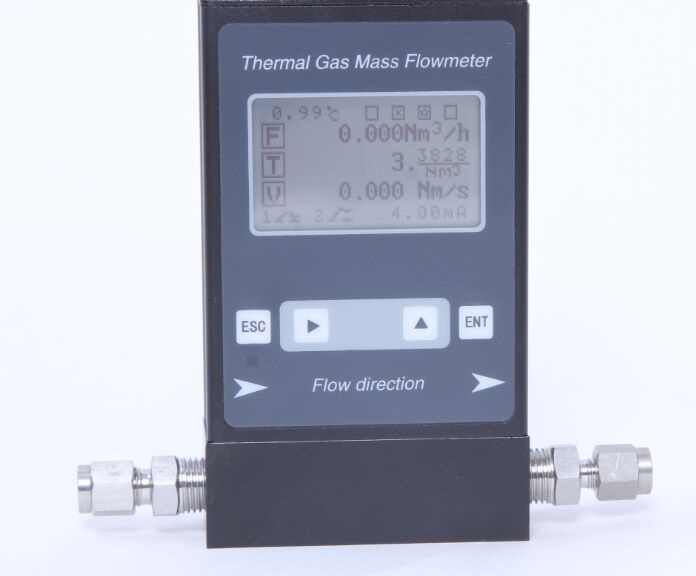 Low flow mass flow meter
 is a kind of mass flow meter which can measure fluids at ultra low flow rate with ml/min unit. We have micro thermal mass flow meter for gas or air mass flow measurement; we a...
VIEW
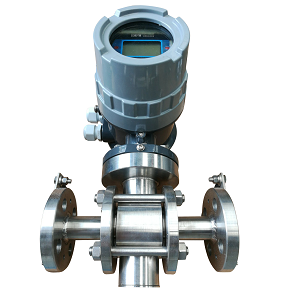 Low flow magnetic flow meter
Low flow mag meters can handle liquid flowas low as to 0.33 LPM (0.09GPM), the mini mag flow sensor size we can provideis 1/8”,1/4”,3/8”,1/2”,3/4”. Micro flow magnetic flow meters are used widely...
VIEW
 Micro low flow Coriolis flow meter
Min flow 0-10 kg/hr Coriolis principle. ATEX approved. Suitable for low flow gas, liquid or steam.
VIEW