English
A micro low-flow Coriolis mass flow meter is sized mainly from the required mass-flow range, not simply from the process pipe diameter. A practical starting point is to keep normal flow around 50% to 80% of full scale, while also allowing for pressure drop, wetted materials, and hazardous-area requirements.
The examples below reflect typical requirements for refrigerant skids, dosing benches, and calibration labs, using the process conditions provided for each application.
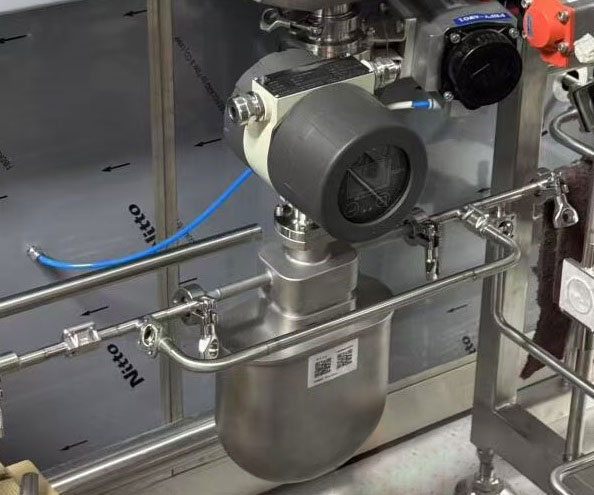
There is no universal threshold for micro or low flow. In practice, micro Coriolis meters cover flows from a few grams per minute to a few hundred kg/h, with sensor bores of about DN1.5 to DN15 (1/16 in to 1/2 in).
Typical flows from our inquiries include:
| Application | Typical flow |
| Peroxide or additive dosing bench | 90 to 105 mL/min |
| Calibration laboratory reference | 100 to 5,000 mL/min |
| Refrigerant liquid line (heat pump) | 30 to 150 kg/h |
| Pilot or skid-mounted process line | 5 to 500 kg/h |
If the required flow is below this range, a different flow meter technology may be a better fit. Please see Section 9 for the main alternatives.
A Coriolis meter measures mass flow, while the process data may be given in L/min or mL/min. Convert the volumetric flow using the fluid density at the operating temperature before sizing the meter.
Water shows why temperature matters. At 5,000 mL/min:
The difference is about 1.5%, which is larger than the accuracy of the meter in this example. Refrigerants and most organic solvents can show a greater density change than water.
The pipeline diameter alone is therefore not enough to size a Coriolis meter.
Pipe size is a common starting point in a flow-meter inquiry, but it does not determine the correct Coriolis sensor bore. Two examples show why.
Inquiry example A: refrigerant line
The sensor size should be based on the required flow range rather than the tube diameter alone. A DN10 sensor may also be suitable if the operating flow falls within an appropriate part of its measurement range.
Case Study: Coriolis Mass Flow Meter for R454B Refrigerant
Inquiry example B: calibration bench
Here, the sensor bore follows the required flow range rather than the line size.
As a practical starting point, aim for normal flow around 50% to 80% of full scale. Higher utilization can increase pressure drop, so the maximum-flow condition also needs attention.
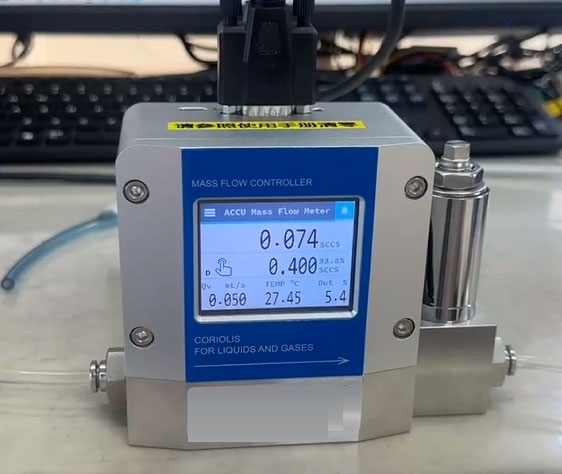
At low flow, two accuracy terms matter: percent of reading and zero stability. Percent-of-reading error changes with the measured flow, while zero stability adds a fixed error in kg/h. As the flow decreases, that fixed term becomes a larger share of the reading.
For example, with a zero stability of 0.01 kg/h, the zero term is 0.1% at 10 kg/h but 1% at 1 kg/h. The meter has not changed, but the same zero error now represents ten times the percentage of the measured flow.
For percent-of-reading accuracy, ±0.2% or better is a realistic target for many micro meters. The more useful specification is the zero stability and the accuracy statement at the actual operating flow, rather than the headline accuracy alone.
Turndown matters for the same reason. A sensor selected for 30 to 150 kg/h (5:1) keeps the normal operating point in a more useful part of the range than a sensor stretched across 1:100.
Small-bore Coriolis sensors can create noticeable pressure drop (Δp), and low-flow skids often have limited pump head. Compare Δp at normal and maximum flow with the available pump head before finalizing the meter.
If pressure drop is the limiting factor, a slightly larger bore can be a better trade-off, provided normal flow still sits in a suitable part of the meter range.
The fluid affects the wetted material, seal selection, and in some cases the meter model. The fluid, concentration, and operating temperature should be stated together because each can change the material requirement and price.
Micro Coriolis applications can cover a wide pressure envelope, especially on refrigerant skids. Two inquiries illustrate the point.
Inquiry example C: refrigerant skid. The line ran from 0.4 mbar abs (300 µmHg, evacuation) up to about 41 bar. The full pressure envelope needs to be stated because it affects construction and pressure rating.
Inquiry example D: heat pump unit. The customer required ATEX approval for A2L refrigerants (R454C, R454B, R32) and a remote display because the meter sits inside a compact unit.
Certificate type, temperature class, cable length, and enclosure rating should be defined early. These configuration details can affect both price and lead time in micro-flow applications.
Because of their small internal bore and low flow rates, micro flow meters require careful attention to installation conditions:
Coriolis offers high measurement accuracy, little straight-pipe requirement, and direct mass-flow measurement. These advantages matter when fluid properties change or the application needs tight accuracy. If the application does not need them, a turbine or oval gear meter may provide the required measurement at lower cost.
A Coriolis meter typically costs several times more than a turbine or oval gear meter.
| Technology | Fluids | Best fit |
| Micro Coriolis | Liquid and gas | Mass flow, changing fluid properties, tight accuracy |
| Micro oval gear | Liquid, including viscous | Viscous liquid, dosing, cost-sensitive builds |
| Low-flow turbine | Clean, non-corrosive liquid | Water, light oil, volumetric calibration |
| Thermal mass | Gas only | Low-flow gas where Coriolis is not economical |
For a wider technology overview, see our low-flow flow meter guide.
The following information is enough to establish the main sizing and configuration requirements:
Send us these items and we can recommend a model and confirm the pressure drop:
For available bores and flow ranges, see our micro Coriolis meter range.
Email sales@silverinstruments.com or WhatsApp +86 189 3675 9191.