
English
Electromagnetic flow meters are widely used for milk and other conductive dairy liquids because milk normally has sufficient electrical conductivity for electromagnetic measurement. Two practical selection points deserve particular attention: the CIP cleaning temperature rating and the flow-rate units stated on the RFQ. Both can result in incorrect sizing or specification, even when the measurement technology itself is suitable.
Electromagnetic flow meters measure conductive liquids, and milk normally meets this requirement easily. The technology typically requires a minimum conductivity around 5 μS/cm, while most milk products used in dairy processing have conductivity well above this level. Because there are no moving parts inside the flow tube, electromagnetic meters avoid rotors or gears exposed to the process fluid, reducing wear and simplifying cleaning in hygienic applications.
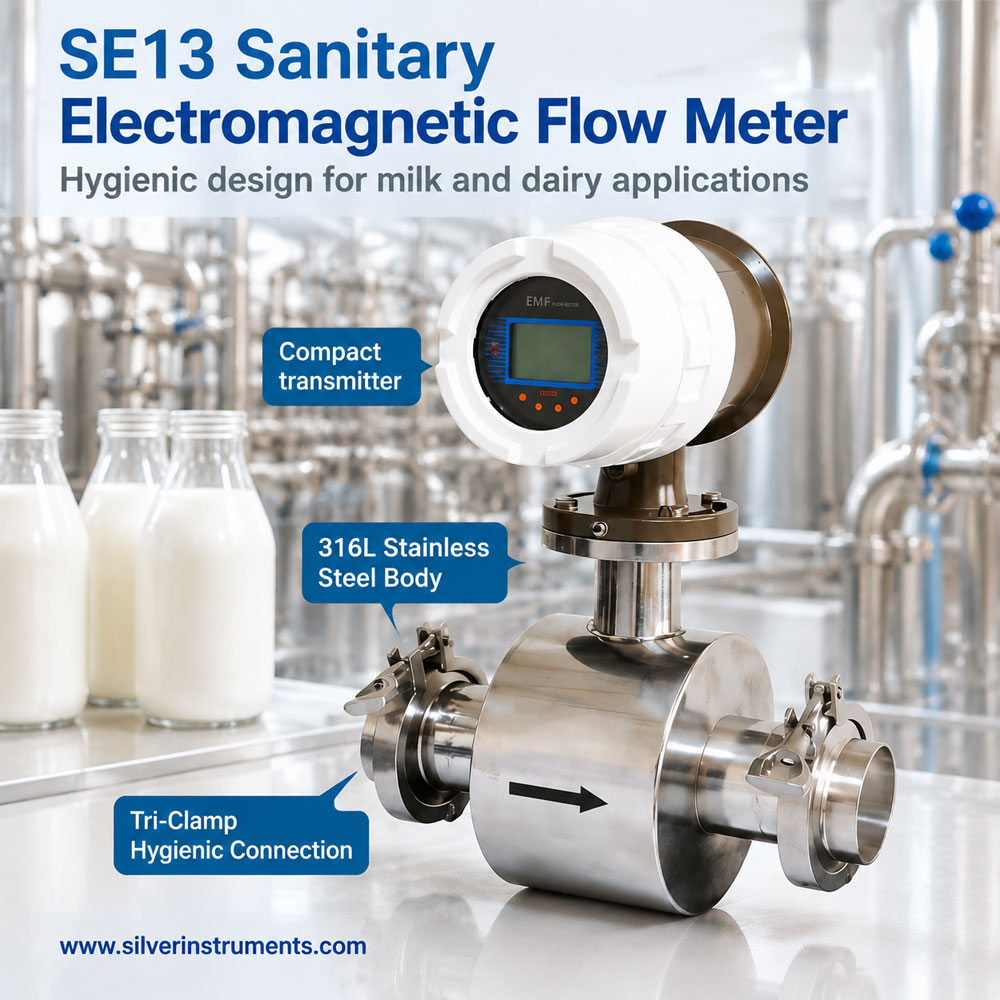
Choosing a milk flow meter starts with matching the measurement technology to the liquid properties and process requirements. magnetic flow meter are suitable for whole milk, skimmed milk, standardized milk, and many CIP cleaning solutions. Other dairy products require additional consideration. For example, high-viscosity or density-sensitive products such as cream, yogurt mixtures, or concentrated dairy products may benefit from Coriolis measurement when direct mass flow or density measurement is required.
A dairy line rarely runs one fluid through one meter. The same pipe carries whole milk during production, skim milk after separation, and caustic or acid CIP solution during cleaning, often several times a day. A sanitary electromagnetic sensor such as the SE13 from Silver Automation Instruments handles this switch without recalibration between runs, because the measurement principle doesn't depend on the fluid's viscosity or fat content. Design engineers still need to check the electrode and liner materials against the CIP chemistry the plant actually uses, since caustic and acid solutions vary by concentration and cleaning agent.
This is where sizing goes wrong most often, and it has nothing to do with the milk itself. It's about what runs through the same pipe afterward.
A standard-temperature sanitary flow meter is rated below 60°C, which covers the milk product but not the CIP cycle. Many CIP programs run hot water or steam-assisted rinses well above that, sometimes reaching 90°C to 130°C depending on the cleaning protocol and how aggressive the plant needs the cycle to be. If the meter's temperature rating doesn't cover the CIP cycle, the instrument either fails prematurely or has to be bypassed during cleaning, which defeats the purpose of having it inline.
The solution is usually a higher temperature grade rather than a different measurement technology. On the SE13 series, this means moving from the standard temperature code to the extended-temperature option, rated to 160°C. The liner material has to support that range too. PTFE handles up to roughly 130°C, while F46 and PFA liners extend to around 180°C, which gives headroom above most CIP cycles. The meter therefore needs to be rated for the CIP peak temperature, not just the milk temperature. Otherwise, the cleaning cycle can exceed the meter's temperature limit.
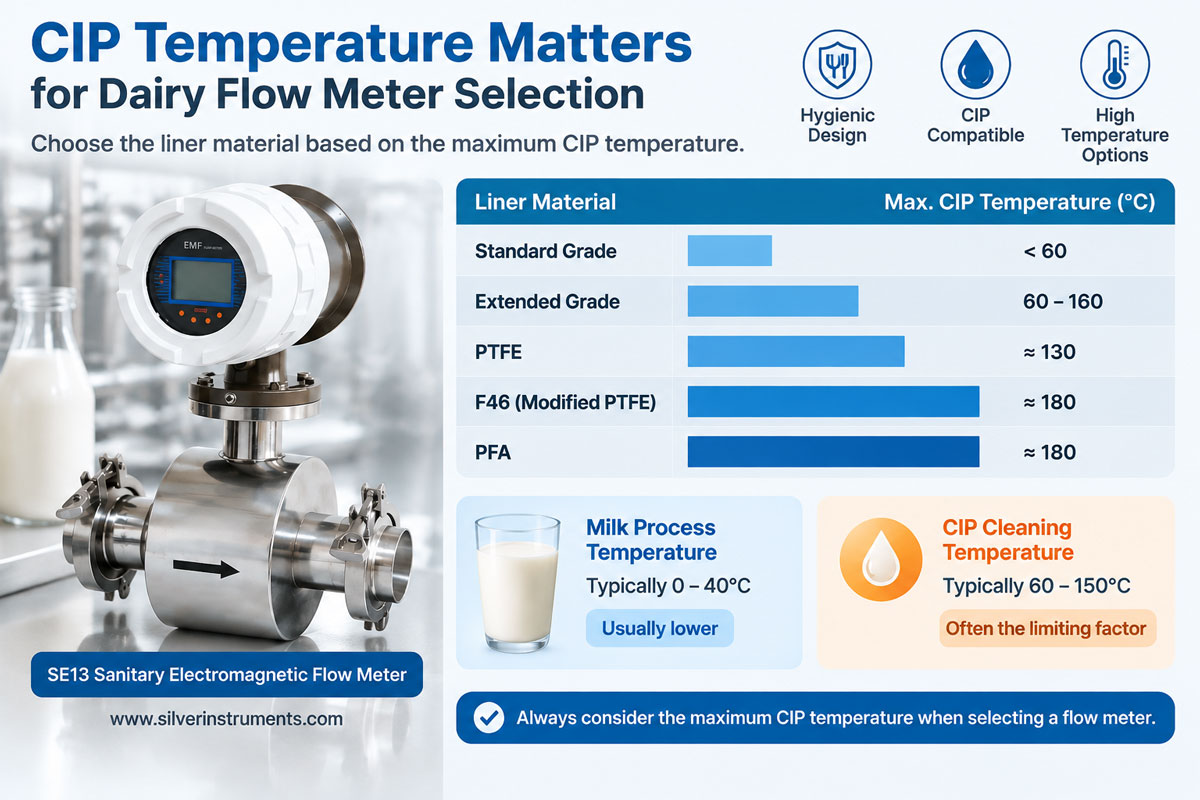
Before sending an RFQ, confirm the maximum temperature the CIP cycle actually reaches, not just the target set point. Steam-assisted CIP can overshoot the programmed temperature briefly, and that peak matters more than the average.
Tri-Clamp connections are widely used in dairy processing because they allow fast disassembly for inspection and cleaning without tools. A sanitary electromagnetic meter in the SE13 range covers DN10 to DN100, which spans everything from small craft dairy lines to full production runs.
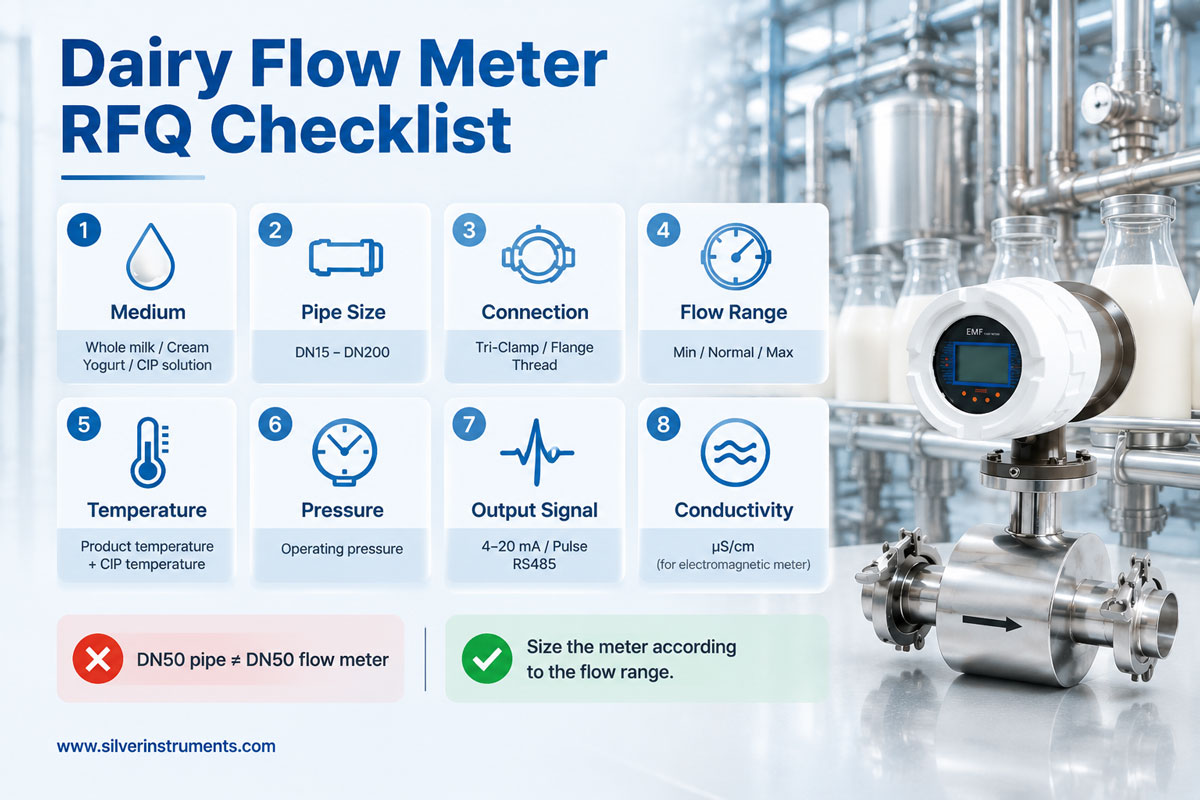
Sizing follows the actual flow rate, not the pipe diameter alone. A DN15 line handling around 15 L/min sits comfortably within a half-inch meter's range. A DN40 line running roughly 10,000 L/hr needs the flow velocity checked against the meter's rated range rather than assumed from pipe size. A DN50 line moving 1,000 to 30,000 L/hr across different products needs the meter sized for its lowest expected flow, since accuracy drops off at the bottom of a mag meter's velocity range.
Many quoting problems start with the specification sheet rather than the meter technology itself. Two mistakes appear frequently in dairy flow meter inquiries.
The first is a decimal point or unit error that changes the required flow rate by orders of magnitude. A quote requesting a flow rate of mL/h when the actual process runs in L/h describes a completely different pipe size and price range. This type of mistake is easy to miss on a specification sheet but costly to correct after a quotation has been issued.
Checking the unit with the Flow Rate Converter before submitting an RFQ helps identify this issue early.
The second is temperature unit confusion. A plant specifying operating and CIP temperatures in Fahrenheit, while the supplier's standard datasheets use Celsius, may result in an incorrect temperature rating if the conversion is not verified. The Temperature Converter removes uncertainty during specification review.
Neither error reflects poorly on the buyer. Metric and imperial units are both common in international sourcing, and a quick verification is usually enough to avoid specification problems.
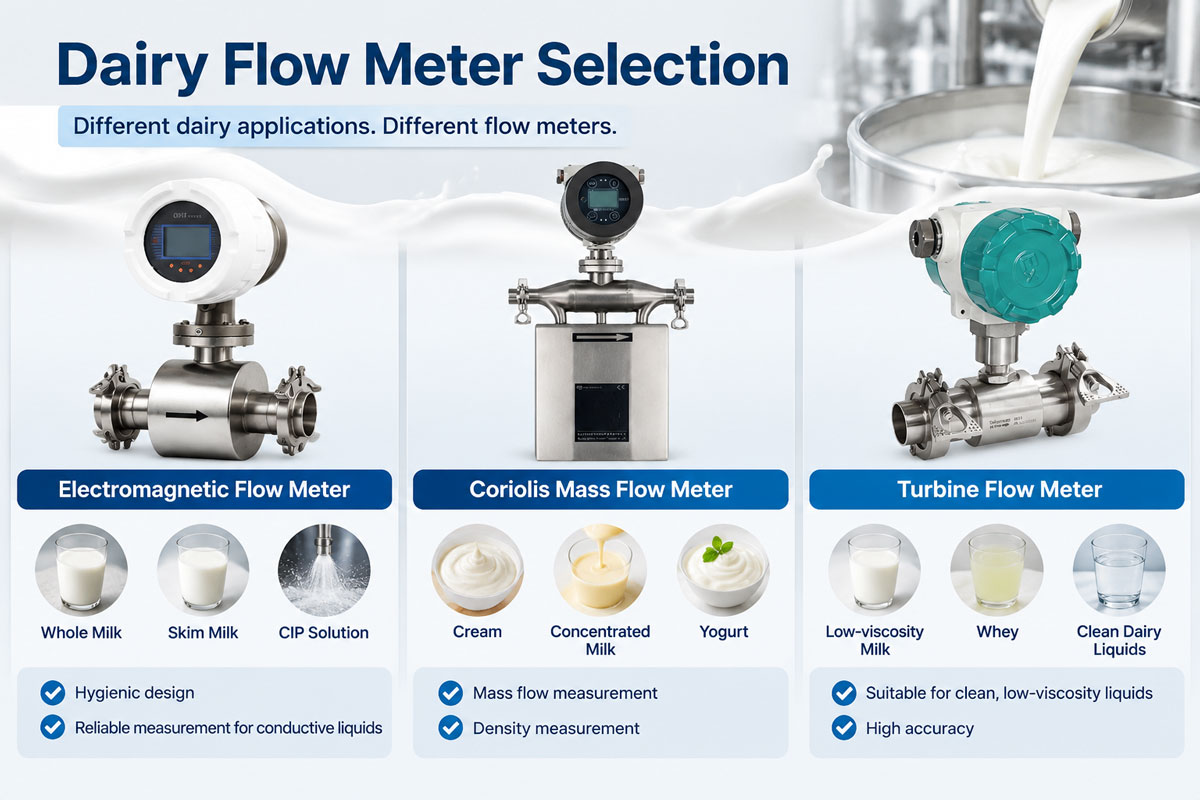
Electromagnetic flow meters cover most standard milk transfer and dairy CIP applications. With no moving parts inside the flow tube, they provide reliable operation, low maintenance requirements, and good compatibility with hygienic processing systems. For most milk pipelines, electromagnetic technology is the practical first choice.
Coriolis flow meters measure mass flow directly and provide density measurement at the same time. This makes them suitable for applications where accurate mass balance, product consistency, or density monitoring is important. For standard milk transfer with stable properties, the additional capability may not justify the higher cost. Coriolis meters are more commonly considered for cream processing, high-value dairy products, or applications requiring direct mass-flow measurement.
Turbine flow meters can be used for clean, low-viscosity dairy liquids and CIP water where stable operating conditions are available. Their rotating rotor provides good measurement accuracy, but the moving components introduce wear considerations and make them less suitable for applications where minimum maintenance and hygienic design are the main priorities.
Turbine flow meters can be used for clean, low-viscosity dairy liquids and CIP water where stable operating conditions are available. However, Their rotating rotor introduces a wear component and requires more maintenance than magmeter with no moving parts.
| Scenario | Typical Size | Temperature Grade | Notes |
| Small-batch or craft dairy line | DN15 | Standard (<60°C) unless CIP runs hot | Confirm CIP peak temperature before assuming standard grade |
| Standard production line, single product | DN40 | Standard or extended, depending on CIP | PFA or F46 liner if CIP exceeds 130°C |
| Multi-product line (whole/skim milk + CIP) | DN50 | Extended (up to 160°C) | Electrode and liner material checked against CIP chemistry |
Send the following to get an accurate quote the first time:
Email: sales@silverinstruments.com | WhatsApp: +86 18936759191