
English
A milk flow meter on a transfer line has one job that matters to the production team: tell them how many liters went from one tank to the next. This case is based on a meter we supplied in 2026 to a small yogurt producer, which installed a DN50 sanitary magnetic flow meter between its milk storage tank and its processing tank. The meter worked from day one, but two questions came up right after start-up: how to show liters instead of cubic meters, and how to see the volume of each transfer. Both questions are common, so the answers are below.
| Question from the plant | Short answer |
|---|---|
| Can the display show L/h instead of m³/h? | Yes. The flow unit is a menu setting and takes a few minutes to change. |
| Why does the reading go to zero when the pump stops? | The main screen shows flow rate. With no flow, the rate is zero. The total is kept on a separate screen. |
| Can the meter show the liters of each transfer? | Not by itself. The meter keeps a running total. Liters per batch need a reading before and after, a batch controller, or a PLC. This plant added a batch controller. |
The transfer line is a 50 mm pipe that carries cold raw milk from a large storage tank to a processing tank, up to 10 minutes per transfer. The yogurt plant receives raw milk into the storage tank. Before each production run, operators pump milk into a processing tank, and they need to know the volume transferred so the recipe is correct.
| Item | Site condition |
|---|---|
| Medium | Raw milk |
| Pipe size | 50 mm, tri-clamp on both sides |
| Temperature | 4–8 °C |
| Pressure | About 3 bar |
| Transfer time | Up to 10 minutes per transfer |
| What the operators need | Liters transferred in each run |
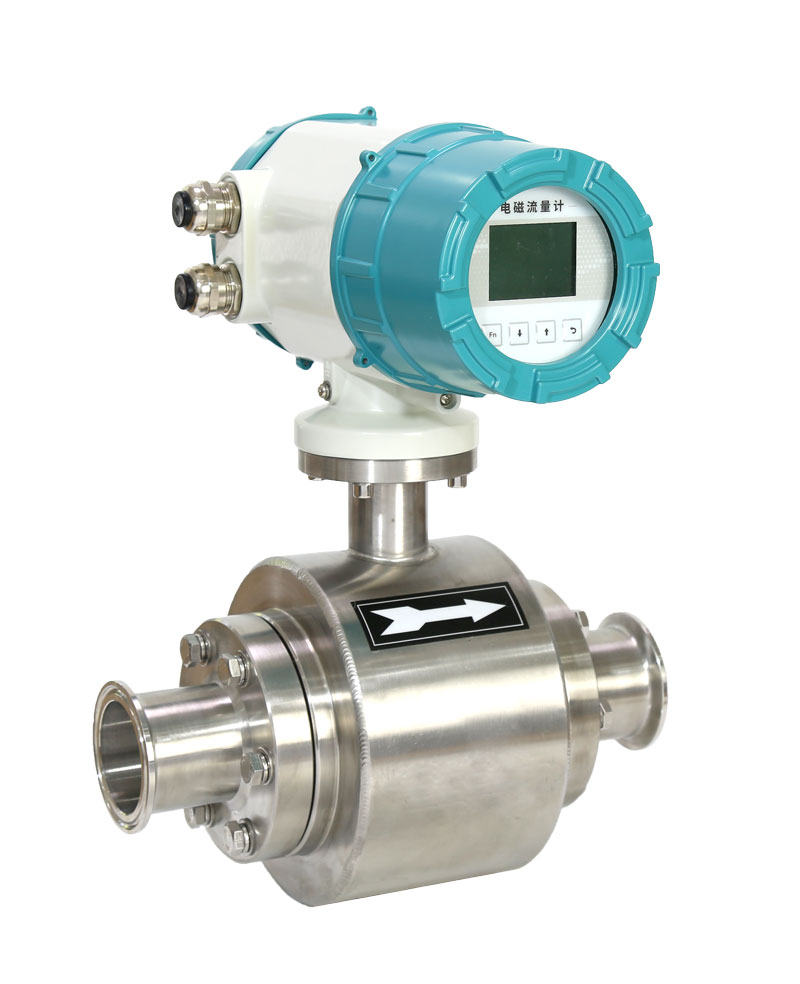
A sanitary magnetic milk flow meter suits milk because milk is electrically conductive, the bore is fully open with no moving parts, and the wetted parts are food-grade. The meter supplied was an SHD-SE13 sanitary type with these options:
| Option | Selection | Why it fits milk |
|---|---|---|
| Size | DN50, flow range 3–60 m³/h | Matches the 50 mm line |
| Connection | Tri-clamp | Quick removal for cleaning |
| Liner | PFA | Smooth, food-contact surface |
| Electrodes | 316L stainless steel | Standard for dairy media |
| Accuracy | 0.5% | Enough for recipe dosing |
| Output | 4-20mA, RS485, pulse | Ready for a PLC or batch controller later |
| Housing and body | SS304 | Washdown areas |
The DN50 range of 3–60 m³/h equals 3,000–60,000 L/h. A transfer pump on a 50 mm dairy line usually sits well inside that range. Selection points for dairy lines, such as CIP temperature and hygienic connections, are covered in our dairy flow meter selection guide.
Changing m³/h to L/h is a converter menu setting that takes a few minutes. No recalibration is needed, because the meter measures the same velocity and only shows the result in a different unit. Our engineers sent the plant a short video, and the operator changed the unit the same day.
The steps on the SE13 converter, the same as on our other magnetic flow meter converters:
Key-by-key instructions, including the password, are in our article on magnetic flow meter key operation.
The reading drops to zero because the main screen of a magnetic flow meter shows the instantaneous flow rate: how fast milk is moving right now, in L/h. When the pump stops, the rate correctly drops to zero. The volume that has passed is not lost. The converter adds it to the totalizer, which is shown on another screen.
| Reading | What it means | When the pump stops |
|---|---|---|
| Flow rate (L/h) | Speed of flow at this moment | Shows 0 |
| Totalizer (L or m³) | All volume since the total was last reset | Stays at the last value |
| Batch volume | Liters in one transfer | Needs a start and end reading |
The plant asked whether the display could "keep the last liter number" after each transfer. The number they wanted was the batch volume, which the meter does not calculate on its own.
Liters per batch come from three methods: subtracting totalizer readings, adding a batch controller, or counting in a PLC. A magnetic flow meter totalizer runs continuously, so one of these is needed. From simplest to most automatic:
| Method | How it works | Extra hardware | Good for |
|---|---|---|---|
| Read the total before and after | Write down the totalizer at start and end, then subtract | None | A few transfers a day, manual records |
| Batch controller | The pulse output feeds a batch controller that counts each run from zero; a relay can stop the pump at a preset volume | Batch controller, wiring | Fixed recipe volumes, operators at the tank |
| PLC or SCADA | The 4-20mA, pulse or RS485 output goes to the plant PLC, which records each batch | PLC input, programming | Plants that already log production data |
The yogurt plant chose the batch controller. The AJ-D batch controller takes the pulse output of the SE13, shows the liters of the current transfer from zero, and keeps the meter's own totalizer running for daily records.
For a 10-minute transfer, the manual method works. Once the plant runs several transfers per shift, or wants the pump to stop on a set volume, a batch controller removes the subtraction and the risk of overfilling.
A milk flow meter on a transfer line reads correctly when the pipe stays full, the meter has straight pipe on both sides, no air enters, and the meter is grounded. The checklist:
Send us these details and our engineers will reply within 24 hours with a suggested meter and batch setup:
Contact our engineers with your line details.