
English
For most industrial facilities, compressed air accounts for 10 to 30% of total electricity consumption. And up to 30% of that air escapes through leaks before it ever reaches the point of use.
As a result, the detection of compressed air leaks is one of the fastest, highest-return energy improvement projects available to plant managers. An effective leak detection program is not determined by a single tool or a one-time event. It is a combination of methods, each serving a different purpose.
Compressed air leaks are largely invisible and can occur anywhere in a production facility. In a busy plant environment, machinery noise masks even significant leaks. Common leaks may also happens at joints, valves, fittings, couplings, and hose connections. However these leaks nearly impossible to detect without the right equipment
A single 1/8-inch leak at 100 psi can waste an estimated 25 CFM of compressed air, approximately $2,500 per year. Without a formal detection program, most operators only notice a problem when system pressure drops or energy bills rise.
To detect Air leaks, various detecting methods are applied in industrial applications. The choice of methods are based on accuracy requirements, environment, and the type of system being tested.
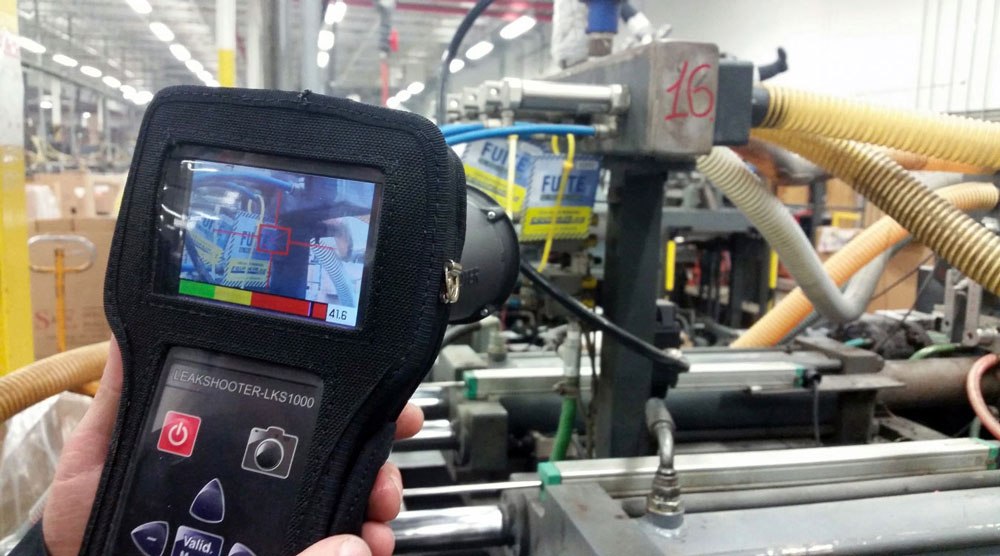
Ultrasonic detection is the most widely used method for most facilities. When air escapes through a small opening, it produces high-frequency sound. A handheld ultrasonic detector picks this up easily, even in a noisy plant. It requires no shutdown, and can catch a leak down to a specific fitting or joint.
The soap bubble test is the simplest method. Apply soapy water to joints, valves, or connections, and any leak will show up as bubbles. It doesn’t require any special equipment and works well on accessible points. The main limitation is that it depends on manual application and visual inspection, which means it can’t be automated or used for continuous monitoring.
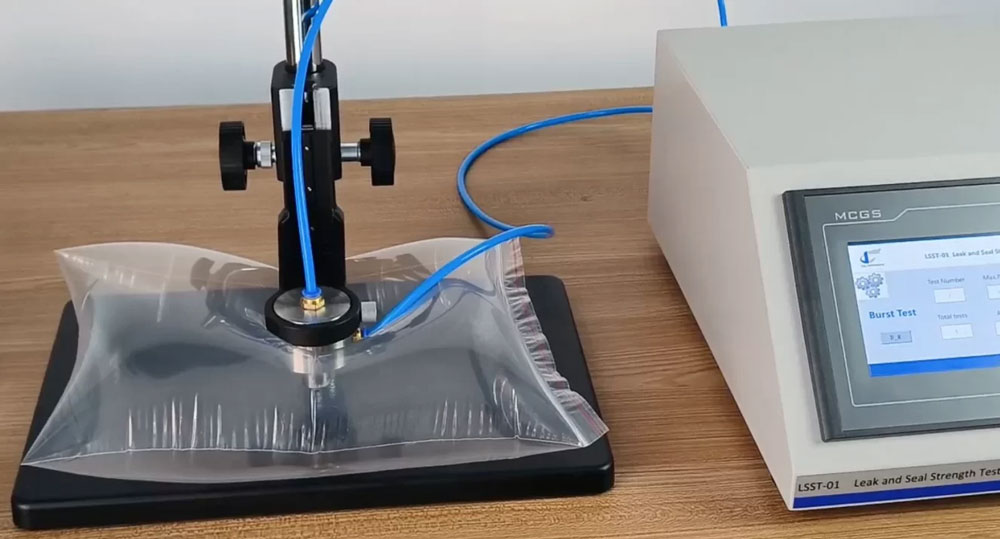
Pressure decay testing workds at the system or zone level. A section of piping is first isolated and pressurized, then the pressure is monitored over time. If the pressure drops quickly, it indicates a higher level of leakage in that section.This method helps identify the areas with the most significant leaks in the system. Maintenance teams can then focus on those areas instead of inspecting the entire system.
Infrared thermography can detect leaks through the temperature change caused by expanding compressed air at a leak point. It’s useful for scanning large areas quickly, but it is not very sensitive to small leaks. In most cases, it is used as a screening or supporting tool rather than a primary detection method.
Tracer gas testing works by introducing a detectable gas, usually helium, into the compressed air system and using a sensitive probe to find where it escapes.
It is very accurate and especially useful for hidden or hard-to-reach pipework. However, because it is more complex and costly, it is typically reserved for critical or specialized systems rather than general manufacturing use.
The methods described above are focused on finding individual leaks. Flow meters serve a different but equally important purpose.
Instead of locating where air is escaping, they measure how much air is being lost in total. This makes them useful for understanding system-wide performance, comparing different areas of a plant, and confirming whether repair work has actually reduced consumption.
One of the most effective applications is the shutdown baseline test. When the plant is not in production and all end-use equipment is turned off, any flow recorded by the meter represents leakage.That means a facility reading 200 SCFM at idle knows immediately the scale of its problem and has a number it can convert directly into annual energy cost.
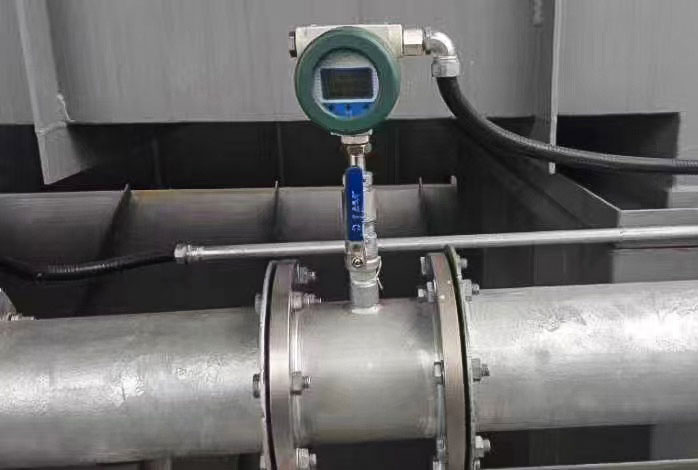
A compressed air flow meter measures the volumetric or mass flow rate of air moving through the distribution system, typically in SCFM (standard cubic feet per minute). It can turn compressed air from an invisible overhead cost into a measurable, manageable utility.
Thermal mass flow meters are the most commonly recommended type for compressed air systems. They work by measuring how much heat the moving air carries away from a heated sensor, even a very small flow produces a detectable reading.
Vortex flow meters and ultrasonic clamp-on meters are also widely used, with clamp-on models offering the advantage of installation without cutting pipe, which makes them ideal for temporary audits on existing systems.
Flow meters are typically installed at the compressor discharge and at key distribution points. This allows teams to break the system into zones and identify which areas are responsible for the highest losses before any detailed leak inspection begins.
After repairs, the same shutdown test can be repeated. Any reduction in idle flow provides immediate and measurable proof of improvement. For example, a drop from 90 SCFM to 25 SCFM in one zone indicates that 65 SCFM of leakage has been eliminated.
The most effective leak detection programs are not to rely on a single method, but to combine several tools in a structured workflow.
Start with a flow meter baseline to measure total leakage and identify the worst-affected zones. Then use ultrasonic detection to locate specific leaks within those zones. Once repairs are made, apply soap testing or pressure decay checks to confirm each connection is sealed. Finallly, verify that the leakage has actually dropped by the flow meter reading.
Leak detection is an ongoing process because leaks develop continuously as equipment wears. Running the program quarterly helps maintain consistent savings. If there is increased airflow during idle periods, it usually means new leaks, often before you see pressure drops or higher energy costs.
The easiest way to watch the compressor. If the compressor keeps cycling frequently during non-production hours when no air tools are running, it usually means there are leaks in the system.
To confirm, install a flow meter at the compressor outlet. Any airflow detected while the system is fully shut down comes from leaks.
No. Ultrasonic detectors can identify leaks while equipment is operating and are preferred for in-production surveys. Shutdown is only needed for pressure decay checks or soap bubble tests on specific connections.
Facilities typically reduce compressed air energy costs by 25–40% after a leak detection and repair program. Actual savings depend on leak rate, system pressure, and operating hours.
Quarterly surveys are recommended. Continuous monitoring during idle periods helps catch new leaks early.