
English
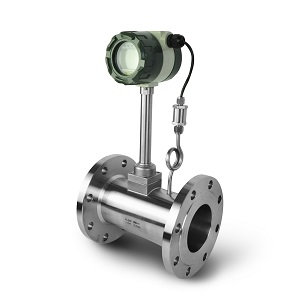
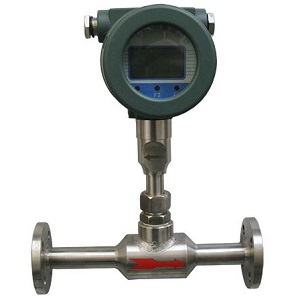
Inline air flow meter can be flanged connectionor thread connection; we often select thermal mass flow meter, gas turbine flowmeter, vortex flow meter or variable area flow meter to measure air flow. ...
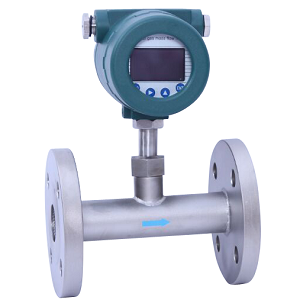
We supply accurate electronic air flow meters at low price cost, industrial air flow meter can be volume flow meter or mass air flow meter.
Quick Answer A vortex flow meter measures compressed air by counting the vortices shed behind a bluff body in the pipe. Frequency scales with velocity, so the meter converts that signal into flow rate without any moving parts to wear out. Silver Automation Instruments builds the STLU-G vortex flow meter with built in temperature and pressure compensation, so one transmitter reports mass flow, standard flow (Nm3/h or SCFM), operating pressure, and temperature at the same time. For DN15 to DN300 compressed air lines at 0.5 to 16 bar, a compensated vortex meter is usually the most cost effective choice next to thermal mass and far cheaper to maintain than a mechanical rotameter or turbine meter. |
The working principle is the Karman vortex street. A bluff body sits across the pipe. Air flowing past it sheds vortices alternately on each side, and the shedding frequency is directly proportional to flow velocity. A piezoelectric or capacitive sensor picks up the pressure pulses from each vortex and converts them into a digital pulse train.
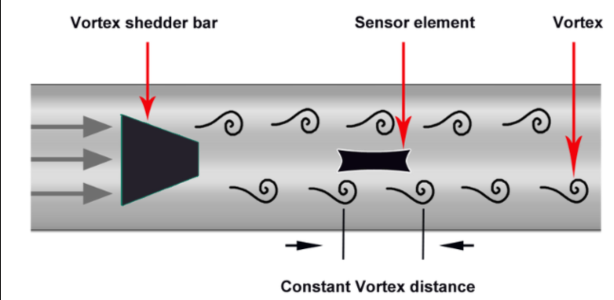
Vortex Flow Meter Principle
There is no rotor, no gear train, and no bearing in the flow path. That is the main reason plants choose vortex over turbine or mechanical rotameters for compressed air. Turbine meters lose accuracy as bearings wear, and that wear is gradual, so an operator can run for months on a meter that is quietly drifting low. A vortex sensor either works or it does not, which makes fault finding much faster.
Because the signal is a frequency, not an amplitude, vortex meters are also fairly immune to voltage drift and cable length. This matters on compressor house installations where the transmitter is often 30 to 80 meters from the control room.
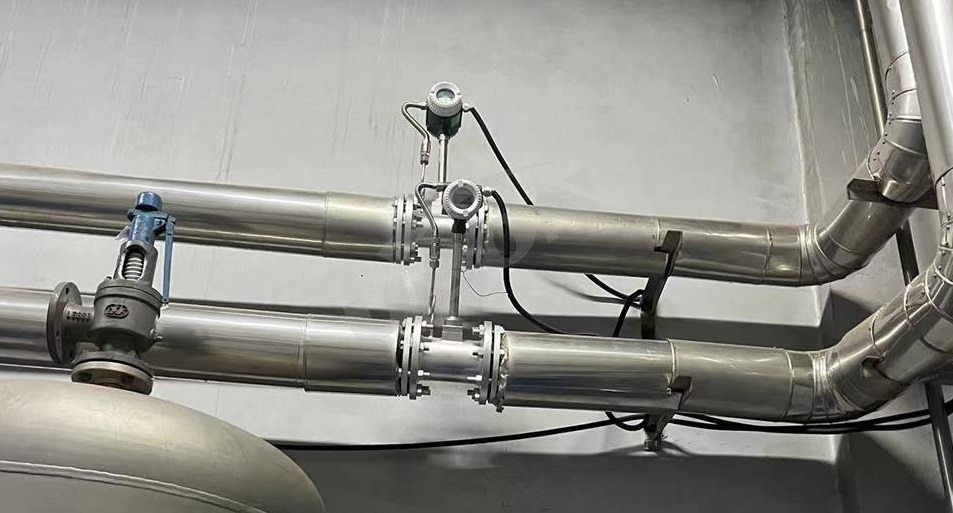
Vortex air flow meter with temperature and pressure compensation
Air is compressible. A cubic meter of air at 7 bar and 40°C contains a very different mass of air than a cubic meter at 3 bar and 15°C, even though the volumetric reading at the meter body looks the same. An uncompensated vortex meter reports actual volumetric flow at line conditions, which is not useful for billing, energy audits, or leak detection because it moves every time the compressor cycles.
The STLU-G integrates a Pt100 temperature sensor and a pressure sensor into the meter body. The onboard electronics apply the compressibility correction in real time and output standard flow in Nm3/h or SCFM, along with the raw operating pressure (bar or psi) and temperature (°C or °F) on the local display. We set this up on a compressor station in Thailand last year where the plant had three compressors staggered on pressure setpoint, and the compensated reading was the only way to get a flow number that made sense to the energy manager.
One limitation worth stating plainly: compensation corrects for pressure and temperature swings within the sensor's rated range, it does not correct for a badly sized meter. If the pipe runs mostly below the minimum detectable velocity, no amount of compensation fixes that. Sizing has to come first.
The STLU-G ships with a 4 to 20 mA analog output plus pulse output as standard, so it drops into existing PLC or DCS wiring without a protocol conversion. HART is available on the same 4 to 20 mA loop for plants that already run a HART handheld for calibration and diagnostics.
For digital integration we support Modbus RS485 RTU. We do not offer Modbus TCP/IP on this product line, so if a project spec calls for Ethernet based Modbus, that needs a separate gateway on the customer side.
| Parameter | Typical Value |
|---|---|
| Line size range | DN15 to DN300 (1/2 in to 12 in) |
| Measured medium | Compressed air, plant air, other clean gases |
| Accuracy | ±1% of reading (gas, compensated) |
| Repeatability | ±0.2% |
| Pressure rating | Up to 4.0 MPa (580 psi), higher on request |
| Process temperature | -40°C to 250°C (-40°F to 482°F) |
| Minimum straight pipe run | 20D upstream, 5D downstream (typical) |
| Minimum detectable velocity | Approximately 2 to 3 m/s, medium dependent |
| Output | 4-20 mA + HART, pulse, Modbus RS485 RTU |
| Power supply | 24 VDC loop powered or two-wire |
| Protection rating | IP65 / IP67 |
| Area classification | ATEX Zone 1 / Zone 2 options available |
Compressed air is one of the most expensive utilities per unit of delivered energy in a typical plant, so metering it usually pays for itself through leak detection and departmental cost allocation rather than through any single dramatic fault.
Installed right after the receiver tank, the compressed air flow meter tracks total plant air demand against compressor output. A garment factory in Vietnam we worked with used this to catch a receiver tank check valve that was cycling wrong and wasting roughly 8% of generated air overnight, something the plant only noticed once the trend line showed steady flow with no production running.
Larger sites split air distribution by department (paint line, packaging, tool room) and put a DN50 or DN80 vortex meter on each branch. This is common in electronics assembly plants in Malaysia and Indonesia, where management wants to charge internal cost centers based on actual air use rather than floor area.
A portable or permanently installed DN25 to DN40 unit on a tool line picks up baseline consumption during a shutdown. If the line still shows flow with every tool disconnected, that flow number is the leak rate, and it gives maintenance a dollar figure to justify fixing it instead of a vague complaint about compressor run hours.
Petrochemical and desalination sites in the Middle East often specify vortex meters on instrument air headers because the ATEX rated version handles the hazardous area classification and the lack of moving parts keeps maintenance intervals long between turnarounds.
Vortex meters need a real minimum velocity to shed a stable vortex, typically 2 to 3 m/s depending on gas density and pipe size. Below that, the signal gets noisy and the reading becomes unreliable. On lines with wide turndown, mostly running near zero with occasional peaks, a thermal mass meter such as our SRK-100 or SRK-DL reads lower flows more reliably because it does not depend on a shedding threshold.
Pulsating flow is the other limit. Reciprocating compressors without adequate receiver volume can put enough pulsation into the line to false trigger the vortex sensor. We usually recommend sizing the receiver tank properly or adding a pulsation dampener rather than trying to filter it out electronically, because electronic filtering on a fast pulsation tends to also filter out real flow changes you want to see.
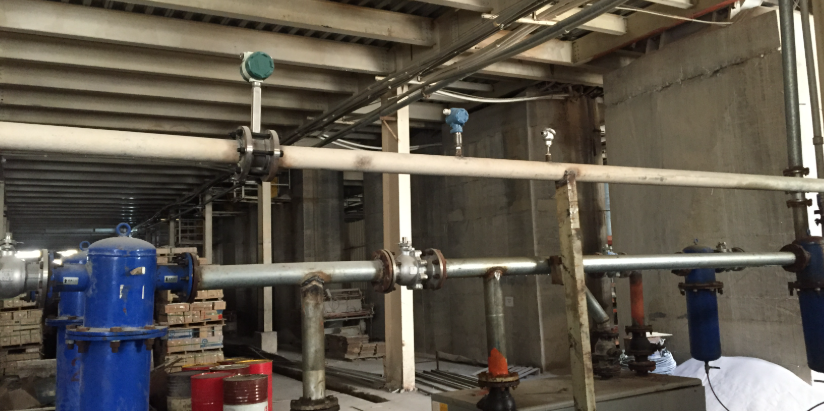
Vortex Air flow meter for compressor
A plastics injection molding plant in Vietnam was running three reciprocating compressors on a shared header with no metering beyond compressor run hour counters. Energy costs had climbed for two years running with no clear explanation. We supplied a DN100 STLU-G with pressure and temperature compensation on the main header plus two DN50 units on the two largest molding hall branches.
Within the first month the data showed one molding hall was consuming 35% more air per shift than the other despite running similar tonnage machines. That pointed maintenance to a cracked quick connect fitting behind a machine that nobody had checked because it was not making an audible hiss. The plant's own estimate put the annual savings from that single fix well above the cost of the three meters.
What accuracy can I expect from a vortex flow meter on compressed air?
A properly sized and installed vortex meter typically holds ±1% of reading on gas service, with ±0.2% repeatability. Accuracy drops off if the flow velocity is close to the minimum detectable threshold, so sizing the meter to the actual flow range matters more than the spec sheet number.
Can one meter give me both flow and pressure and temperature?
Yes. The STLU-G integrates temperature and pressure sensing with the vortex sensor, so the transmitter outputs compensated standard flow along with live pressure and temperature on the same display and the same 4-20 mA/HART or Modbus RS485 loop.
What is the minimum flow velocity for a vortex meter to work?
Roughly 2 to 3 m/s for most compressed air applications, though the exact figure depends on gas density, pipe size, and the bluff body design. Below that threshold, size down to the next pipe size or consider a thermal mass meter instead.
Do I need straight pipe runs before and after the meter?
Yes. Plan on 20D of straight pipe upstream and 5D downstream as a starting point. Elbows, tees, valves, or reducers close to the meter distort the flow profile and will show up as measurement error, not as a meter fault.
Vortex or thermal mass flow meter, which should I choose for compressed air?
Vortex suits mid to high flow ranges with reasonably steady velocity and gives you pressure and temperature in the same package. Thermal mass, such as our SRK-100 or SRK-DL, handles low air flow and wide turndown better because it does not need a minimum shedding velocity. On a line with a narrow flow range, vortex is usually the more economical option; on a line that swings from near zero to peak demand, thermal mass reads the low end more reliably.
Send the following to sales@silverinstruments.com and we will come back with a model recommendation and price within one business day:
Pipe size (DN or inch) and pipe schedule
Operating pressure (bar or psi) and temperature (°C or °F)
Flow range, minimum and maximum, in Nm3/h or SCFM
Output required: 4-20 mA, HART, pulse, or Modbus RS485 RTU
Area classification, if the installation is in a hazardous zone
See our vortex flow meter product line for steam and liquid applications if compressed air is only part of what you need to meter on site.
we will contact you within 24 hours..