
English
An 80GHz FMCW radar level transmitter is the preferred choice for edible vegetable oil tanks up to 30m tall. The Silver Automation Instruments SDRD82 radar level transmitter with a flush PTFE lens antenna handles condensation, oil vapor, and foam without calibration drift. Output is 4-20mA/HART or RS485 Modbus, powered by 24V DC.
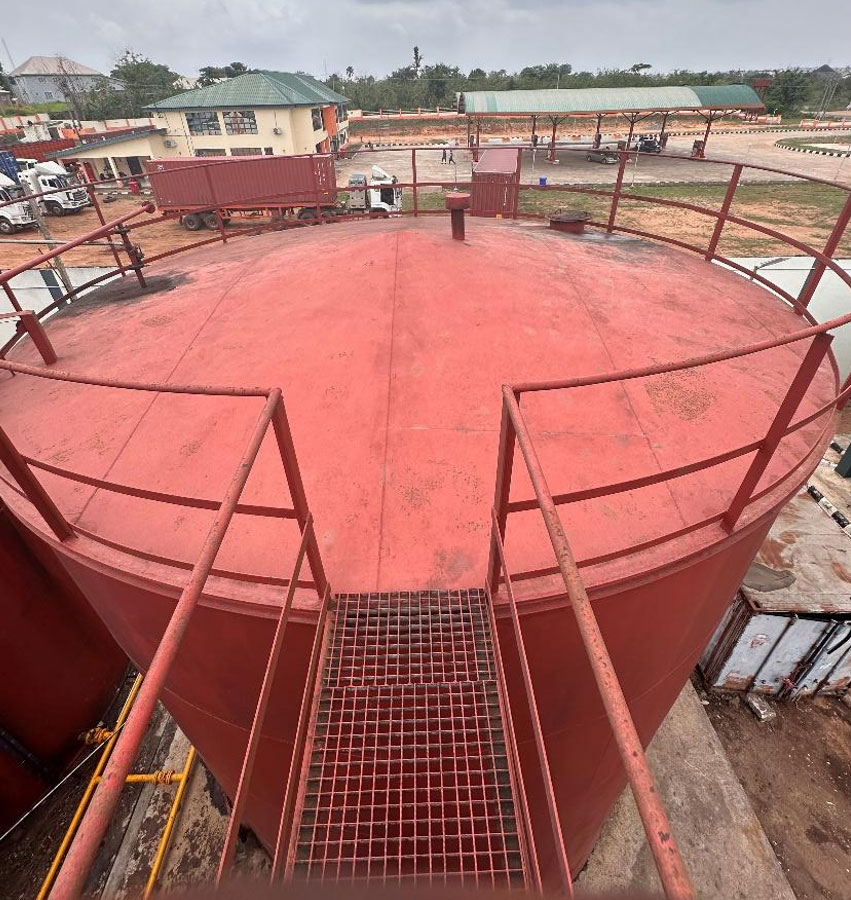
Vegetable oil tanks look straightforward on paper. But ask any instrumentation engineer who has dealt with palm oil condensate in a tropical unheated dome, or sunflower oil vapor fogging a sensor lens overnight, and they will tell you the level reading is the part that keeps them up. The medium is not aggressive, but the environment around it is.
This article covers how to select and configure an 80GHz radar level transmitter for edible vegetable oil storage, what antenna material and process connection to specify, and where the common mistakes happen during installation.
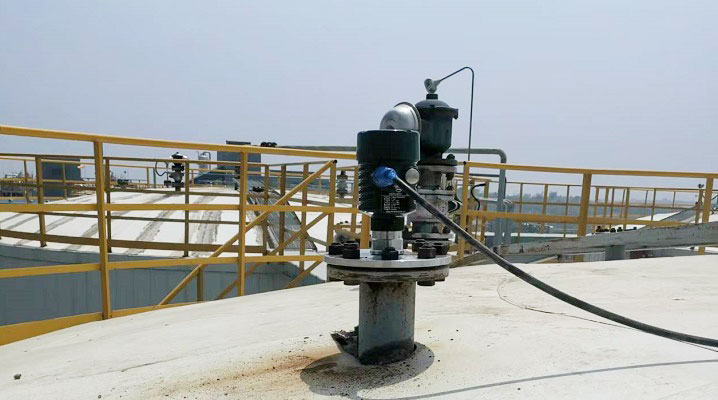
The 80GHz frequency band gives a narrower beam angle compared to older 26GHz units. For a typical vertical storage tank with a dome or conical top, that matters. A 6-degree half-angle beam on a SDRD82 with a DN50 lens stays well clear of the sidewall down to around 500mm, even in a 3-meter diameter tank. Less interference from tank walls, fewer false echoes.
Oil has a dielectric constant typically in the range of 2.8 to 3.2, which is on the lower end. Radar reflection is weaker than water. But 80GHz FMCW (frequency modulated continuous wave) is sensitive enough to get a reliable return at these low dielectric values, even through moderate vapor layers.
FMCW is the right principle here. It transmits a continuous swept signal rather than a pulse, which gives better signal-to-noise ratio at low dielectric media. The SDRD82 uses this method and resolves level to within 2mm across the full range.
In outdoor tanks without insulation, temperature swings create condensation on the antenna face. Oil vapor from the product surface can also deposit a thin film on the lens over time. Both effects reduce signal return.
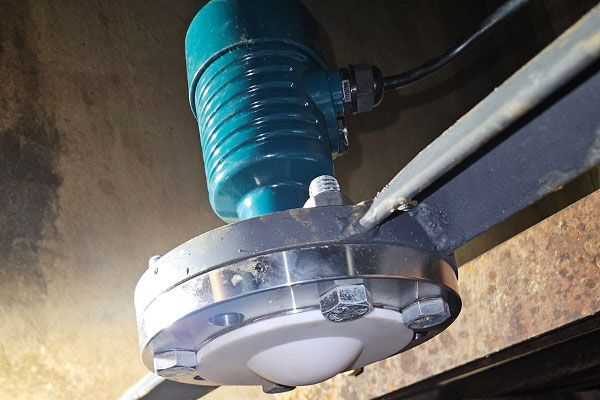
Flush PTFE lens antenna of radar level sensor
A flush PTFE lens antenna solves most of this. The PTFE surface is non-stick and self-cleaning to a degree: condensate runs off rather than pooling. Oil film buildup is slower compared to a bare metal or PP antenna. For the SDRD82, the DQ or EQ antenna option uses a 316L stainless steel body with a PTFE lens, rated to 200°C process temperature and 2.5MPa. That is far beyond what vegetable oil storage needs, so there is headroom on both temperature and pressure.
For installations where vapor is heavy, the connecting pipe stub (nozzle) should be kept short. The SDRD82 datasheet specifies a maximum nozzle height of 150mm for a DN50 antenna and 200mm for DN80. Exceeding that creates a waveguide effect that can trap echoes and produce phantom readings at 0% or 100%. We see this fairly often when tanks have been retrofitted with a long process neck originally designed for a float gauge.
For a 5.7-meter tank storing edible vegetable oil, the SDRD82 in the DS or DQ variant is the standard recommendation. The DS uses a DN50 flange with a 316L+PTFE antenna lens; the DQ is the same but with a longer antenna extension rated to 200°C for higher-temperature applications. Both achieve 2mm accuracy across 0 to 30 meters.
| Parameter | SDRD82 DS/DQ Specification |
| Measuring range | 0 to 30m |
| Accuracy | ±2mm |
| Process connection | DN50 / DN80 / DN100 flange (PN16) |
| Antenna material | 316L stainless + PTFE lens |
| Process temperature | Up to 150°C (DS) / 200°C (DQ) |
| Process pressure | -0.1 to 2.5MPa |
| Output signal | 4-20mA / HART or RS485 Modbus |
| Power supply | 2-wire 24V DC or 4-wire 10.8-26.4V DC |
| Protection rating | IP67 / IP66 |
| Frequency | 77-81GHz |
For food-grade applications requiring hygienic face sealing, the SDRD83 KW/KQ series with a 2" or 3.5" sanitary clamp connection is an alternative. But for bulk storage tanks measured through a flanged nozzle, the SDRD82 is the practical choice and the one most commonly specified in West Africa, Southeast Asia, and the Middle East for this exact application.
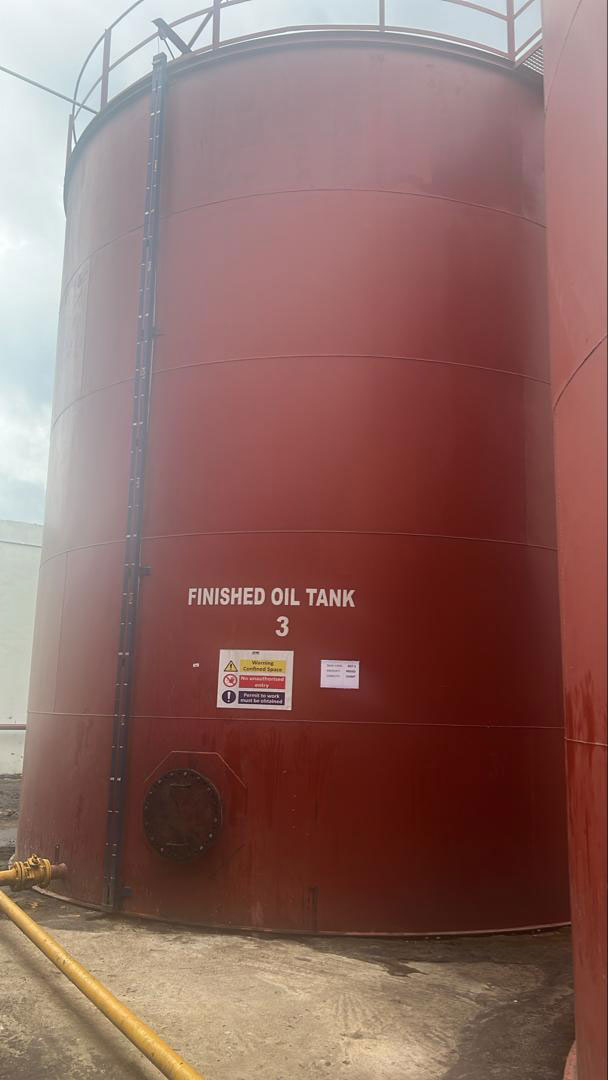
An uninsulated dome top has two implications. First, the instrument sees ambient temperature variation. The SDRD82 housing is rated for -40°C to 80°C ambient, which covers any outdoor installation in Lagos or similar climates comfortably. Second, if the dome is arched, avoid mounting on the apex. A curved top causes multiple reflections (the radar sees the dome surface as an additional target) and degrades accuracy. Mount at a position offset from center, keeping at least 200mm clearance from the vessel wall.
If the tank has internal structures like a suction pipe or heating coil, perform a virtual echo learning sequence after installation. This maps out fixed false targets and removes them from the measurement. The SDRD82 does this via the ViewPoint display module or through a HART handheld programmer connected across a 250-ohm resistor on the loop.
Cable entry requires an M20x1.5 gland. For outdoor installation, route the cable with a drip loop below the gland to prevent water ingress. The gland must be rated IP66 or better. The housing of the SDRD82 itself is IP67.
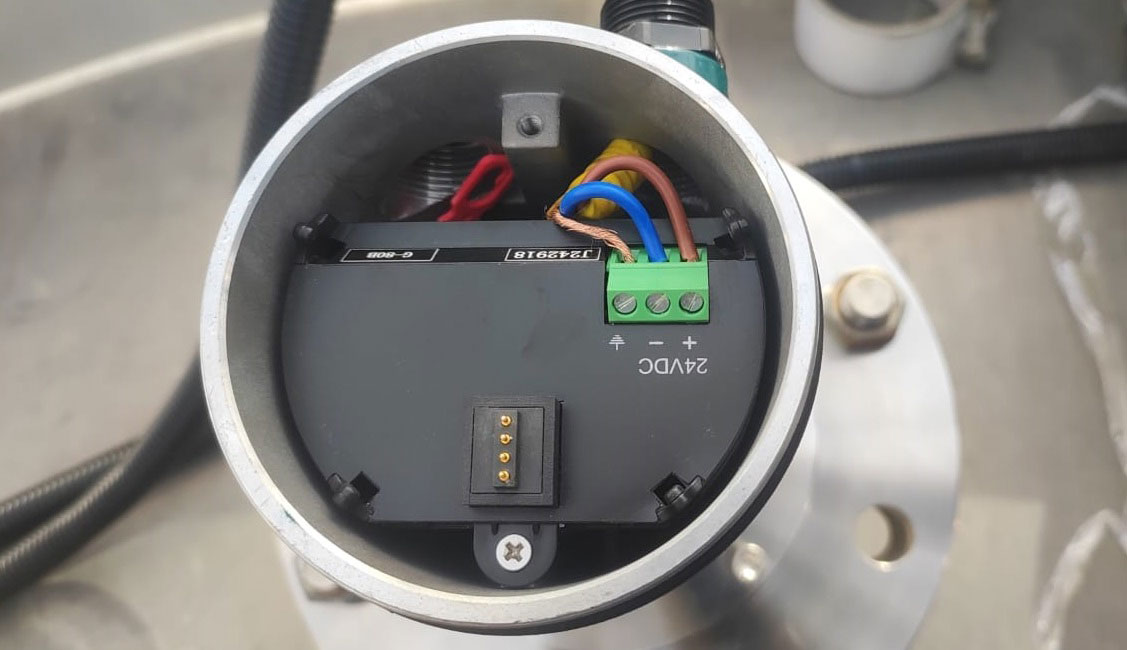
Wiring of 80G radar level transmitter
Two-wire 4-20mA / HART is the most common configuration for vegetable oil tank farms. The instrument draws power from the loop at 24V DC and returns the 4-20mA signal on the same pair. Total loop resistance can go up to approximately 1000 ohms at 24V supply. HART communication sits on top of the 4-20mA signal, so you can use a HART communicator or connect to a COMWAY converter for PC configuration without breaking the loop.
RS485 Modbus RTU is available as an alternative if the site uses a PLC or SCADA system that prefers digital fieldbus. In that case, the 4-wire configuration applies: separate power (24V DC) and RS485 signal pairs. The baud rate and slave address are configurable via the display module.
For explosion-proof requirements, the SDRD82 supports intrinsic safety certification (Ex ia IIC T6 Ga) with an FBS-2 safety barrier. Vegetable oil vapor does not typically classify the area as Zone 0, but some sites near the oil filling station may require Zone 1 classification. Confirm the area classification with the site's hazardous area document before finalizing the order.
Among level measurement instruments used for oil tanks, float gauges work but they involve a moving part in contact with oil, which requires periodic cleaning and can stick if the oil solidifies in cold weather.Not suitable for unmanned remote tank farms.
Guided wave radar (GWR) is an alternative for low-dielectric media, but the probe hangs into the tank. In large bulk storage tanks (50,000 liters and above), a 5-6 meter probe is expensive and creates a maintenance access issue. GWR also cannot be used if the tank has an internal agitator.
Ultrasonic level sensors are sensitive to vapor and foam. Edible oil tanks often have a low foam layer during filling, and the ultrasonic beam loses the surface temporarily. False low-level alarms during loading are a common complaint from operators who tried ultrasonic first.
80GHz FMCW radar avoids all three problems. No moving parts, no probe, and the signal penetrates light foam reliably enough for most storage applications.
| Specification | Metric | Imperial |
| Tank height (this application) | 5.7m | 18.7 ft |
| Max measuring range (SDRD82) | 30m | 98.4 ft |
| Accuracy | ±2mm | ±0.08 in |
| Beam angle (DN50 lens) | 6° | 6° |
| Beam angle (DN80 lens) | 3° | 3° |
| Process temperature range | -40°C to 200°C | -40°F to 392°F |
| Process pressure range | -0.1 to 2.5MPa | -14.5 to 362.6 psi |
| Power supply (2-wire) | 24V DC | 24V DC |
| Output | 4-20mA / HART / RS485 | 4-20mA / HART / RS485 |
| Nozzle max height (DN50) | 150mm | 5.9 in |
| Min wall clearance | 200mm | 7.9 in |
| Ambient temperature | -40°C to 80°C | -40°F to 176°F |
| Weight (SDRD82) | Approx. 8.0 kg | Approx. 17.6 lb |
Silver Automation Instruments supplies the SDRD82 80GHz radar level transmitter from stock for standard configurations. Lead time for flanged variants with PTFE lens antenna is typically 3 to 5 weeks for 6 units.
To prepare a quotation, please send the following details to sales@silverinstruments.com:
See our full 80G radar level meter range at silverinstruments.com for model selection guides, dimensional drawings, and ordering codes.