
English
Vortex is the cheaper, simpler pick for clean steam, gas, or liquid when volumetric flow is all you need. It needs a long straight pipe run and won't read below a minimum velocity. Coriolis measures mass flow directly, holds tighter accuracy, and handles viscous, dirty, or multi-phase fluids — but it costs more, gets heavy past DN150, and still struggles when gas carries significant liquid.
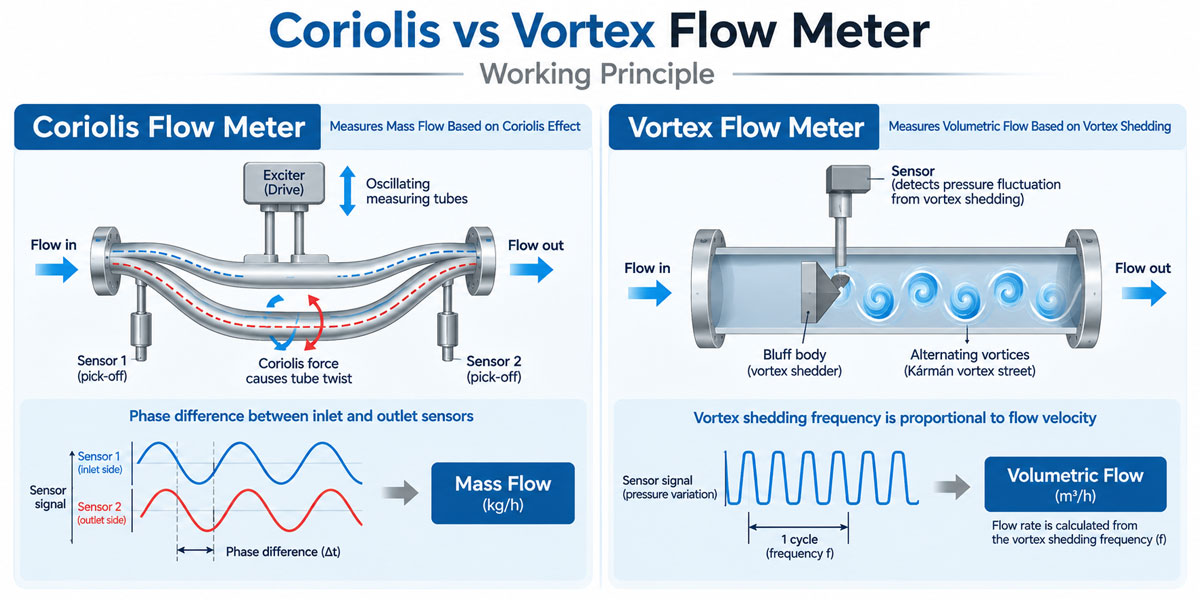
A vortex meter drops a bluff body into the flow. As fluid moves past it, vortices peel off alternating sides, and the rate at which they shed is proportional to velocity. Count that frequency, multiply by the pipe's cross-sectional area, and you have volumetric flow. Nothing moves inside the pipe, and the raw signal doesn't need density.
A Coriolis meter vibrates one or two tubes at their natural frequency. Fluid moving through a vibrating tube creates a Coriolis force that twists the tube slightly. That twist shows up as a phase shift between the inlet and outlet ends, and the shift is proportional to mass flow. The same vibration also gives you density, so one sensor outputs mass flow, volumetric flow, and density together.
The difference in one line: vortex infers flow from velocity and needs a known pipe area; Coriolis measures mass directly and doesn't care what density is doing.
Vortex flow meter:
Coriolis flow meter:
| Parameter | Vortex flow meter | Coriolis flow meter |
| What it measures | Volumetric flow (velocity x area) | Mass flow directly, plus density and temperature |
| Accuracy | ±1.0% (liquid), ±1.5% (gas/steam) | ±0.1% to ±0.5% of reading |
| Turndown ratio | 6:1 to 30:1 | 20:1 to 100:1 |
| Straight pipe run | Usually 10D to 20D upstream, 5D downstream | Not required for the meter itself; stress-free mounting is the real constraint |
| Size range | DN25 to DN300 in-line; DN250 to DN1000 insertion type | DN1 to DN300 full-bore; larger sizes get heavy and costly fast |
| Media temperature | -40°C to 250°C standard, up to 300°C extended | -50°C to 350°C |
| Pressure rating | 1.6 / 2.5 / 4.0 MPa and others | Up to 32 MPa on small sizes |
| Pressure drop | Low, about 1/4 to 1/2 of an orifice plate | Moderate, higher than vortex at the same line size |
| Cost | Lower | Higher, and the gap widens with pipe size |
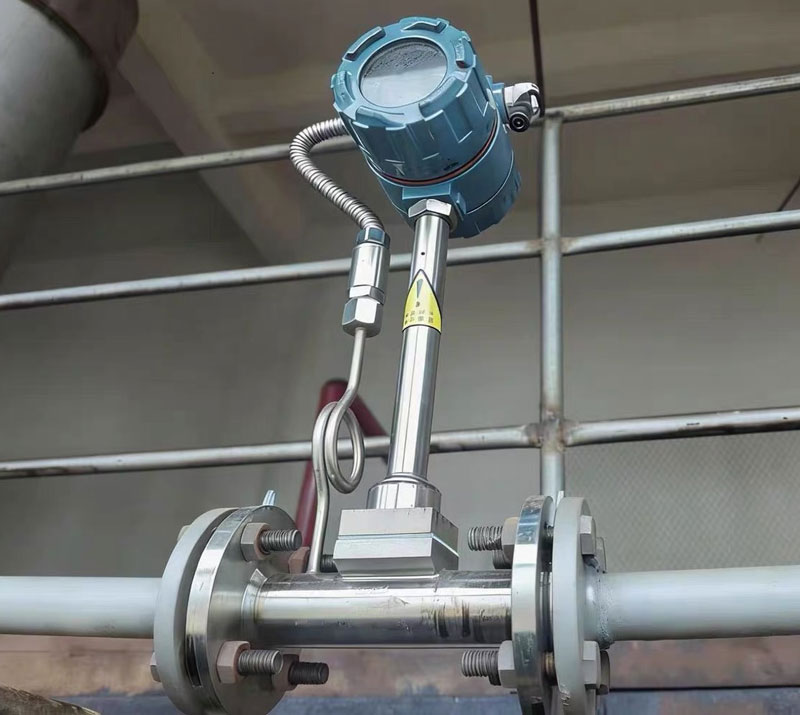
Vortex flow meter
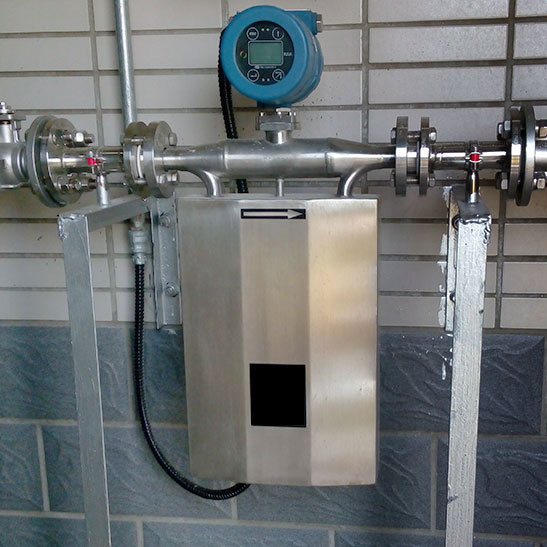
Coriolis effect mass meter
Most comparison articles stop at the table above. The real selection question in the field is what the fluid is doing when it's not a clean single phase.
For dry, saturated or superheated steam with no significant condensate, vortex is usually the practical choice. It's the cheaper meter, it doesn't need temperature and pressure compensation to be reasonably accurate on a well-behaved gas, and the technology has decades of steam service behind it. Coriolis works here too, but for straightforward dry steam it's often more meter than the application needs.
Two-phase flow is where the two technologies both struggle, just in different ways. A Coriolis meter measures whatever mass is moving through the tube. When a liquid slug passes through, the meter reports a mass flow spike that reflects the slug, not the underlying gas flow rate. It doesn't know the difference between "more gas" and "a slug of condensate." A vortex meter's shedding frequency tracks bulk velocity, so light liquid loading has less effect on the reading than you might expect, but heavy droplets or films still disturb the vortex pattern and shift the Strouhal number the meter relies on. Neither meter is a clean answer for significant liquid carryover in a gas line.
The practical fix is upstream separation, not a better meter. If liquid carryover is a known problem, a knockout drum or slug catcher ahead of the flow meter solves more than switching flow meter technology ever will. If separation isn't possible and liquid content is meaningful, expect degraded accuracy from either technology and specify accordingly, or look at differential pressure designs built for wet service.
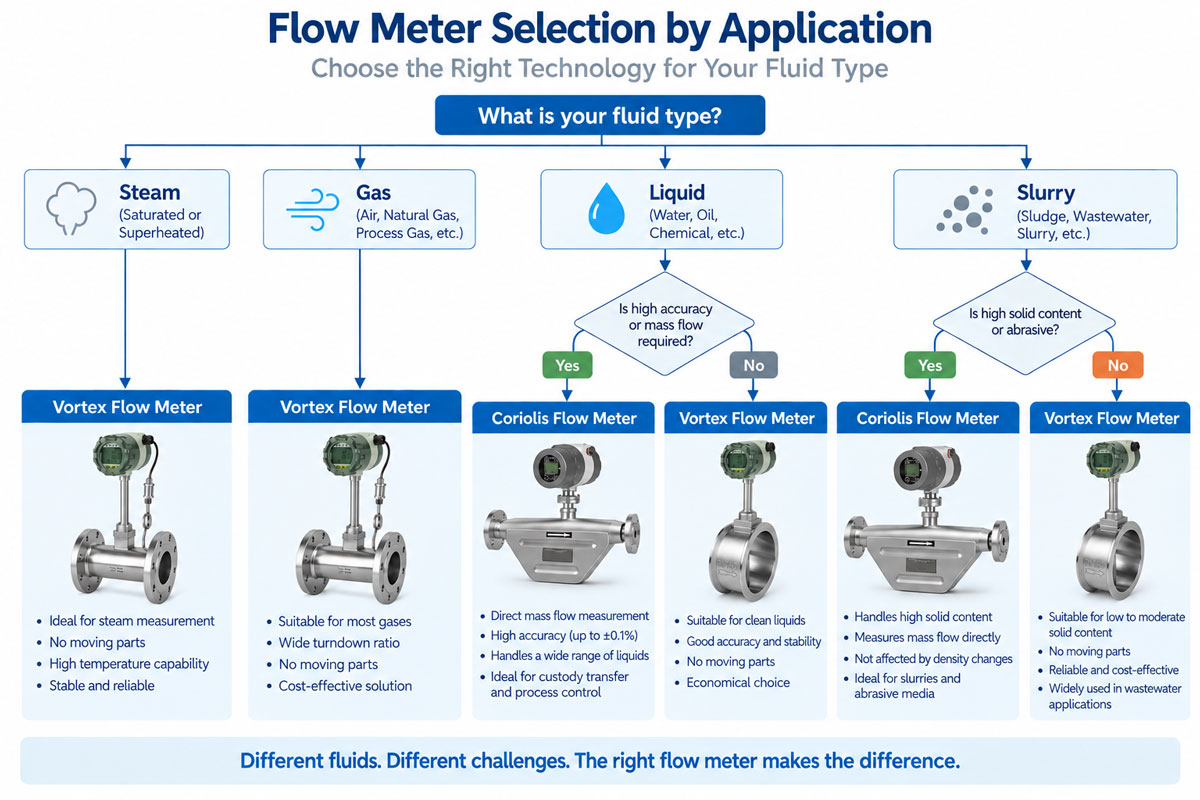
Steam.
Clean gas, single phase.
Liquid, low to moderate viscosity, clean.
Either meter works here.
Slurries, high viscosity, or fluids with entrained solids.
Custody transfer and trade measurement.
Choose Coriolis in almost every case, including crude oil and refined product transfer, LNG loading, and fiscal metering at terminals. Direct mass measurement with independently verifiable density output is what these applications need, and the accuracy vortex offers usually isn't tight enough to clear the bar.
Large line sizes, gas or steam, cost-sensitive.
Choose vortex; it's typical in HVAC chilled water and steam distribution across large campuses or plants. A DN300 Coriolis meter is heavy, expensive, and often has a long lead time, so vortex or insertion-type meters cover large ductwork at a fraction of the cost.
Send us your line size (DN), fluid type, operating temperature and pressure, and whether you need mass flow or volumetric flow. We'll recommend the right flow meters based on your actual process conditions, not a default.
WhatsApp: +86 18936759191 | sales@silverinstruments.com | https://www.silverinstruments.com/