
English
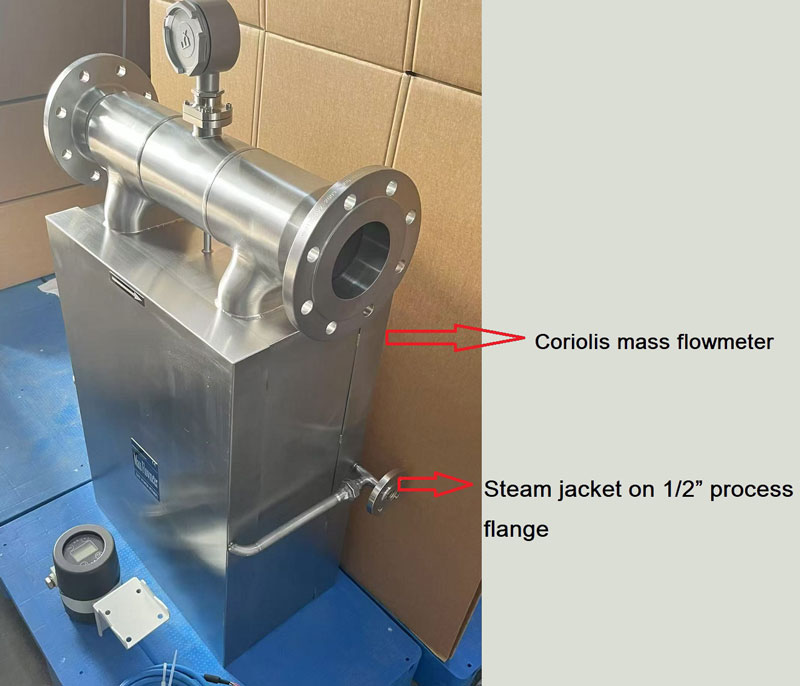
Asphalt and bitumen are solid or semi-solid at room temperature. They must be heated to remain fluid, so flow meters for these applications require a heating jacket to keep the medium flowing during shutdowns and restarts.
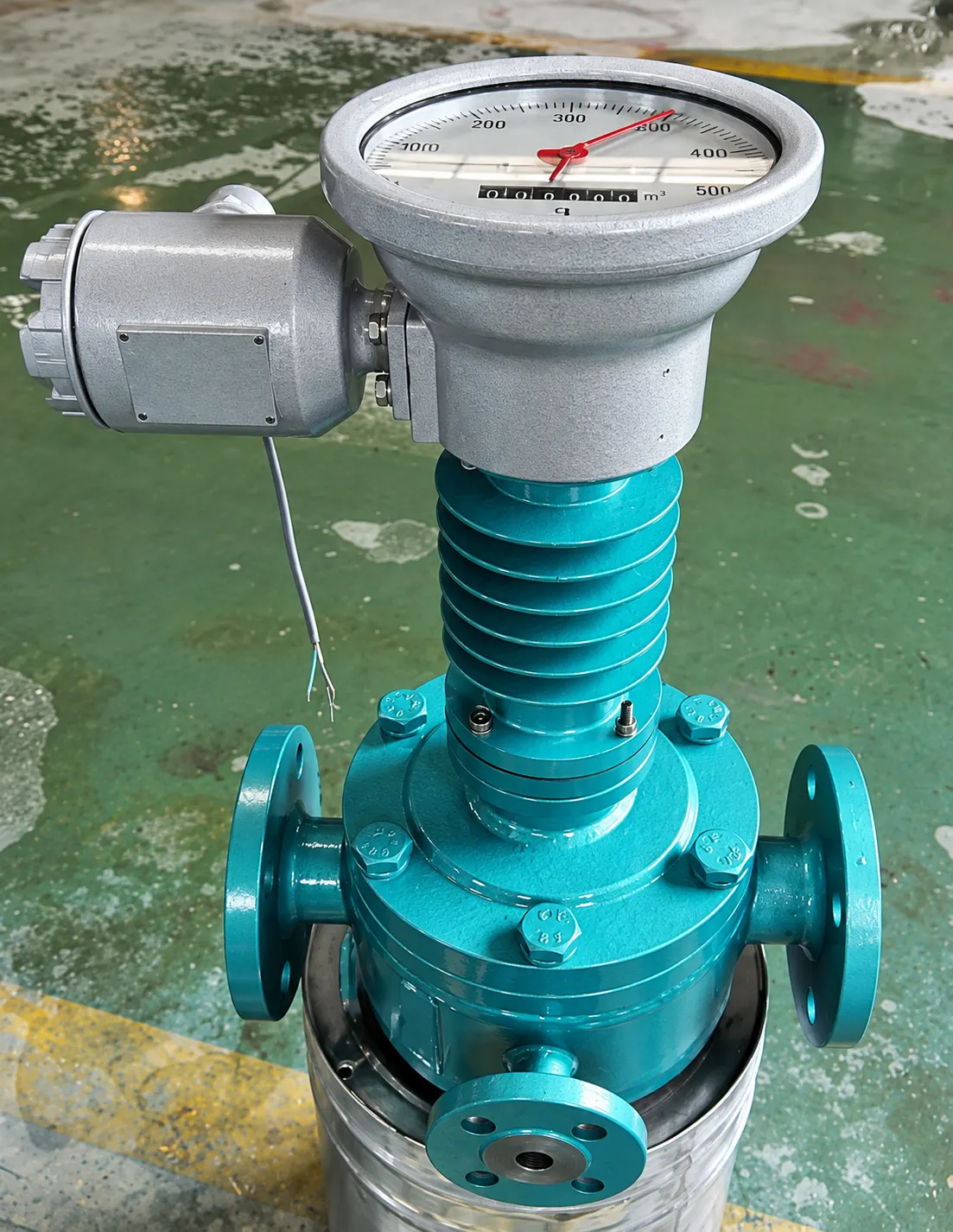
Two technologies are commonly used for asphalt and bitumen measurement: oval gear and Coriolis flow meters. An oval gear meter with a heating jacket offers a cost-effective solution, particularly for clean asphalt and smaller line sizes. For demanding applications, a Coriolis flow meter with a thermal jacket provides high measurement accuracy, stable performance across viscosity changes, and simultaneous measurement of mass flow and density.
Asphalt and bitumen viscosity changes significantly with temperature, so temperature control is an important consideration when selecting a flow meter. The meter must operate within a temperature range that keeps the asphalt sufficiently fluid for stable pumping and measurement. For Superpave asphalt binders, viscosity targets of approximately 170 mPa·s for mixing and 280 mPa·s for compaction are commonly used as reference points, although the actual operating temperature depends on the binder grade, formulation, and applicable material specification.
A heating jacket can help maintain the temperature around the meter body and reduce the risk of asphalt solidifying inside the measuring chamber during shutdowns or extended stops. This is particularly relevant for positive displacement meters such as oval gear meters, where solidified bitumen can restrict rotor movement and make restarting difficult. Steam, hot water, or heat-transfer oil can be used as the heating medium, with the jacket normally considered together with pipe insulation and heat tracing. Therefore, when selecting an asphalt flow meter, the required operating temperature, shutdown conditions, heating method, and asphalt viscosity should be specified along with the flow range, pressure, pipe size, and required accuracy.
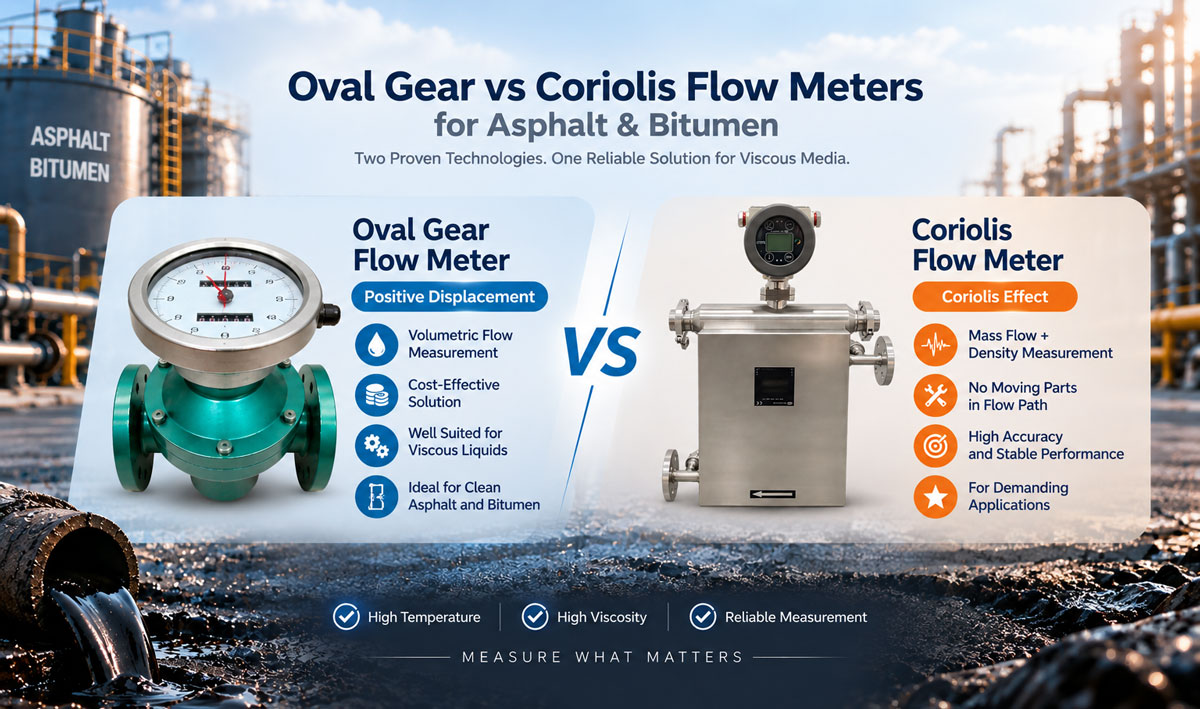
For asphalt and bitumen applications, two flow meter technologies are particularly relevant: oval gear and Coriolis. Both are suitable for high-viscosity fluids, but they use different measurement principles and offer different advantages when handling temperature-sensitive media.
An oval gear meter uses positive displacement measurement, with two gears rotating inside the measuring chamber as the asphalt passes through. This design is well suited to viscous liquids and can be equipped with a heating jacket to help maintain the required temperature around the measuring chamber. It is commonly considered when volumetric measurement is sufficient and equipment cost is an important factor.
A Coriolis meter measures mass flow through vibrating tubes and provides density information in addition to mass flow. With no mechanical gears in the flow path, it avoids the rotor and gear wear associated with positive displacement designs. This makes it worth considering for applications involving particulates, additives, tighter accuracy requirements, or a need for direct mass and density measurement.
The choice between the two depends on the actual application rather than the measurement principle alone.
Once the application requirements are clear, the choice between an oval gear meter and a Coriolis meter becomes easier to define. We compare the two Silver Automation Instruments options below to show where each technology fits in asphalt and bitumen applications.
For either option, we do not recommend selecting the meter based on viscosity and temperature ranges alone. We also need to consider the actual asphalt viscosity at operating temperature, minimum and maximum flow rates, pressure, and available pressure head before determining the final meter size and configuration.
| Parameter | Oval Gear + Jacket (LC Series) | Coriolis + Jacket (SH-CMF Series) |
| Measuring principle | Positive displacement, mechanical gear count | Vibrating tube, Coriolis effect |
| Reading | Volumetric flow | Mass flow + density |
| Accuracy | 0.2% to 0.5% | 0.1% to 0.5% |
| Viscosity limit | 2000 mPa·s | No inherent limit, but check pressure drop at high viscosity |
| Medium temperature | Standard: -20 to 60°C. High temp version: 60 to 200°C | -50 to 350°C |
| Particulate tolerance | Lower. Clean media recommended, filter advised | Higher. No moving parts in contact with fluid |
| Relative cost | Lower | Typically 2 to 4 times oval gear |
| Typical use case | Clean asphalt, small line size, cost sensitive | Particulate laden media, large line size, custody transfer, density readout needed |
The choice between oval gear and Coriolis becomes clearer when we look at three application variables.
Medium cleanliness: Clean refined asphalt can work well with either technology. When the medium contains significant particulates, modifiers, or reclaimed material, Coriolis becomes more attractive because it has no mechanical gears in the flow path.
Line size and budget: For smaller lines such as DN50 and below, oval gear is often considered when equipment cost is a key factor. For larger lines or applications requiring higher measurement accuracy, Coriolis may justify its higher initial cost.
Mass flow or density requirement: If the process only requires volumetric flow measurement, an oval gear meter may be sufficient. When direct mass flow or density measurement is required, Coriolis is the more suitable choice.
Consider an asphalt mixing plant discharge line operating at around 150°C with refined asphalt and relatively low particulate content. If the process mainly requires volumetric flow measurement, an oval gear meter with a heating jacket can be a practical solution.
If the same line regularly handles modified asphalt containing polymer additives or other solids, the mechanical components of an oval gear meter require more careful evaluation. In such a case, Coriolis may be worth considering because it eliminates rotor and gear wear inside the flow path.
A smaller tank farm discharge line handling stable, clean refined asphalt presents a different situation. When volumetric measurement is sufficient and equipment cost is a major consideration, an oval gear meter with a heating jacket may meet the application requirements without the additional features of a Coriolis meter.
Helical gear meters are another positive displacement option for viscous liquids. Their helical rotor design can be used for high-viscosity applications and larger flow rates, but they are less commonly considered than oval gear and Coriolis for the asphalt applications discussed here.
For most asphalt and bitumen projects, we would first evaluate oval gear and Coriolis against the actual operating conditions before considering an alternative meter technology.
The same basic selection logic can be applied to coal tar and modified bitumen, but we should not simply reuse standard asphalt parameters. Viscosity, operating temperature, solids content, corrosiveness, and material compatibility can change significantly between different media and formulations.
SBS modified bitumen, for example, can have substantially different viscosity and flow characteristics from the base bitumen. Where modifiers or other solids are present, we should evaluate their potential effect on mechanical wear as part of the meter selection.
Before sizing a meter for these media, we recommend confirming the actual viscosity at operating temperature, temperature range, pressure, flow range, and material compatibility.
Preheating: Before restarting a system after a shutdown, operators should circulate the heating medium and confirm that the asphalt has returned to a sufficiently fluid state. This reduces the risk of excessive mechanical load when measurement begins.
Piping: Both oval gear and Coriolis meters generally have less stringent straight-run requirements than vortex meters, which can simplify some retrofit installations. The manufacturer's installation requirements should still be followed for the selected meter.
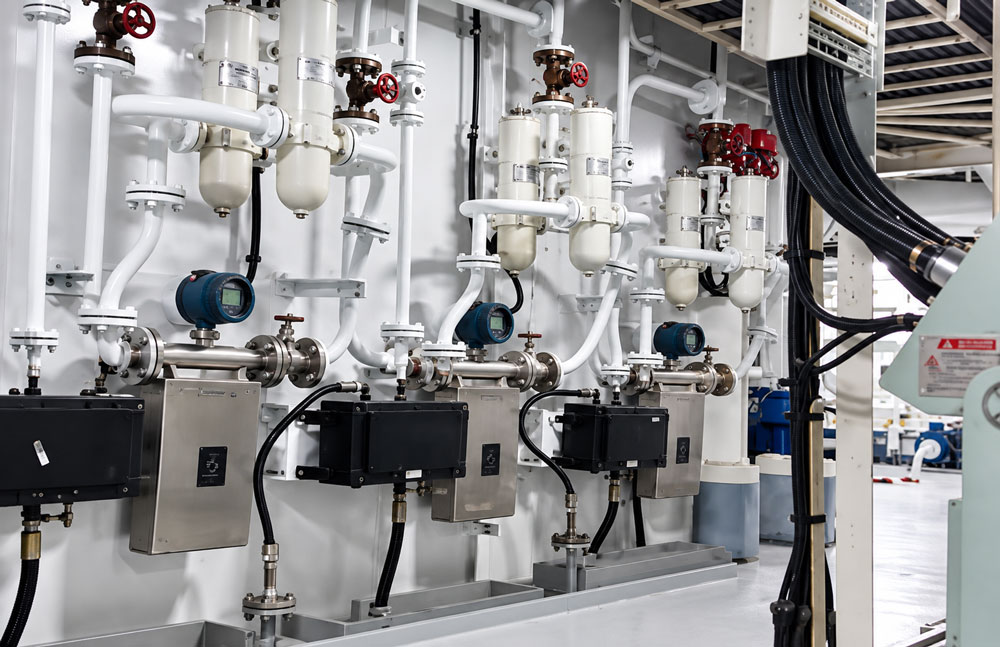
Heating medium: Steam, hot water, and heat-transfer oil can all be used for meter or pipe heating, depending on the required temperature and available plant utilities. The heating method should be selected together with insulation, heat tracing, ambient conditions, and shutdown requirements.
The right choice depends on the actual process conditions, not viscosity alone. Send us:
Email sales@silverinstruments.com or send us your P&ID. We will help check the suitable meter type and configuration.