
English
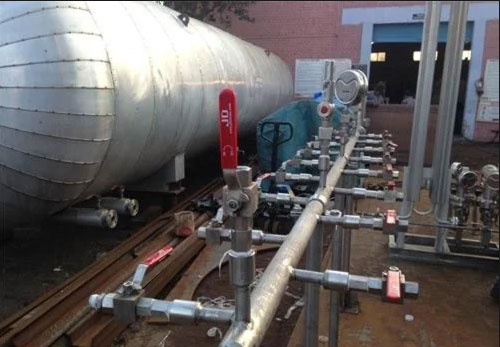
For filling CO2 cylinders with welding gas or multicomponent mixtures at 500 to 800 kg/h, DN15 line, 35 to 45 °C, and pressure ramping from 0.5 MPa up to 7 MPa, a DN15 Coriolis mass flow meter is the right tool. It reads true mass flow regardless of pressure swings, density changes, or temperature drift. Silver Automation Instruments supplies the SH-CMF-15 series rated to 10 MPa, with 4-20 mA plus pulse output that drives the filling PLC setpoint logic directly. Standard accuracy 0.5%, 316L wetted parts, explosion-proof transmitter, and flange process connection. Configured model code: SH-CMF-15-P4-H1-T1-O1O2-C3-E1-A4-B1-P1-M1-PC1.
A customer in the industrial gas business runs a cylinder filling station for welding mixtures. The process is straightforward on paper but punishing on the flow meter:
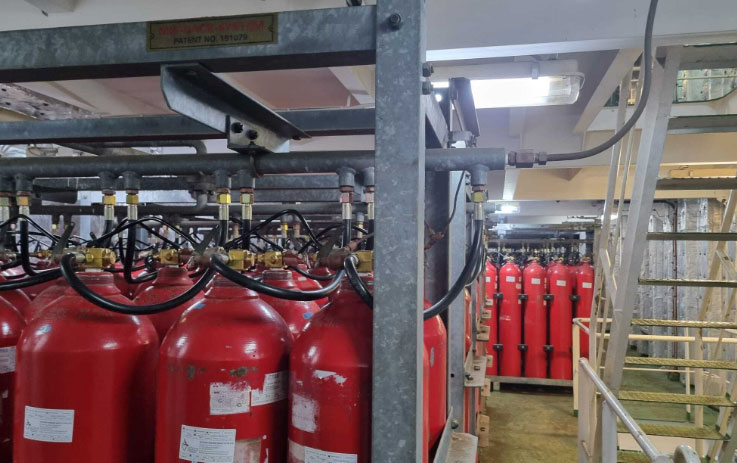
The fill cycle is the hard part. Pressure climbs by a factor of 14 in a single cycle. CO2 density at 0.5 MPa and 40 °C is around 9 kg/m³. At 7 MPa and 40 °C, the gas is approaching its supercritical region and density jumps above 250 kg/m³. Any meter that measures volume will be off by more than 25x across the cycle. The only way to dose mass accurately is to measure mass directly.
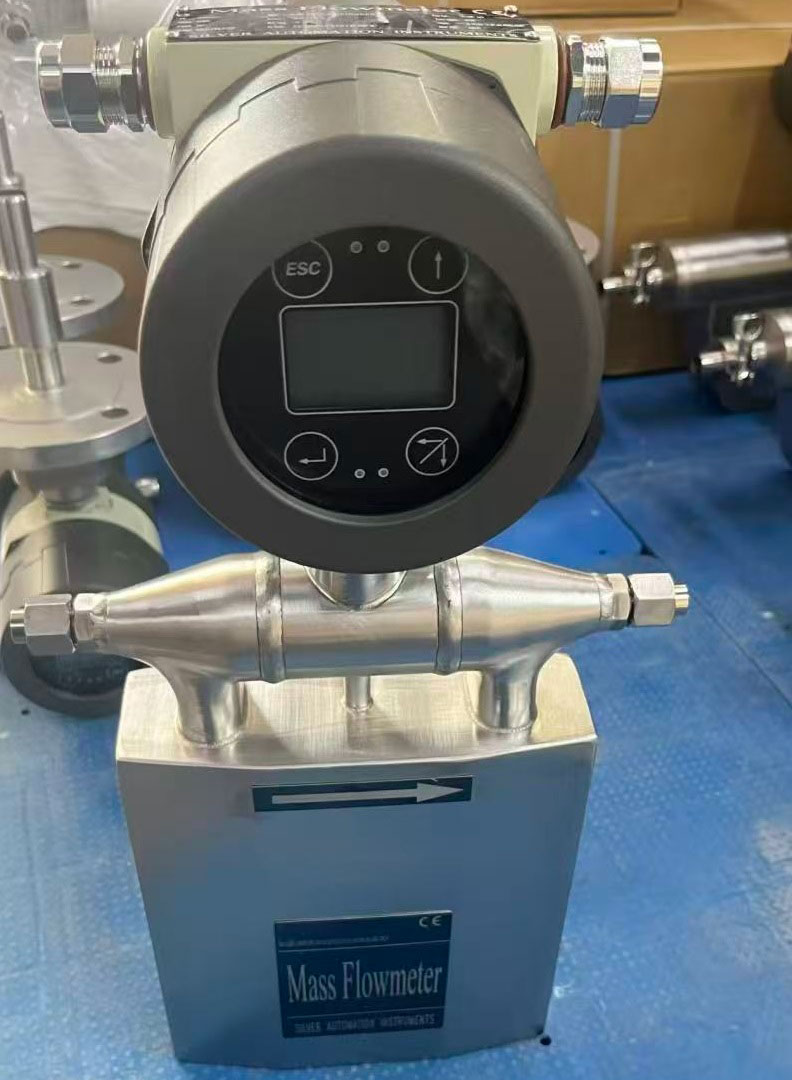
Coriolis flow meter is a perfect choice for CO2 Cylinder Filling
Below are the alternative flow meter for Coriolis flow meter in CO2 cylinder filling application:
• Thermal mass flow meter: works on gas but rated for low pressure, typically below 1 MPa. At 7 MPa the sensor will be destroyed. Also calibrated for a fixed gas composition. The customer also fills multicomponent welding mixtures (Ar/CO2, He/Ar/CO2), so the gas blend changes between batches. Thermal meters need a recalibration or a gas conversion factor for each blend, which adds error.
• Vortex flow meter: needs a minimum velocity, around 4 to 5 m/s for gas. At DN15 and 800 kg/h, CO2 velocity does sit in range, but vortex meters are volumetric. You then need pressure and temperature compensation to back out mass. Through a 14x pressure swing the compensation math drifts, especially near the CO2 phase boundary where the equation of state is nonlinear.
• Orifice plate or differential pressure: rangeability around 3:1, accuracy 1 to 2% of full scale. Acceptable for steady-state metering, useless for a fill cycle that starts at low pressure and ends near supercritical.
• Turbine: not suitable for cylinder filling. Pressure spikes from the initial 0.5 MPa to 2 MPa transient will shock-load the rotor bearings.
A Coriolis meter measures mass flow directly by sensing the Coriolis force on a vibrating tube carrying the fluid. The reading does not depend on pressure, density, temperature, or composition. Whether the cylinder is at 0.5 MPa or 7 MPa, whether the gas is pure CO2 or a welding mixture, the meter reports the same mass flow in kg/h. That is exactly what the filling PLC needs.
SH-CMF series Coriolis mass flow meter Data sheet link download>>
For this customer we configured the SH-CMF series at DN15. Breaking down the code:
• SH-CMF: Silver Coriolis Mass Flow Meter, U-tube design
• 15: DN15 sensor size, flow range 0 to 3 t/h (the 500 to 800 kg/h working point sits in the middle of the range, where Coriolis accuracy is best)
• P4: pressure rating 10 MPa, gives 30% margin above the 7 MPa peak
• H1: compact integral display, transmitter mounted on the sensor
• T1: process temperature range -50 to 150 °C
• O1O2: dual output, 4-20 mA analog plus pulse output. The 4-20 mA feeds the PLC analog input for live rate, the pulse output feeds a high-speed counter input for accumulated mass
• C3: HART communication on the 4-20 mA line, for remote configuration and diagnostics
• E1: explosion-proof transmitter housing, certified for hazardous area use (Ex d IIC T6)
• A4: accuracy 0.5% of mass flow reading
• B1: transmitter ambient -20 to 50 °C
• P1: 24 V DC power
• M1: 316L stainless steel tube material, compatible with dry CO2 and welding gas mixtures
• PC1: flange process connection
The PLC uses two signals from the meter, and that is why we specified dual output O1O2:
4-20 mA analog: scaled 0 to 1000 kg/h (or whatever range the operator prefers). This is the live rate. The PLC uses it to monitor the fill, detect a blocked line if rate suddenly drops, and ramp the inlet valve from cracked-open to fully open as the cylinder pressure builds.
Pulse output: each pulse represents a fixed mass, for example 0.1 kg. The PLC counts pulses on a high-speed counter input and compares the count against the setpoint (say, 25 kg for a standard welding cylinder). When the count hits the setpoint, the PLC closes the fill valve. Pulse counting is the right way to control batch totals because it does not drift the way an analog signal might.
The setpoint logic is simple: operator selects cylinder size, PLC loads the corresponding mass target in kg, opens the fill valve, watches the pulse counter climb, closes the valve at target. The Coriolis meter is the single instrument that makes the whole loop work.
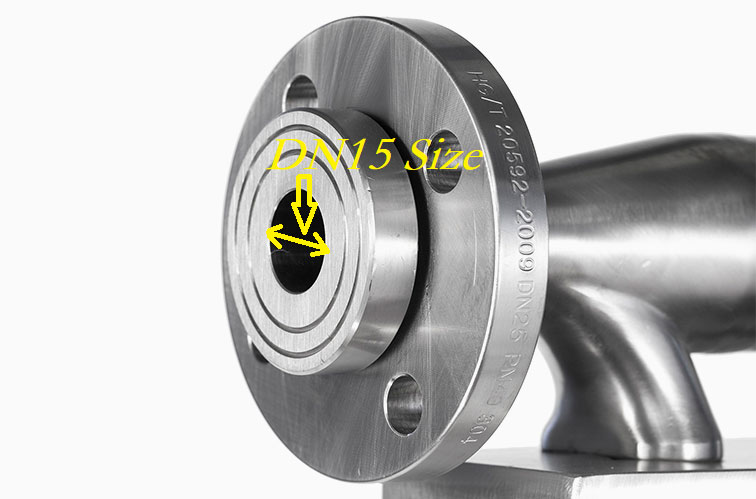
DN15 mass flow meter
At 800 kg/h peak flow and CO2 density of around 250 kg/m³ at the top of the fill cycle, volumetric flow is about 3.2 m³/h. At DN15 (15 mm inner diameter), gas velocity is around 5 m/s at peak. That sits in the comfortable range for a Coriolis tube: fast enough to give a good signal, slow enough to avoid tube erosion or excessive pressure drop.
Going to DN10 would push velocity above 11 m/s and add maybe 0.3 MPa of pressure drop, which on this duty is not critical (the supply pressure is much higher than the cylinder), but it would also shorten tube life. Going to DN20 would drop velocity to about 3 m/s at the low end of the fill cycle, which is fine, but the meter cost is higher and the lower velocity slightly reduces signal-to-noise at the start of the cycle when pressure is only 0.5 MPa and gas density is low.
DN15 is the right balance for 500 to 800 kg/h CO2 cylinder filling.
A few things we always tell customers building a filling skid around a Coriolis meter:
1. Mount the sensor vertically with flow upward if there is any chance of liquid CO2 in the line. Even small slugs of liquid will momentarily change density and add noise to the reading. Vertical-up flow lets any liquid drain back to the source.
2. Use a bypass loop with isolation valves. CO2 cylinder filling stations need regular cleaning and inspection. A bypass lets the line stay in service while the meter is removed for calibration.
3. Bond and ground the sensor. Explosion-proof rating only protects against ignition inside the housing. Static charge on the gas piping needs a separate ground path. We supply a grounding lug as standard.
4. Zero the meter at line pressure, not at atmospheric. Coriolis meters have a small zero offset that shifts slightly with operating pressure. For a meter that swings from 0.5 to 7 MPa, we recommend zeroing at the mid-range pressure (around 3 to 4 MPa) with no flow, valves closed both sides.
5. Pulse output wiring: keep the cable short (under 30 m) and shielded. The pulse signal is digital but the PLC counter input is sensitive to noise on long runs.
Pure CO2 filling is the simple case. The customer also fills Ar/CO2 mixtures (80/20, 75/25, 90/10 are standard welding blends) and tri-mixes like He/Ar/CO2 for stainless steel welding. Each blend has different density behavior under pressure.
A thermal or volumetric meter would need a separate calibration curve for each gas blend. The customer would have to either keep multiple meters or accept large errors when switching products. A Coriolis meter sees mass directly, so the same instrument fills any blend without recalibration. The density output from the Coriolis (free of charge as a secondary variable) also lets the operator verify that the blend has not separated in the bulk storage, which sometimes happens on multicomponent mixtures stored for long periods.
This is the case where the higher cost of a Coriolis meter pays back fast. One meter, all blends, no recalibration when switching products.
The SH-CMF-15 with full explosion-proof configuration, 10 MPa pressure rating, HART, dual output, and 316L flange connections lands between USD 6,800 and 8,500 depending on flange standard (ANSI 600# or DIN PN100) and surface protection. Lead time is 25 to 35 working days from order confirmation. We ship EXW Shanghai or DDP to most destinations in Southeast Asia, the Middle East, Africa, and Latin America.
Factory Calibration certificate is included. Each meter is wet-calibrated on water as the reference fluid, with a documented mass flow accuracy of 0.1% on water. The 0.5% accuracy figure on the customer datasheet is the published spec for gas service, which accounts for typical installation effects and density uncertainty in gas applications.
If you are building or upgrading a cylinder filling station for CO2, welding gas, or multicomponent mixtures, send us:
We will reply within one working day with a recommended Coriolis model code, accuracy statement, price, and lead time. For high-pressure or supercritical CO2 applications above 10 MPa, ask about the SH-CMF-P5 (16 MPa) and SH-CMF-P6 (25 MPa) options.
we will contact you within 24 hours..