English
Coriolis Flow Meter for Liquid CO2: Selection Guide and Application Examples
For liquid CO2 measurement, a Coriolis mass flow meter is the most reliable choice across cryogenic (-78 degC), pressurized, and supercritical conditions. It measures true mass flow directly, requires no density or temperature correction, and handles the phase sensitivity of CO2 better than any volumetric technology. Recommended wetted material is SS316L; pipe sizes range from DN6 to DN50 depending on flow range.
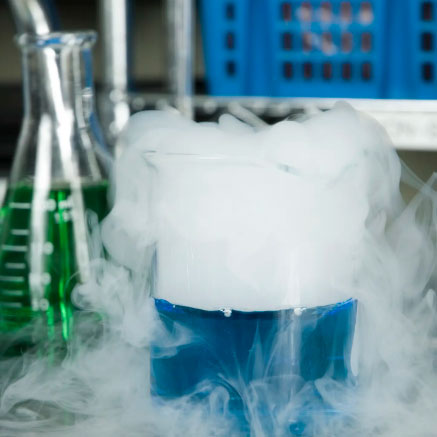
CO2 behaves differently from most industrial liquids. At atmospheric pressure it sublimates directly from solid to gas at -78.5 degC. To keep it liquid, you need either cryogenic temperature (below -56.6 degC at the triple point) or elevated pressure above 5.18 bar. Many industrial applications use both: high-pressure liquid CO2 at ambient temperature for carbonation and fire suppression, or cryogenic liquid CO2 at low pressure for research and food freezing.
This dual-condition nature creates problems for conventional flow meters. A meter sized for ambient-temperature high-pressure CO2 will not handle cryogenic service. A thermal mass flow meter designed for CO2 gas will fail immediately on contact with liquid. Even among meters that can handle the temperature or pressure, most measure volume, and the density of liquid CO2 varies significantly with both temperature and pressure. Without real-time density correction, a volumetric reading can carry errors of 5% or more.
Turbine flow meters measure volume. They need density compensation to derive mass, and bearing lubrication degrades fast below -20 degC. In cryogenic liquid CO2 service, bearing life is short and maintenance intervals are inconveniently frequent for production environments.
Oval gear positive displacement meters work well for viscous fluids but liquid CO2 viscosity is around 0.10 to 0.12 cP. That is too low to maintain the gear-to-housing seal. Internal leakage past the gears increases at low viscosity, and measurement error rises accordingly. Flash evaporation risk at the meter outlet is also real if back pressure is not controlled.
Vortex flow meters need a minimum Reynolds number to shed stable vortices. At low flow rates through small-bore pipe, this minimum is not always met, and the low-end accuracy of a vortex meter in liquid CO2 service is unreliable. They also measure volume.
Ultrasonic flow meters can work for high-pressure liquid CO2 in large pipes (DN50 and above) where straight-run requirements are met. For small-bore cryogenic applications, clamp-on ultrasonic is ruled out by the insulation layer, and inline ultrasonic at cryogenic temperature requires special transducer materials that raise cost significantly.
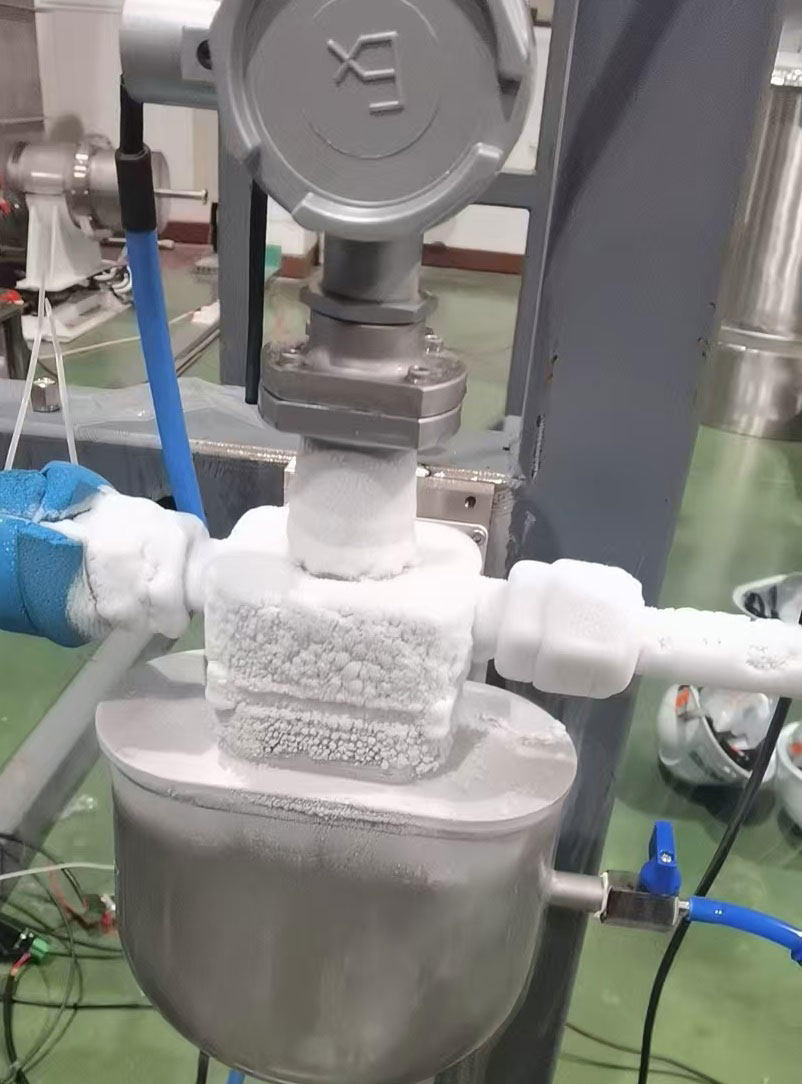
The Coriolis principle measures mass flow directly through inertial force on a vibrating tube. It does not rely on fluid velocity, viscosity, or density assumptions. That independence is exactly what makes it suitable for liquid CO2, where density and viscosity change with temperature and pressure in ways that defeat volumetric meters.
A Coriolis meter for liquid CO2 uses SS316L or Hastelloy C-22 tubes rated to -200 degC and working pressures up to 100 bar depending on model. Accuracy is typically 0.2% of reading for mass flow and 0.5% for density. Repeatability is 0.1%. The meter also outputs real-time fluid density, which is useful for detecting phase change events at the measurement point.
Standard outputs are 4-20 mA for analog mass flow and density, pulse output for batch totalization, and RS-485 Modbus RTU for PLC or SCADA integration. HART protocol is available on most models. For food and beverage CO2 service, tri-clamp process connections and material certification are available.
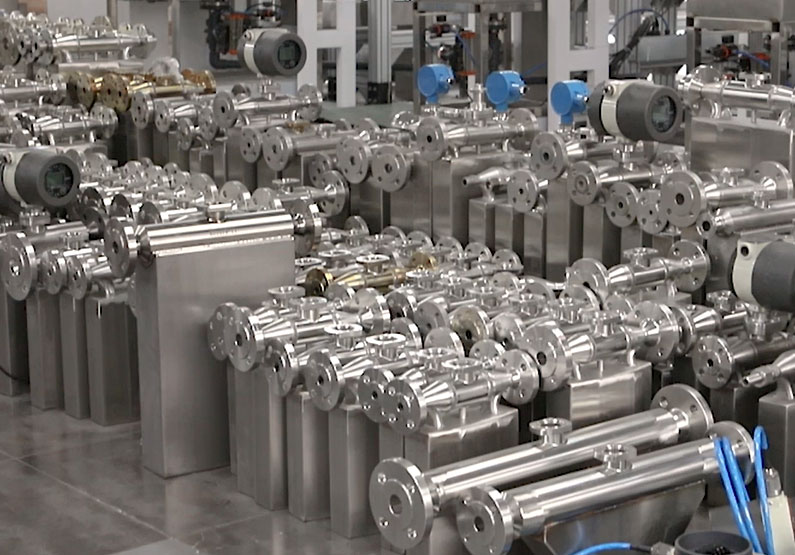
Choose correct size for liquid CO2
Coriolis meters are sized on mass flow rate, not pipe diameter. The pipe connection size follows from the required flow range and acceptable pressure drop. A common mistake is specifying meter size to match existing pipe size rather than to match the flow range. An oversized Coriolis meter loses low-end accuracy; an undersized one creates excessive pressure drop that can trigger flash evaporation.
For cryogenic applications, select a model with a low-temperature electronics option. The transmitter enclosure must be rated for the ambient temperature range if located near the cold section of the line.
Food and beverage carbonation uses high-pressure liquid CO2 at near-ambient temperature, typically 20 to 25 bar. Accuracy and hygiene are the main requirements. DN15 to DN25 Coriolis meters with tri-clamp connections are standard here.
Fire suppression systems store CO2 at high pressure (around 55 to 60 bar at ambient temperature) and release it rapidly. Flow meters on these systems must handle fast transients. Coriolis meters with high-frequency response and batch totalization output are used for cylinder filling verification.
Supercritical CO2 extraction (CO2 above 31.1 degC and 73.8 bar) is used in coffee decaffeination, hop extraction, and pharmaceutical processing. Coriolis meters rated to 200 bar with Hastelloy wetted parts are used in this service.
Cryogenic research and lab-scale processes use liquid CO2 at -78 degC directly from dry ice or cryogenic storage tanks. This is the most demanding condition for a flow meter. Small-bore DN6 to DN15 Coriolis meters with cryogenic-rated tube material are the correct selection.
A construction technology research company in Southeast Asia contacted us recently. They run lab-scale concrete curing experiments using liquid CO2 dosing and needed to know exactly how much CO2 mass entered each test batch. Their setup: 1/2 inch pipe, operating pressure below 100 psi (6.9 bar), flow range 5 to 80 L/min from a small cryogenic tank in a 28 degC warehouse.
The CO2 exits the tank at approximately -78 degC. That rules out turbine, oval gear, and thermal meters for the reasons described above. The 16:1 turndown (5 to 80 L/min) rules out vortex at the low end. A DN15 SS316L Coriolis meter covers the full range with 0.2% accuracy and outputs kg/h directly to their data logger via Modbus RTU. No density correction step needed in their software.
We recommended verifying that inlet pressure stays above the CO2 saturation pressure throughout the run to prevent flash evaporation at the meter inlet. At -78 degC, liquid CO2 is already near atmospheric pressure saturation, so back pressure control at the meter outlet is important for stable readings.
SS316L is standard for most cryogenic liquid CO2 applications down to -196 degC. For aggressive or high-purity applications, Hastelloy C-22 provides better corrosion resistance. PTFE seals are required; standard Buna-N or EPDM seals fail at cryogenic temperature.
Yes. The meter's real-time density output will drop sharply if CO2 flashes to gas inside the tube. Some PLC configurations use the density signal to trigger an alarm or pause totalization when density falls below a set threshold, which is useful for accurate batch accounting.
Standard DN15 models are rated to 100 bar. High-pressure versions for supercritical CO2 extraction are available to 200 bar and 400 bar. Specify your maximum allowable working pressure (MAWP) when requesting a quote.
CO2 is not flammable, so ATEX is not required for the meter in a CO2-only environment. If the meter is installed in a zone classified for other flammable media nearby, check the area classification drawing. Standard IP67 protection is sufficient for most industrial and lab installations.
Standard: 4-20 mA (mass flow), 4-20 mA (density), pulse output (totalization), RS-485 Modbus RTU. Optional: HART protocol, PROFIBUS DP, For lab data acquisition, Modbus RTU over RS-485 is typically the simplest to implement with a USB-RS485 adapter and standard logging software.
Send the following parameters for a same-day model recommendation:
Contact Silver Automation Instruments at silverinstruments.com with the parameters above.
we will contact you within 24 hours..