
English
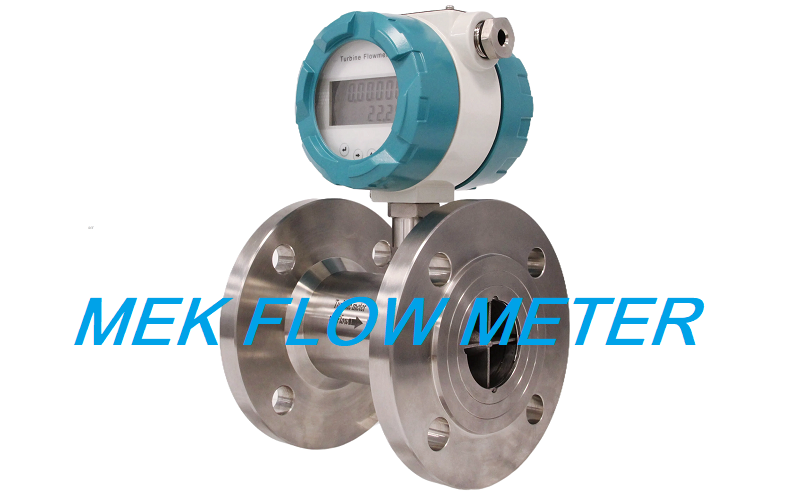
MEK (methyl ethyl ketone, also called 2-butanone) is a low-conductivity, low-viscosity, flammable organic solvent. You cannot measure MEK with a magnetic flow meter. The conductivity is too low.
The three real options, listed from the lowest cost to the highest accuracy, are turbine flow meters, oval gear positive displacement meters, and Coriolis mass flow meters. Each technology has a clear best fit:
Turbine flow meter (TUF) — budget option for clean MEK in steady-flow applications.
Oval gear flow meter — mid-range option for small-batch dosing and drum filling.
Coriolis flow meter — premium option for blending, custody transfer, and high-value batches.
In this article, we will explain what makes MEK hard to measure, which technology fits which application, and what you need to send us to get a fast quotation.
Water is the easy case. It conducts electricity. It has a fixed density near 1000 kg/m³. Almost every flow technology works on it. MEK breaks most of these assumptions.
Three properties matter for sizing:
Density at 20 °C is about 805 kg/m³. Not 1000.
Viscosity at 20 °C is about 0.43 cP. Very low. Almost as low as gasoline.
Electrical conductivity is below 5 µS/cm. Sometimes far below.
The conductivity number rules out the magnetic flow meter. A magnetic flow meter needs at least 5 µS/cm to operate. Most manufacturers recommend a safety margin above 20 µS/cm. MEK does not reach that level.
Some buyers still ask for a magnetic flow meter because it is cheap and they have used it for water. We do not recommend this. The meter will read zero or jump randomly. We have seen this on customer sites many times.
MEK is also flammable. The flash point is around minus 9 °C. Any meter installed on an MEK line in a closed plant must carry an ATEX or IECEx hazardous-area certificate. This is a strict requirement.
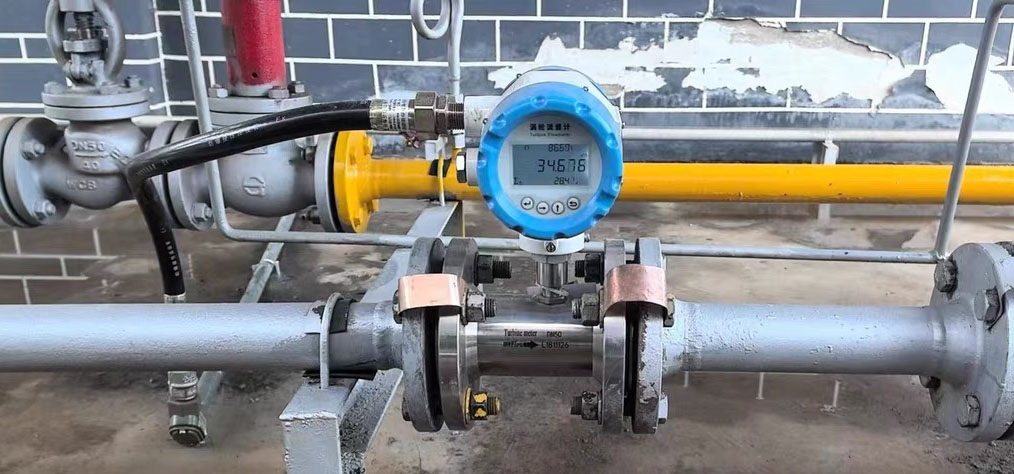
The turbine flow meter uses a small rotor inside the pipe. Liquid passes through and spins the rotor. The rotation speed is proportional to the flow rate. A magnetic pickup counts the rotor pulses and converts them to volume.
Turbine meters work very well on MEK because MEK is clean and has low viscosity. There are no fibers, no solids, and no risk of build-up on the rotor. The repeatability is excellent, usually ±0.1%. The total accuracy is typically ±0.2% to ±0.5% of reading after factory calibration.
Wetted parts for MEK service must be 316L stainless steel for the body and tungsten carbide or ceramic for the bearings. Standard PTFE seals are required. Do not accept a turbine meter with PTFE-replacement seals such as Viton or Buna-N for MEK service.
Best for: continuous MEK transfer lines, recirculation loops, tank-to-tank pumping, and any application with steady flow above 10% of the maximum range.
Limit: not suitable for pulsating flow. Not suitable when the line frequently runs at low flow rates. The rotor bearings wear out over time and need replacement every one to two years in continuous service.
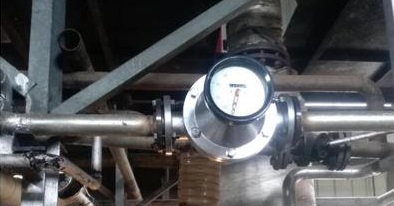
A mechanical meter with two oval gears that rotate as the liquid passes through. Each turn equals a known volume. The meter counts the turns and reports the total volume.
Because MEK has low viscosity, oval gear meters require tight tolerances and proper material selection. PTFE seals and stainless steel bodies are required. MEK attacks many elastomer materials. If a supplier offers Buna-N or Viton seals for MEK, refuse the offer.
The advantage over a turbine meter is that an oval gear meter works at very low flow rates and gives the same accuracy across the full range. It is the standard choice for filling, dosing, and any application where the batch volume must be exact.
Best for: small-batch dosing, drum filling, lab applications, IBC filling stations, and budget projects under USD 1200.
Limit: moving parts wear out over time. Recalibration is needed every one to two years. Higher pressure drop than turbine or Coriolis. Not suitable for line sizes above DN50.
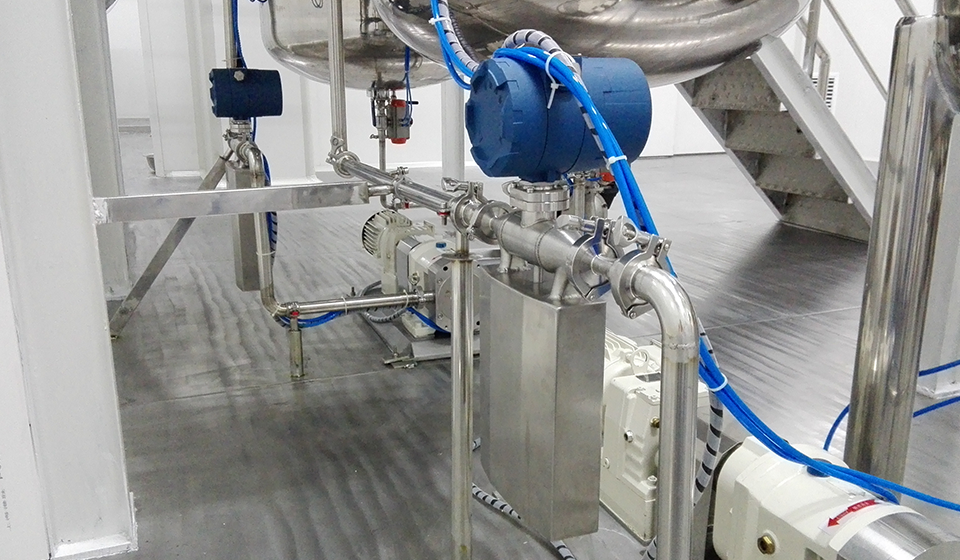
The Coriolis meter measures mass flow directly. It uses a vibrating tube to detect the Coriolis force generated by the moving liquid. The frequency shift of the tube is proportional to the mass flow rate. Density and temperature are measured at the same time.
This is the most accurate option for MEK. Accuracy is typically ±0.1% to ±0.2% of reading. There are no moving parts in contact with the liquid. The calibration is stable for five years or more. The meter also reports density in real time, which is useful when MEK is blended with other solvents and you want to verify the mixture ratio.
The trade-off is the price. A Coriolis meter for a DN15 MEK line costs three to five times more than a turbine of the same size. For high-value batches, custody transfer, and any line where measurement errors translate directly into product loss, the higher cost is justified.
Best for: batching, custody transfer, blending lines, high-value solvent metering, and any application where one meter must report mass, volume, density, and temperature together.
Limit: higher purchase price. Sensitive to entrained gas bubbles. The pipe must stay full of liquid. Heavier and physically larger than a turbine of the same line size.
| Item | Turbine | Oval Gear | Coriolis |
|---|---|---|---|
| Accuracy | ±0.2% to ±0.5% | ±0.5% | ±0.1% to ±0.2% |
| Reads mass directly | No | No | Yes |
| Reads density | No | No | Yes |
| Handles low viscosity | Excellent | Good | Excellent |
| Moving parts | Yes (rotor) | Yes (gears) | None |
| Pressure loss | Low | Medium | Low to medium |
| ATEX / IECEx version | Available | Available | Available |
| Typical price (USD) | 200 to 1200 | 500 to 1800 | 3000 to 8000 |
| Best for line size | DN10 to DN200 | DN8 to DN50 | DN6 to DN100 |
| Recalibration cycle | 1 to 2 years | 1 to 2 years | 5+ years |
MEK is aggressive on rubber. Buna-N (NBR) and EPDM swell and fail within weeks. Viton (FKM) is also not safe with MEK over time.
The only two seal materials we recommend are PTFE and PEEK. Wetted-part metals should be 316L stainless steel. For high-purity applications, Hastelloy is recommended.
If a supplier quotes you a "general purpose" flow meter for MEK without asking about seal material, do not buy from them. The meter will leak within three months.
Last year a paint manufacturer in Southeast Asia asked us to specify a meter for MEK feed into a 5000 L reactor. The flow rate was 200 L/h normal and 350 L/h peak. The pipe was DN15, already installed. The pressure was 3 bar. The plant was classified as ATEX Zone 1.
The customer first asked for a turbine flow meter to save cost. We checked the flow profile and found that the line ran intermittently. Each batch dose was about 50 liters, finished in 15 minutes. After each batch, the line sat empty for 30 to 60 minutes before the next dose. This stop-and-start pattern is exactly what wears out turbine bearings.
We sized a DN10 Coriolis meter instead. We chose one size below the pipe because the velocity in DN15 was too low for accurate readings. Material was 316L. Seals were PTFE. The unit was ATEX Zone 1 certified. The output was 4-20 mA plus pulse for the reactor PLC.
The meter was installed in three hours and calibrated on site. It has been running for fourteen months with zero drift. The customer now uses the same model on three other solvent lines.
If you want a price and a model number within 12 hours, please send the following information:
Solvent name and purity (pure MEK, or a blend)
Flow rate: minimum, normal, maximum (L/h or kg/h)
Pipe size (DN or inch)
Operating pressure (bar or MPa)
Operating temperature (°C)
Flow pattern: continuous, intermittent, or batch dosing
Hazardous area classification (ATEX Zone 1, Zone 2, or none)
Output signal needed (4-20 mA, pulse, HART, Modbus RTU)
Power supply (24 VDC, 220 VAC, or battery)
If you do not know all of these, send what you have. We will fill in the rest with reasonable assumptions and tell you what we assumed.
We ship MEK-rated flow meters to coating, adhesive, ink, and pharmaceutical plants in more than 40 countries. All meters are ATEX, IECEx, and CE certified. Lead time is 7 to 14 days for stocked configurations.
The fastest way to get an accurate quotation is to send us a complete RFQ. Below are four real RFQ examples from different industries. Use the closest one as a template and replace the values with your own.
| Application | MEK dosing into a 5000 L coatings reactor |
| Fluid | Pure MEK, 99.5% purity |
| Flow rate | Min 50 L/h, normal 200 L/h, peak 350 L/h |
| Pipe size | DN15 carbon steel, already installed |
| Pressure | 3 bar working, 6 bar design |
| Temperature | 25 °C ambient, no heating |
| Flow pattern | Batch dosing, 50 L per batch, 30 to 60 min idle between batches |
| Hazardous area | ATEX Zone 1, IIB T3 |
| Output signal | 4-20 mA + pulse output for PLC |
| Power supply | 24 VDC |
| Recommended meter | DN10 Coriolis mass flow meter, 316L wetted parts, PTFE seals, ATEX Zone 1 transmitter |
| Application | MEK transfer from bulk tank to 200 L drums |
| Fluid | MEK, technical grade |
| Flow rate | Min 100 L/h, normal 600 L/h, max 800 L/h |
| Pipe size | DN25 stainless steel |
| Pressure | 2 bar working |
| Temperature | 20 to 30 °C |
| Flow pattern | Intermittent, one drum filled every 15 to 20 minutes |
| Hazardous area | ATEX Zone 2 |
| Output signal | Pulse output to a batch controller with preset stop |
| Power supply | 24 VDC, less than 5 W |
| Recommended meter | DN25 oval gear flow meter, 316L body, PTFE seals, ATEX Zone 2 pulse output |
| Application | MEK feed from storage tank to mixing vessel, 24/7 operation |
| Fluid | Pure MEK |
| Flow rate | Constant 2000 L/h |
| Pipe size | DN50 stainless steel |
| Pressure | 4 bar |
| Temperature | 15 to 35 °C |
| Flow pattern | Continuous, steady flow above 50% of range |
| Hazardous area | ATEX Zone 1 |
| Output signal | 4-20 mA HART |
| Power supply | 24 VDC loop powered |
| Recommended meter | DN50 turbine flow meter, 316L body, tungsten carbide bearings, PTFE seals, ATEX Zone 1 |
| Application | MEK blended with ethyl acetate, ratio must be verified in real time |
| Fluid | MEK + ethyl acetate blend, ratio 70:30 |
| Flow rate | Min 20 kg/h, normal 80 kg/h, max 120 kg/h |
| Pipe size | DN15 |
| Pressure | 5 bar |
| Temperature | 20 °C, jacketed line |
| Flow pattern | Continuous with frequent recipe changes |
| Hazardous area | ATEX Zone 1, EHEDG sanitary preferred |
| Output signal | Modbus RTU, mass flow + density + temperature |
| Power supply | 24 VDC |
| Recommended meter | DN15 Coriolis mass flow meter, 316L wetted parts, PTFE seals, EHEDG sanitary connections, ATEX Zone 1, Modbus RTU output |