English
Among all the heavy duty anti-corrosion coating, shipbuilding, steel structure protection, and similar fields, epoxy coatings, epoxy zinc rich primers, and polyurethane topcoats are the most commonly used high-performance coatings. However, these coatings generally have high viscosity, high solid content, and contain particles. During spray production, accurately measuring and controlling the flow rate has always been a challenge for on-site engineers. Especially when the pipe diameter is only 1/4 inch to 3/8 inch, the flow rate is as low as 3 liters per minute, and the working pressure is as high as 400 bars, ordinary flow meters can hardly work properly.
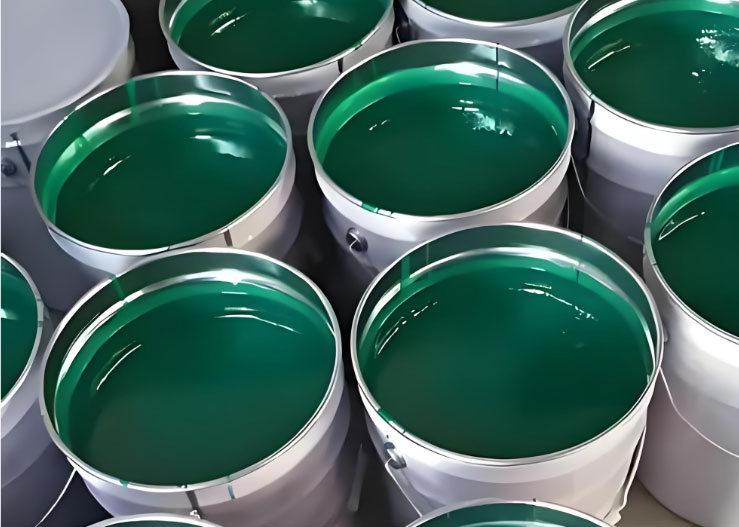
Based on a set of typical parameters of epoxy and polyurethane coatings, this article discusses several key issues that must be considered when selecting a flow meter for high viscosity paints.
Take a certain epoxy coating, Hempadur 4774D, as an example. Its viscosity reaches 105 kU (about 3500 cP), while another polyurethane topcoat, 5521, has a viscosity of around 63–87 kU (about 800 cP). Density fluctuates between 0.9 and 1.5 kg/L. These coatings also contain zinc powder, pigments, and fillers, with a maximum solid content of up to 80%. More importantly, a diluent (5% thinner) is needed on site to adjust the application viscosity, meaning the same flowmeter must handle multiple media with different rheological properties.
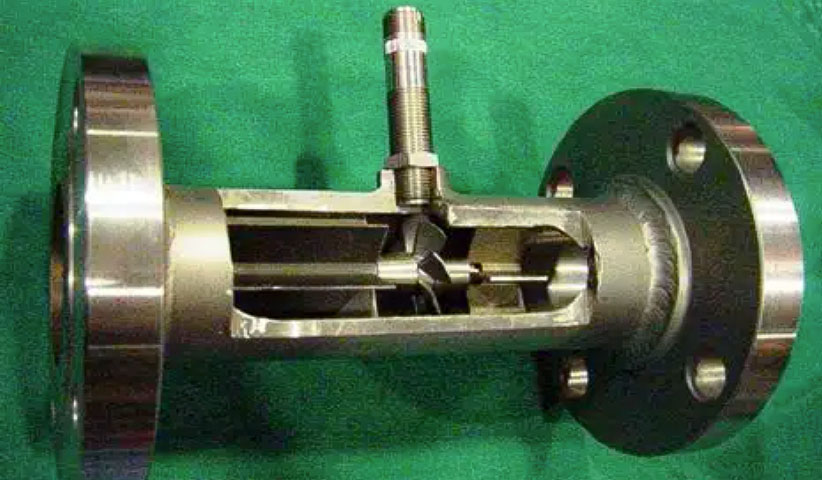
Turbine flow meter may suffer impeller jamming due to high viscosity liquid
Under such conditions, traditional turbine flowmeters may suffer from impeller jamming due to high viscosity. Electromagnetic flowmeters require conductive media, which many solvent borne coatings do not provide. Differential pressure flowmeters experience significant pressure loss and a sharp drop in accuracy at low flow rates and high viscosity. Therefore, a flow measurement solution specifically designed for high viscosity, low flow, and high pressure is required.
Currently, the most mature solutions for epoxy and polyurethane spray lines are the Coriolis mass flowmeter and the oval gear flowmeter (a type of positive displacement flowmeter). Their characteristics are discussed separately below.
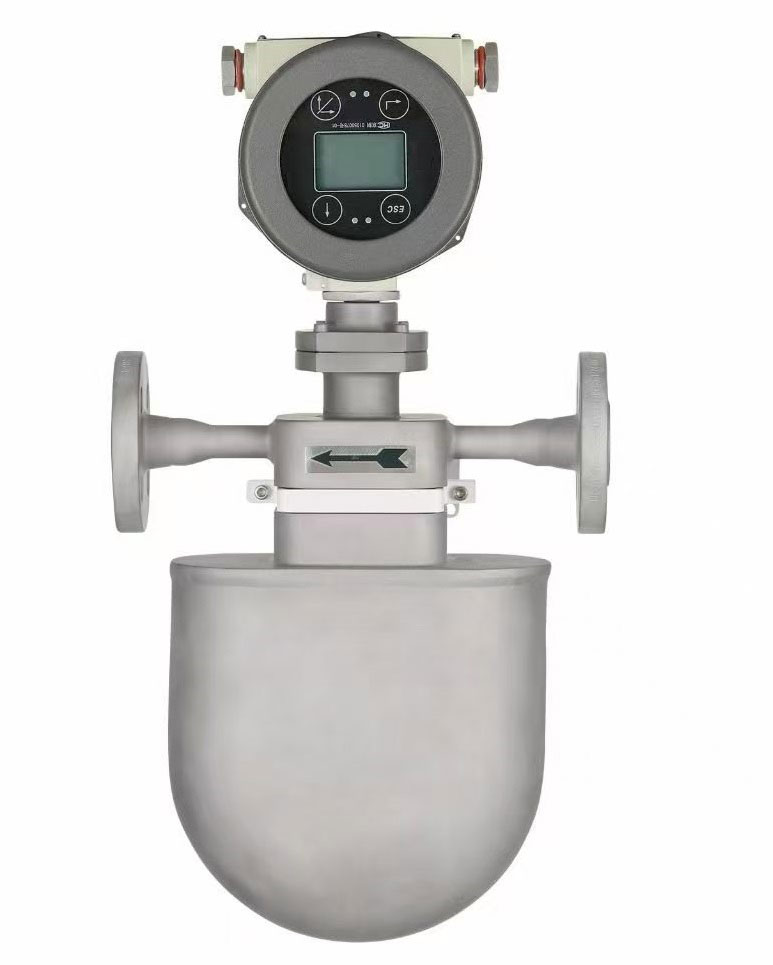
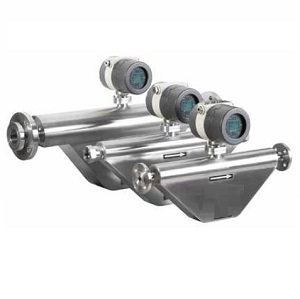
A Coriolis mass flowmeter directly measures mass flow, unaffected by changes in medium viscosity, density, or temperature. For scenarios where the viscosity of paints like 4774D and 5521 differs by several times, the Coriolis flowmeter maintains high accuracy of ±0.1% to ±0.2% without requiring correction. At the same time, it can directly output density and temperature signals, making it easy to monitor whether the paint has been over thinned.
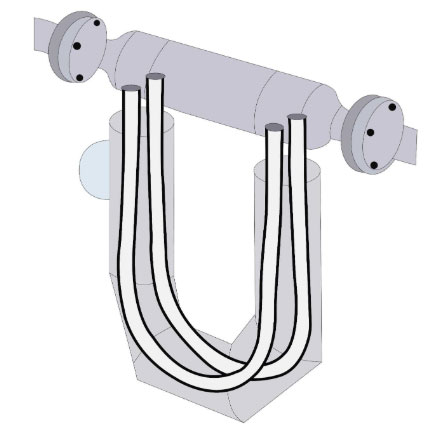
Full bore of Coriolis sensor allows liquid with particles
For high-pressure spraying applications, a high-pressure Coriolis flowmeter (with a maximum pressure rating of 414 bar or higher) can fully match a working pressure of 400 bar. The full-bore design allows small particles (such as zinc powder and pigment agglomerates) in the paint to pass through smoothly without clogging. The 316L stainless steel construction meets the corrosion resistance requirements of most industrial coatings.
However, the cost of a Coriolis flowmeter is relatively high. For flow rates ranging from 3 L/min to 15 L/min, an appropriate pipe diameter (1/4 inch or 3/8 inch) must be selected to balance pressure drop and accuracy.
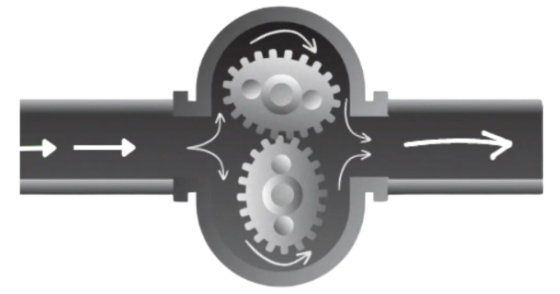
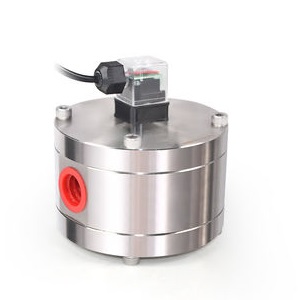
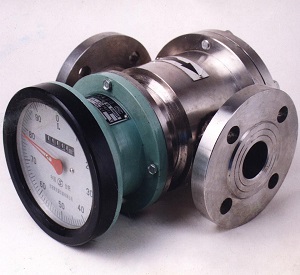
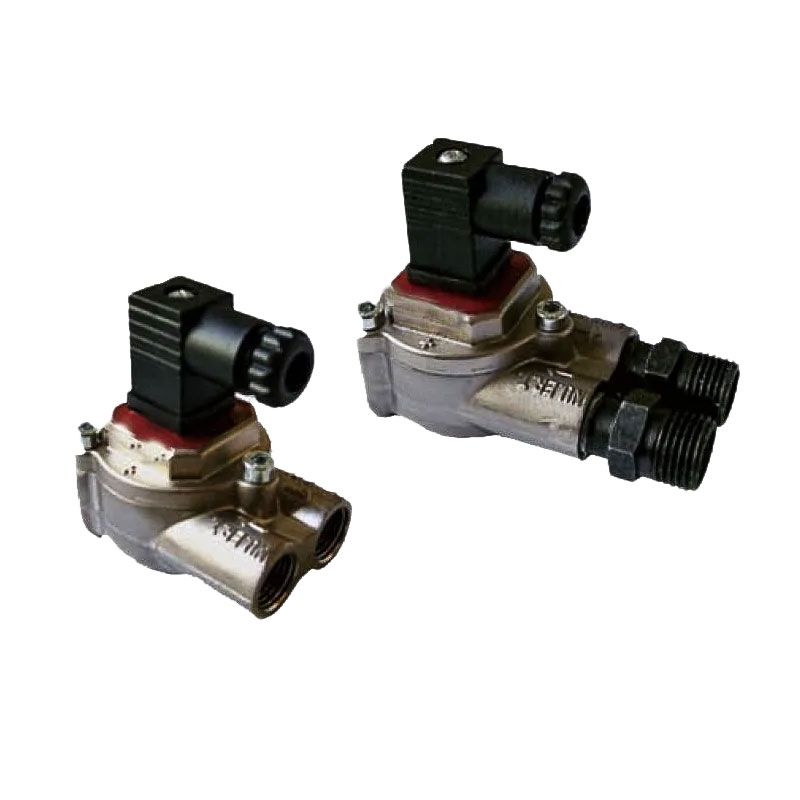
A oval gear flowmeter is a positive displacement flow meter (PD flow meter) that uses a pair of meshing gears to measure the volume of fluid passing through. For high viscosity liquids, the leakage through the gaps between the gears and the housing actually decreases; therefore, the higher the viscosity, the better the accuracy of a gear flowmeter, typically reaching ±0.5%. At a minimum flow rate of 3 L/min, the gear flowmeter can still output a stable pulse signal, making it very suitable for batching or proportional mixing.
Oval Gear flowmeters can also withstand pressures above 400 bar and are more cost-effective than Coriolis flowmeters. If a 4-20 mA signal output is required, a corresponding transmitter or secondary instrument can be connected. The disadvantage of oval gear flowmeters is the presence of moving gears inside. If the paint contains many hard particles (e.g., zinc powder in epoxy zinc-rich primers), gear may be broken; otherwise, long-term use will lead to accuracy degradation due to wear.
In actual inquiry and procurement processes, many customers provide only the pipe diameter and flow range, omitting some critical details. Based on our experience with similar high viscosity paint flow meters, we recommend confirming the following points before selecting a high viscosity flowmeter:
Maximum particle size in the medium: Although epoxy and polyurethane paints do not contain large particles like some food slurries, pigment agglomerates, undispersed fillers, or lumps generated by curing can clog the flowmeter. If the particle size exceeds 0.5 mm, a full-bore Coriolis flowmeter should be the first choice.
Process connection type: For 1/4 inch or 3/8 inch pipes, NPT female threads, ferrule fittings, or high-pressure hose fittings are commonly used. At 400 bar, cone seals or metal gasket seals are recommended to avoid leakage.
Output signal type: Most spray control systems require a 4-20 mA analog signal for continuous monitoring, or a pulse signal for batch control. Some projects may also require Modbus RTU or Modbus TCP communication to upload flow data to a control room or the cloud.
ATEX flow meters: Since paints often contain organic solvents (e.g., xylene, butanone), spraying sites are typically located in hazardous areas., ATEX flow meters are needed in such cases, an intrinsically safe or explosion-proof flow meter should be selected, used in conjunction with a safety barrier.
In addition to the conventional spray flow monitoring described above, similar flowmeters are also widely used in the following scenarios:
Two-component paint ratio control: Epoxy paints usually need to be mixed with a curing agent in a specific ratio. Two high precision flow meters (one for the epoxy base, one for the curing agent) combined with a proportional valve can achieve closed loop control and ensure a constant mixing ratio. The Coriolis flowmeter has significant advantages in this application because it can simultaneously measure density to determine whether the mixture is uniform.
Small-dose batching: Some automatic filling lines require dispensing 28 mL of paint every 6 seconds. In such cases, repeatability in the micro flow range is critical. Due to its positive displacement principle, a gear flow meter offers better repeatability at low flow rates than many other types.
High-pressure airless spraying: In airless spraying equipment operating at pressures up to 400 bar, the flow meter must not only withstand the pressure but also resist high velocity erosion from the paint. Both stainless steel Coriolis and gear flowmeters are capable, but attention should be paid to whether the pressure drop across the flowmeter affects the spray fan pattern.
For epoxy and polyurethane paints such as Hempadur 4774D and 55210, with a viscosity range of 800 cP to 3500 cP, a maximum working pressure of 400 bar, and a minimum flow rate of 3 L/min, the following two options are recommended:
If budget permits and additional information such as density and temperature is needed, choose a high-pressure Coriolis mass flowmeter with a 1/4-inch or 3/8-inch bore, 316L material, and 4-20 mA or Modbus output.
If cost effectiveness is a priority and the paint contains few hard particles, choose a stainless steel gear flow meter with pulse output and a 4-20 mA conversion module, paying attention to the wear resistance of the gear material.
Regardless of which flowmeter is selected, we recommend conducting a small-scale test under actual operating conditions to verify its accuracy and stability at the lowest flow rate and highest viscosity. If you are looking for a suitable flow measurement solution for epoxy coatings, polyurethane topcoats, or epoxy zinc-rich primers, please provide the specific medium name, operating temperature, and allowable pressure loss. We can then recommend the most suitable model and provide a formal quotation.