English
In water treatment plant projects, DN500 electromagnetic flow meters are commonly used for raw water intake, process water transportation, and factory measurement of treated drinking water. Whether the selection is reasonable directly affects the measurement effect and equipment life. This article combines the actual inquiry requirements of the Diwaniyah water treatment plant in Iraq, and explains from four aspects: flow range and velocity, lining material, installation method, and protection level. Finally, it answers several common questions.
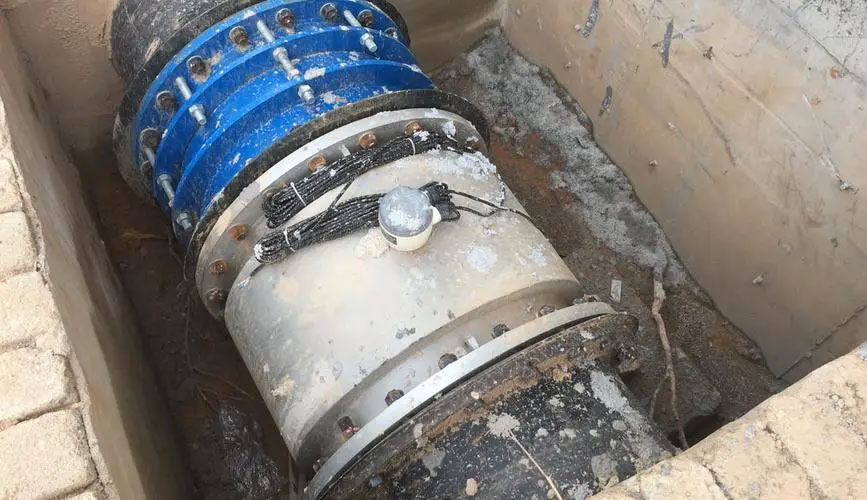
DN500 watermeter used in water treatment
The normal operation of electromagnetic flowmeter requires ensuring that the water is filled in the pipeline and the flow rate is within a reasonable range. For DN500 (20 inches) water flow meter, the commonly used flow range is about 330 m ³/h to 6600 m ³/h (1500~29000 GPM), corresponding to a flow velocity of approximately 0.5 m/s to 10 m/s.
Low flow velocity (less than 0.5 m/s) may cause unstable signals and affect measurement accuracy. If the flow rate is too high, it may exacerbate the wear of electrodes and liners, while affecting water flow sensor long term operation. In the design phase, it is recommended to calculate the maximum, minimum, and common water flow rates based on the actual water supply capacity of the water treatment plant, ensuring that the range of the magnetic flow meter covers these flow range. It is usually ideal to choose a commonly used flow velocity between 1 m/s and 2.5 m/s.
we will contact you within 24 hours..
The lining is a component of the electromagnetic flowmeter that directly contacts the medium, and its selection mainly depends on the corrosiveness, wear resistance, and temperature of the medium.
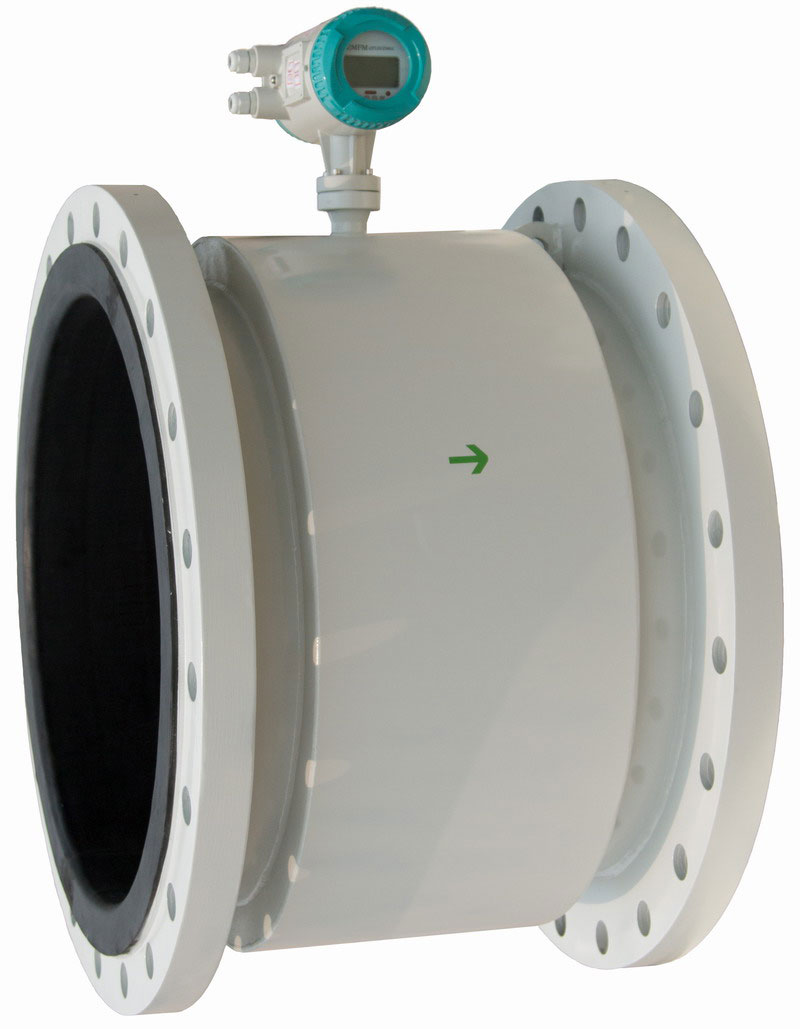
Rubber liner of DN500 water flow meter
Hard rubber: Suitable for media containing small amounts of sediment such as raw water, river water, and well water. Good wear resistance, moderate price, but temperature resistance generally does not exceed 80 °C.
Polyurethane: It has better wear resistance than hard rubber and is suitable for raw water with high sand content. The disadvantage is that the corrosion resistance is average and it is not suitable for strong acid and alkali environments.
PTFE (teflon): It has strong corrosion resistance, can withstand almost all chemical media, and has a smooth surface that is not easy to scale. Suitable for treated drinking water or process water with added chemicals. But PTFE is not wear-resistant and should not be used for raw water containing a large amount of particulate matter.
For DN500 water meter treatment projects, if measuring untreated river water, it is recommended to use hard rubber or polyurethane lining. If measuring treated drinking water, PTFE is a more suitable choice.
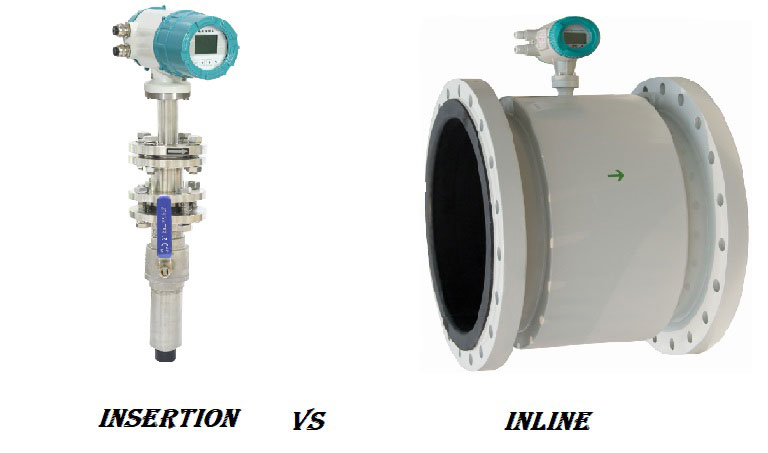
In large-diameter water flow measurement, insertion type and inline type are the two main structural forms, with significant differences in applicable scenarios.
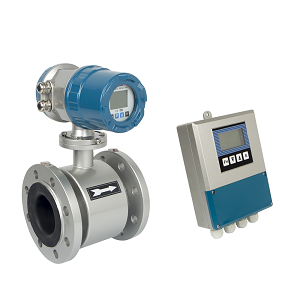
Inline electromagnetic flowmeter refers to a complete measuring pipe section with flanges at both ends directly connected to the pipeline. Its advantages are high measurement accuracy (usually up to level 0.5 or higher), real flow calibration before leaving the factory, and on-site installation before being put into use. The disadvantage is that the body is relatively long, heavy, and has high procurement and transportation costs. For process segments that require trade settlement or high-precision control, inline type water flow meter is preferred.
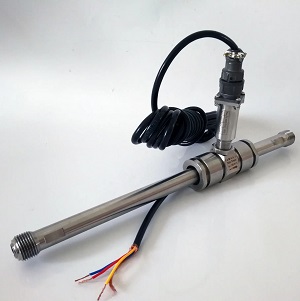
Insertion type electromagnetic flowmeter involves inserting the sensor into the interior of the pipeline through the mounting seat, measuring the local flow velocity, and then calculating the average flow velocity through conversion. The advantage is that it is easy to install and can be opened under pressure without stopping the water supply. The cost is usually only one-third to half of that of pipeline type. The disadvantage is that the accuracy is relatively low (generally between 1.0 and 2.0 levels), and higher requirements are placed on the length of the upstream and downstream straight pipe sections. Suitable for situations where precision requirements are not high, the diameter is particularly large (such as DN200 or above), or the installation of pipeline type conditions is not available on site.
For DN500 water treatment projects, if used for preliminary metering or process control of raw water intake, insertion magnetic flow meter is an economical option. If used for factory measurement or trade handover of treated drinking water, it is recommended to use a pipeline type.
The ingress protection (IP level) indicates the device's ability to protect against the intrusion of solid foreign objects and liquids. The flow meters of water treatment plants are usually installed outdoors, in pipe trenches or underground meter wells, in humid environments and may even be submerged in water for a short period of time.
IP65: Dustproof and able to prevent water spray. Suitable for general outdoor environments, but not suitable for prolonged soaking.
IP67: Dustproof and can be immersed in water for a short period of time (1 meter depth, 30 minutes). Suitable for installation in pits or surface wells that are prone to water accumulation.
IP68: Dustproof and capable of long-term immersion in water. Suitable for occasions that require complete immersion in underwater work, such as submerged installations or underwater pipelines.
For projects in the Middle East, Southeast Asia and other regions, rainstorm often occurs in summer, and the groundwater level is high. It is recommended that the sensor protection level should not be lower than IP68, and the converter (meter head) should at least reach IP67. When installed separately, the magnetic water flow sensor part can be immersed in water for a long time, while the converter is installed in a relatively dry control room .
The price is influenced by multiple factors, including water flow meter brand, the structural form (insertion or inline type), lining material, electrode material, Ingress Protection, and whether separate installation is required. Generally speaking, the price of a insertion electromagnetic flowmeter is about 30% to 50% of that of a pipeline type. For DN500 inline type, 316L electrodes and rubber lining are used, and the price usually ranges from $1800 from silverinstruments.com, depending on the brand and technical requirements.
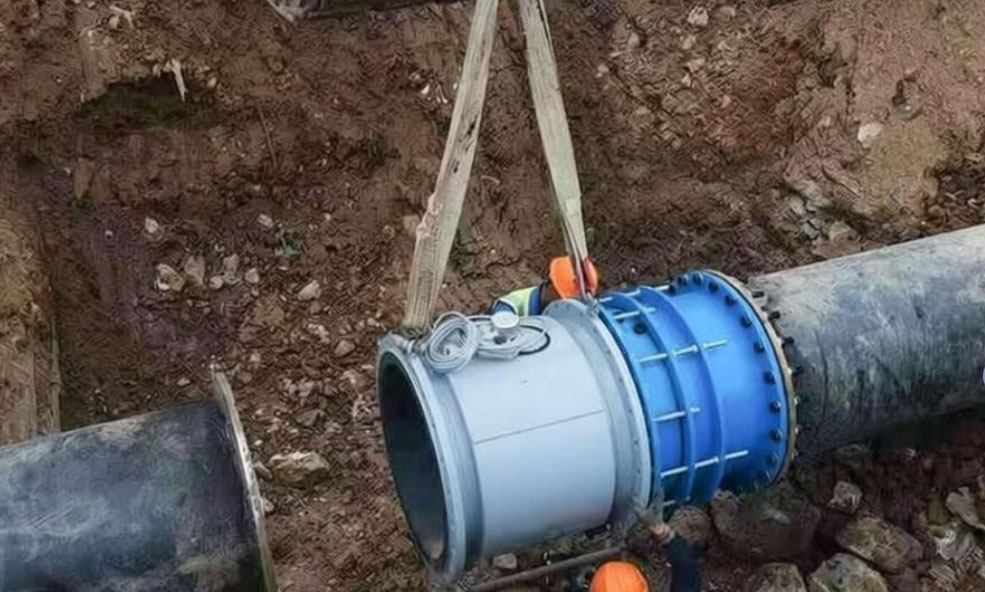
The installation of in-line type electromagnetic flowmeter requires cutting the pipeline, welding flanges or connecting short pipes, requiring the pipeline to be shut off and emptied, and requiring lifting equipment (DN500 magnetic water meter is heavy) for hoisting. Grounding and wiring are required after installation. The entire process requires professional construction personnel to complete. The plug-in electromagnetic flowmeter is relatively simple, and can be opened with pressure using specialized tools without stopping the water supply. The installation time is short; usually two people can complete it in half a day. Overall, insertion water flow meter installation is simpler, while pipeline installation is more complex.
The accuracy of pipeline electromagnetic flowmeter is usually ± 0.5% or ± 0.2%, suitable for trade settlement and precise control. The accuracy of insertion type is generally ± 1.0% to ± 2.0%, suitable for process monitoring, trend judgment, or non trade occasions. In practical applications, if the length of the straight pipe section on site is insufficient or the fluid velocity distribution is uneven, the actual error of the insertion type may further increase. Therefore, in situations where high-precision measurement is required, insertion type should not be used instead of pipeline type.
Mag flow meters have requirements for the length of upstream and downstream straight pipe sections. In general, a straight pipe section with a diameter at least 5 times that of the pipeline is required upstream, and a straight pipe section with a diameter at least 3 times that of the pipeline is required downstream. For a DN500 water meter, this means that a straight pipe section of about 2.5 meters is required upstream and about 1.5 meters is needed downstream. If there are bends, valves, or pumps upstream, the length of the straight pipe section should be appropriately increased to 10 times the diameter. DN500 insertion flow meters have higher requirements for straight pipe sections, typically requiring 10 times the diameter upstream and 5 times the diameter downstream.
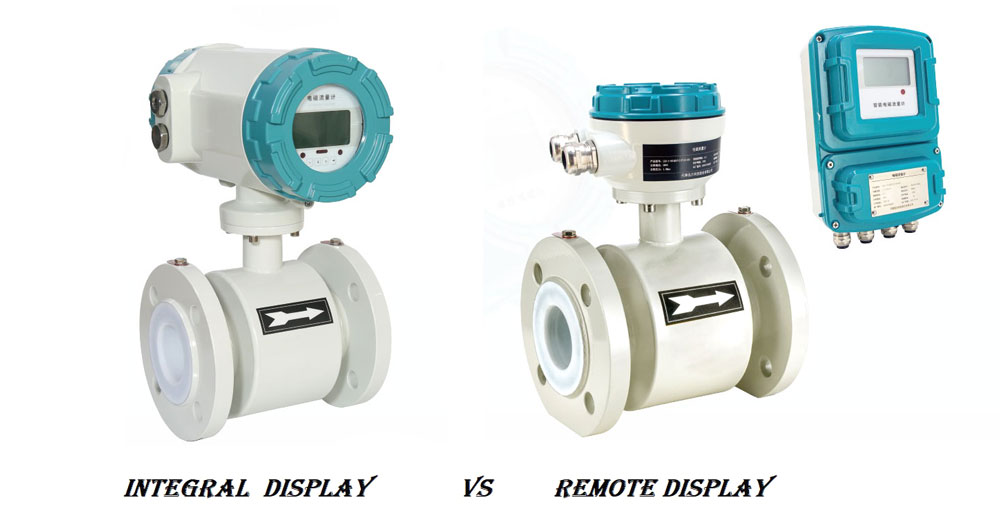
Integrated installation refers to the direct installation of the converter (or display) on the water flow sensor, with a compact structure, low cost, and suitable for places with suitable ambient temperature, low vibration, and easy reading operation. Remote display magnetic flowmeter installation separates the converter and sensor, connects them through cables, installs the sensor on the pipeline, and installs the converter in the control room or protective box. When the on-site environmental temperature is too high or too low (exceeding the range of -20°C to 60°C), the humidity is high, the vibration is severe, or the installation location is difficult to access, it is recommended to choose a split type. In water treatment projects, when installed outdoors and during high temperatures in summer, the split type is more reliable.
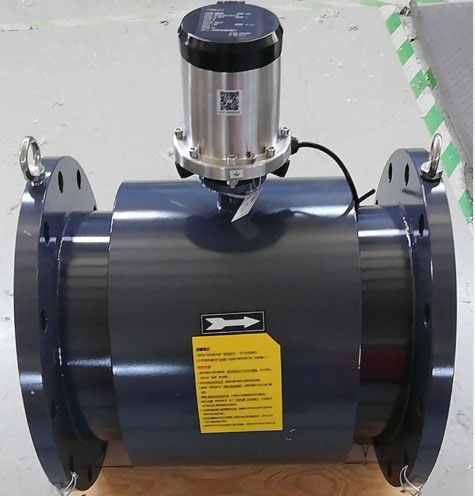
The common power supply methods for electromagnetic flow meters are 24V direct current (DC) or 220V alternating current (AC) ,however silverinstruments.com even can provide battery operated water flow meter. For export projects, especially in the Middle East and Africa regions, customers tend to prefer 24V DC for unified power supply with control systems. The output signal from mag flow transmitters typically includes 4-20mA analog (with HART protocol), pulse or frequency output, and RS485 MODBUS communication. In water treatment projects, it is recommended to provide at least 4-20mA and pulse output to meet the requirements of flow display and total flow acquisition.