
English
Most slurry applications are measured with either a magnetic flow meter or a Coriolis mass flow meter. A magnetic flow meter suits conductive, water-based slurries such as cement, mineral and mining slurries. A Coriolis meter is used when the fluid is not conductive or when density is needed as well as flow. Whichever type you choose, size it from the line velocity and the full flow range rather than from the pipe size alone, because abrasive slurry wears a meter fastest at high velocity and an oversized meter loses accuracy at low flow.
Solids in a slurry erode wetted parts, settle at low points and change the density of the fluid from one batch to the next. Turbine and positive displacement meters have moving parts that solids jam or wear down. A vortex meter depends on a bluff body in the flow path, and abrasive particles erode that body until the reading drifts. Transit time ultrasonic meters lose signal when the solids content is high.
That leaves two practical choices for most slurry lines: the electromagnetic flow meter, which has an open bore with nothing in the flow path, and the Coriolis mass flow meter, which has no moving parts. The steps below show how to choose between them and how to size the one you choose.
Two properties of the fluid narrow the choice before sizing starts: whether it is conductive, and whether you need volumetric flow, mass flow or density. A magnetic flow meter only works on a conductive liquid. Water-based slurries are almost always conductive enough. The Silver Instruments SHD-SE16 slurry magnetic flow meter, for example, needs a conductivity of at least 5 μS/cm. Oil-based sludge is not conductive, so a magnetic flow meter cannot measure it at any size.
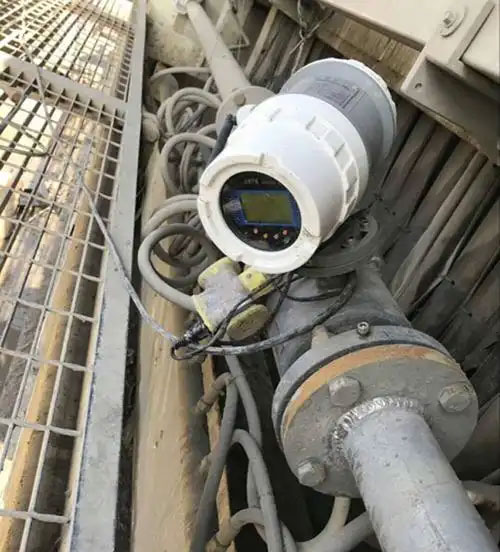
Then check whether the process needs volumetric flow only or mass flow and density as well. A magnetic flow meter gives volumetric flow. A Coriolis meter measures mass flow directly and also reports density and temperature from the same sensor. Where slurry density is a process parameter, as it is in well cementing, a Coriolis meter can replace a separate densitometer. The trade-off is that a Coriolis meter sends the slurry through its measuring tubes, so the tube walls take the abrasion. The Silver Instruments SH-CMD micro bent tube Coriolis meter is available from DN10 to DN300, while the SHD-SE16 magnetic flow meter goes up to DN2000.
With abrasive slurry, wear rises sharply as velocity increases. A meter body smaller than the pipe raises the velocity through the sensor and shortens its life. The reducer in front of the meter also gives solids a place to pack.
An inquiry from a well-cementing service company shows how velocity, pipe reduction and wear decide the meter size. The customer wanted to measure cement slurry on an existing 5-inch line.
| Parameter | Value |
| Fluid | Cement slurry for well cementing, single-phase liquid |
| Density | 1.44 to 1.95 g/cm³ (up to 2.0 g/cm³ in specific cases) |
| Solids | Silica sand up to 35% by weight of cement, ferrite additive 15 to 20%, balance Class G cement, retarders and fluid-loss additives below 3% |
| Flow rate | Min 0.25 bbl/min (2.4 m³/h), normal 4 bbl/min (38.2 m³/h), max 8 bbl/min (76.3 m³/h); 80% of jobs run at 4 to 5 bbl/min |
| Line velocity | About 160 ft/min (0.81 m/s) at 4 bbl/min and about 205 ft/min (1.04 m/s) at 5 bbl/min in the 5-inch line |
| Temperature | 35 to 40 °C |
| Pressure | About 250 psi (1.72 MPa) |
| Line size | 5-inch existing line, with a 6-inch line also under evaluation |
| Connection | Flanged or Victaulic style |
| Current meter | Micro Motion F300E on a separate 3-inch line, limited to 4-inch size |
The customer’s existing Coriolis meter was only available up to 4 inches. Fitting it to the 5-inch line would need a 5-inch to 4-inch reduction, and the customer’s concern was that cement could pack in the reducer and set in place. That is why they were looking for a 5-inch meter.
A 5-inch meter removes the reducer, but it keeps the full line velocity inside the measuring tubes. Two SH-CMD micro bent tube Coriolis meters were quoted: the 5-inch SH-CMD-125 (DN125) and the 6-inch SH-CMD-150 (DN150). The 6-inch meter was recommended for the 5-inch line, because a 5-inch meter would wear out quickly with this slurry. The larger meter lowers the velocity through the tubes. It also reports slurry density directly: the SH-CMD measures 0.5 to 2.5 g/cm³ with ±0.002 g/cm³ accuracy, which covers the 1.44 to 1.95 g/cm³ cement range.
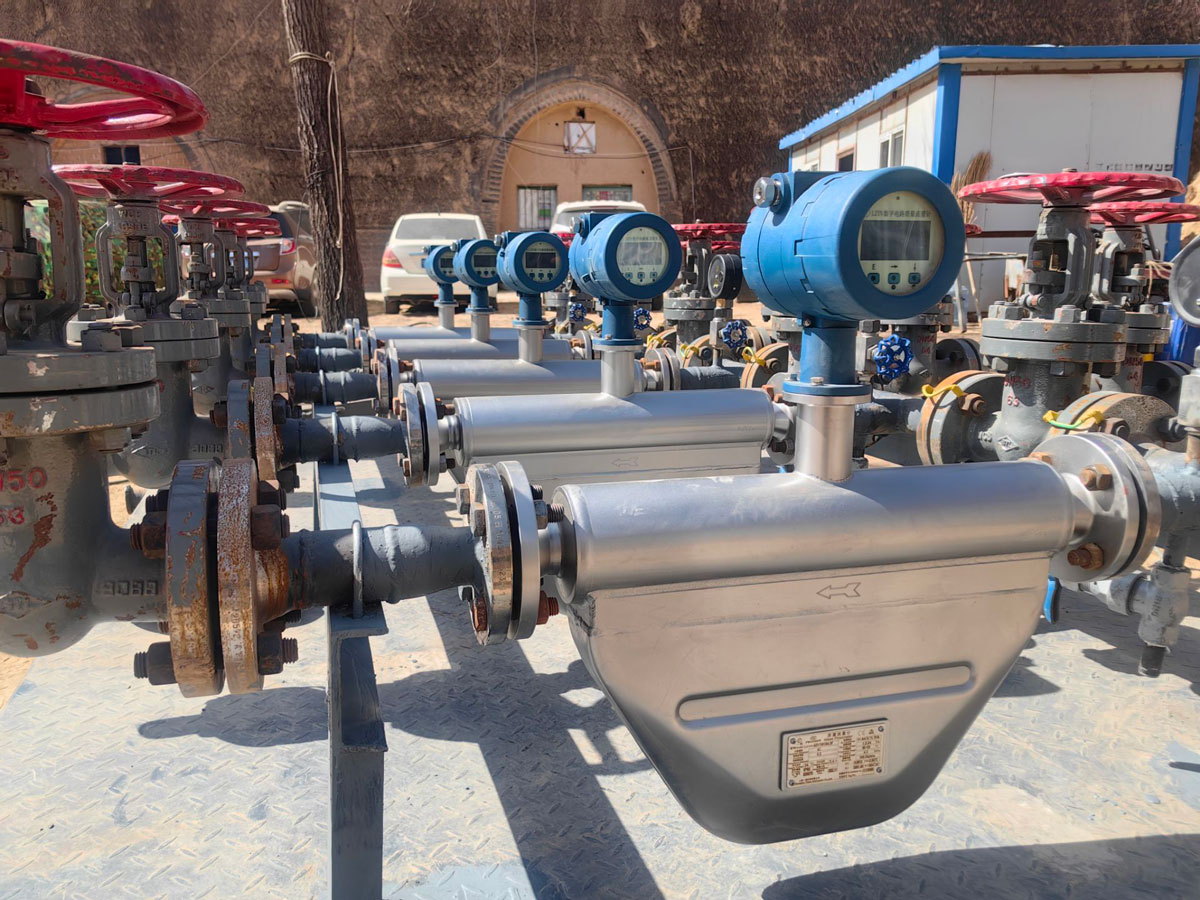
Upsizing for wear moves the low end of the flow range further down the meter’s scale. For a Coriolis meter, the error at low flow is the stated accuracy plus ±[(zero stability / flow) × 100]%, so it grows as flow drops. At 1.44 to 1.95 g/cm³, the cement flows sit on the SH-CMD-150 range of 0 to 300 t/h as follows:
Before ordering, the buyer and supplier should agree which flow band must meet the stated accuracy. In this application, 80% of jobs run at 4 to 5 bbl/min, so the meter can be sized to measure that band well, and the lowest flows are treated as indication only. If the low flows must be measured accurately, the larger body is the wrong choice, and the buyer has to accept faster wear in a smaller one.
Check the pressure rating at the same time. The standard SH-CMD-150 is rated 1.6 MPa, and this line runs at about 1.72 MPa, so the order needs the 2.5 MPa or 4.0 MPa option. The process temperature of 35 to 40°C is within the standard -50 to 150°C range. Flanged connections are standard, so a Victaulic connection has to be confirmed at the order stage.
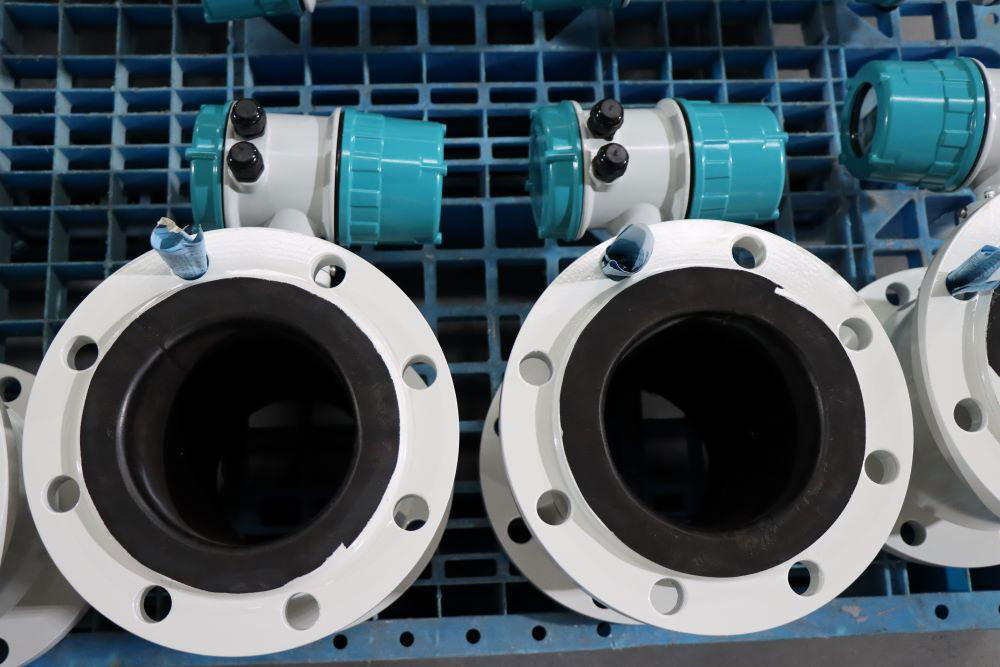
In a magnetic flow meter, the liner and electrodes are the only wetted parts. For abrasive slurry, they decide the service life more than any other option. The SHD-SE16 magmeter uses a polyurethane rubber liner, which is suited to pulp and slurry, and tungsten carbide electrodes for abrasion resistance. Other liner options, such as PTFE, PFA, and hard rubber, are intended mainly for corrosive or high-temperature service rather than abrasion. Electrodes in 316L, Hastelloy, titanium, or tantalum are chosen for chemical compatibility.
For cement, mining, and mineral slurries, polyurethane with tungsten carbide is the usual starting point. If the slurry is also chemically aggressive, send the chemistry along with the solids data so that the liner and electrodes can be matched to both.
Oily sludge, used cooking oil, and waste oil carrying food or process solids are viscous, non-conductive liquids with suspended solids. Three things decide the meter choice for these fluids. The first is whether solids can pass through the meter. The second is how viscosity changes with temperature. The third is whether the meter sits on the suction side of a pump. On vacuum and suction lines, pump position and pressure drop affect the reading as much as the meter type does.
Used cooking oil collected by a vacuum tanker is a typical example. A used-oil recycler gave these conditions:
| Parameter | Value |
| Fluid | Used cooking oil, fat, crumbs, and other solids from deep fryers |
| Viscosity | About 90 cSt at 5°C and about 200 cSt at 15°C (thicker sludge higher) |
| Temperature | 2 to 15°C |
| Pressure | Vacuum: -0.51 to -0.61 bar gauge (51 to 61 kPa below atmospheric) |
| Flow rate | Oil at 15°C: about 85 to 90 gpm (19.3 to 20.4 m³/h); oil at 2°C: about 40 to 60 gpm (9.1 to 13.6 m³/h); sludge: 15 to 25 L/min (0.9 to 1.5 m³/h) |
| Line size | 2-inch EPDM hose |
| Installation | 1,000 L steel drum, of which about 200 L is sludge mixed with small food solids; vacuum tanker with on-board pump |
Cooking oil is not conductive, so the proposal was a DN50 SH-CMF Coriolis meter with 316L wetted parts, a 1.6 MPa rating, a -50 to 150°C temperature range, 0.2% accuracy, 4 to 20 mA and pulse output, RS485 and HART communication, an explosion-proof design, and flanged connections. The customer’s follow-up questions are the ones most buyers of a slurry meter should ask.
There is no fixed lifespan for a meter in abrasive slurry. Wear depends on the solids type and particle size, the velocity through the meter, and the running hours, and all three change from one plant or job to the next. A wear-life figure given without test data on the same slurry is only an estimate, not a specification.
Buyers often ask for a wear-life figure before ordering. In the cementing application above, the customer asked for wear life in hours, percentage or tonnage, and no reliable number could be given for their slurry.
What a buyer can control is the velocity through the meter and the choice of liner and electrodes. Those two decisions do the most to extend service life.
Each answer below changes the meter type, the size, or the materials, so have them ready before you ask for a quote.
Send us these details via sales@silverinstruments.com:
Our engineers will recommend the meter type, body size and wetted materials for your line, and tell you what accuracy to expect at your minimum flow.