
English
Oval Gear Flow Meter vs Coriolis Flow Meter: How to Choose the Right Technology
Quick AnswerOval gear flow meters are positive displacement meters that measure volume directly through mechanical gear rotation, best suited to high viscosity liquids such as oils, resins, and syrups up to 2000 mPa·s, at 0.5% or 0.2% accuracy. Coriolis flow meters measure mass flow directly by reading the twist a vibrating tube produces as fluid passes through it, holding tighter accuracy, typically within 0.1 to 0.15 percent of reading, across a wider range of fluids, but usually at a higher cost and a larger pressure drop. Silver Automation Instruments supplies both, the LC series oval gear meter and the SH-CMF Coriolis meter, and the right pick comes down to your fluid viscosity, budget, and whether you need mass or volume flow. |
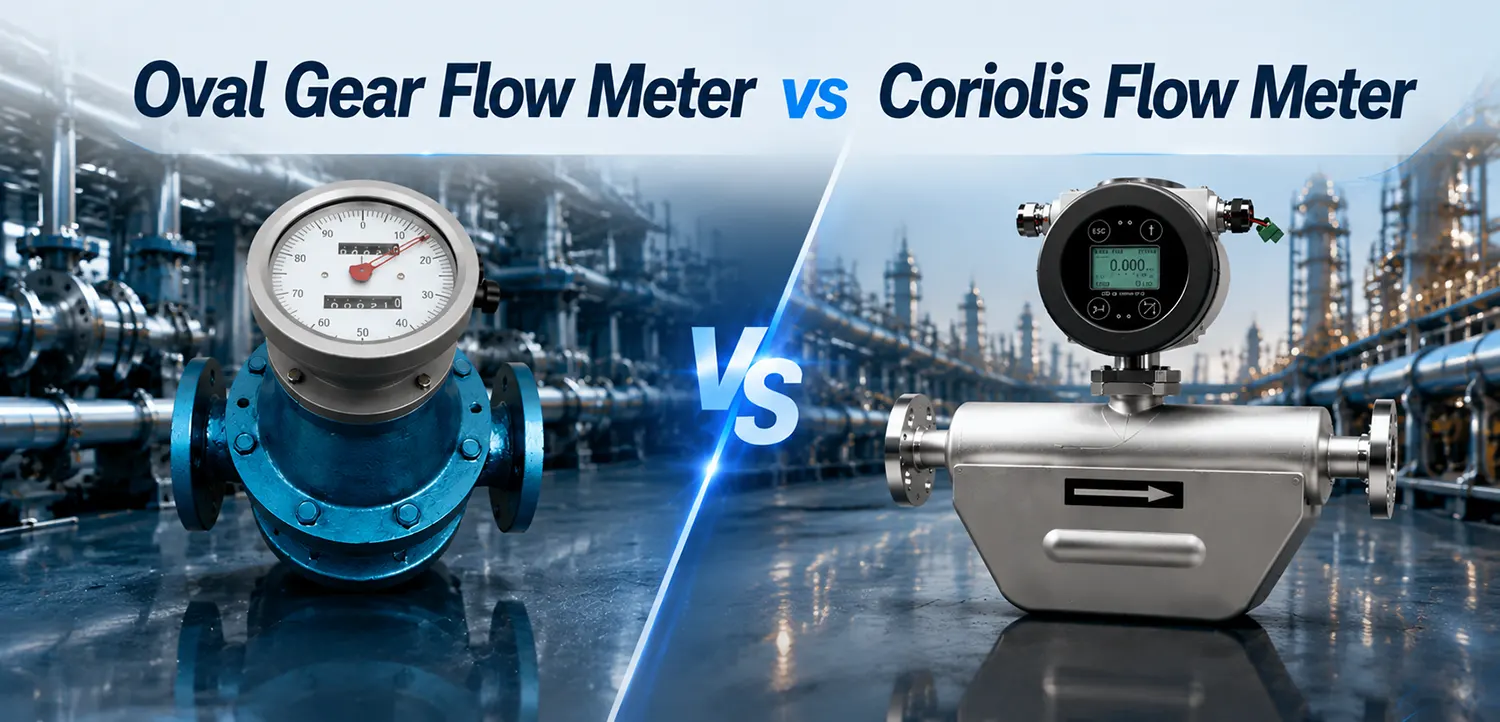
Oval gear flow meters are positive displacement instruments. A pair of oval gears rotate inside a measuring chamber, and each rotation pushes a fixed volume of liquid through. Count the rotations, and you have a direct volume reading, no electronics doing inference, just mechanics doing the counting. Coriolis mass flow meters work on an entirely different principle. A tube, or a pair of tubes, vibrates at its natural frequency. When fluid moves through a vibrating tube, the Coriolis effect twists the tube slightly, and that twist is proportional to mass flow rate, not volume. No moving parts touch the fluid path the way a gear does. The tradeoff is a more complex, more expensive sensor and transmitter package.
In the measuring chamber, a pair of oval wheels and a cover plate form a crescent shaped cavity that acts as the measuring unit. Pressure difference across the meter rotates the wheels, and each full revolution displaces four times the volume of that cavity. A mechanical or digital register converts wheel rotations into instantaneous and totalized flow.
Because the reading comes from actual displaced volume, oval gear meters do not need a long straight pipe run before or after installation, unlike vortex or electromagnetic meters. That is a real advantage on retrofits and tight skid layouts.
A Coriolis meter drives one or two tubes into oscillation with an electromagnetic actuator. As fluid flows through the vibrating tube, its mass generates a small phase shift between the inlet and outlet sections of the tube, and that phase shift scales directly with mass flow rate. Sensors at each end pick up the timing difference and the transmitter converts it into a mass flow reading in kg/h or lb/h.
The same vibrating tube also gives you fluid density, since the tube's resonant frequency shifts with the density of whatever is inside it. That density output is reliable for liquids. It is not reliable for gas service, so if a Coriolis meter's spec sheet advertises a density reading, treat that as a liquid-only feature and do not lean on it for gas density.
The LC series oval gear meter ships at 0.5% or 0.2% of reading, depending on the model and viscosity band, which is more than good enough for process control and most custody transfer on viscous fluids.
Coriolis meters as a technology generally do better on paper, with many models across the industry, the SH-CMF included, specified in the 0.1 to 0.15 percent of reading range on liquid service. Send us your fluid and flow range and we will confirm the exact accuracy class for your specific SH-CMF configuration before you buy on a number alone.
This is where the two technologies really diverge. Oval gear meters are happiest on medium to high viscosity fluids, the LC series is rated up to 2000 mPa·s, and they actually get more accurate as viscosity climbs, since less fluid slips past the gears uncounted. Heavy fuel oil, resins, adhesives, and syrups are classic oval gear territory.
Coriolis meters cover a wide viscosity window too, but the physics work against them at the extremes. Very high viscosity fluid moving through a narrow vibrating tube builds up pressure drop fast, and very low flow rates on a big tube can fall below the sensor's noise floor. Coriolis tends to be the better fit for low to medium viscosity liquids, multiphase or aerated streams, and applications where you need mass flow and density from one sensor.
More information about high viscosity fluid flow meters>>
Oval gear meters run a genuinely low pressure loss for a mechanical meter, and installation orientation is flexible since the measuring principle does not depend on flow profile.
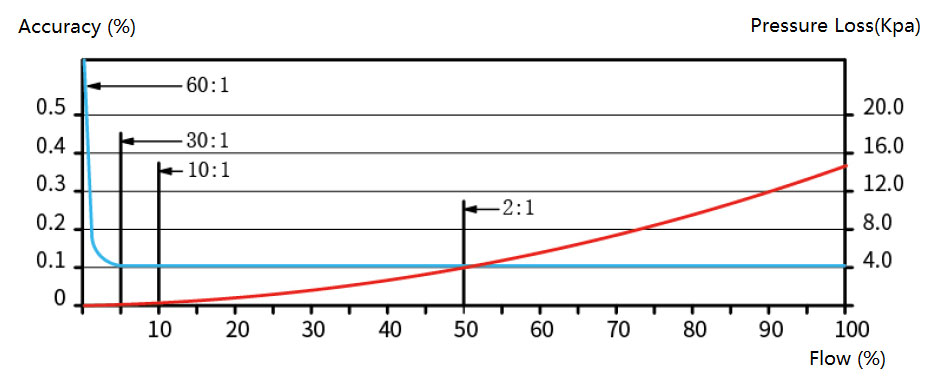
SH-CM Series Coriolis Flow –Accuracy –Pressure loss relationship
Coriolis meters can surprise people on pressure drop. The tube geometry, especially on smaller bore or high viscosity duty, sometimes produces a pressure drop that exceeds the head actually available in the line, particularly on gravity fed or low pressure systems. We would rather flag that during sizing than have a customer find out after installation. Always check the pressure drop curve against your available differential before finalizing a Coriolis order on a viscous or low pressure line.
Oval gear meters have moving parts, so they need reasonably clean fluid. Abrasive particles or grit accelerate wear on the gears and bearings, which shows up as accuracy drift over time. A strainer upstream is cheap insurance.
Coriolis meters have no moving parts in the flow path, so they tolerate dirty, particulate-laden, or slightly abrasive fluid far better. That is one reason plants running slurries or unfiltered process streams often lean Coriolis despite the higher upfront cost.
An oval gear meter reads volume. If you need mass, you have to apply a density value, from a lab sample or an inline density meter, to convert. That is fine for fluids with stable density, less fine for fluids that vary by batch or temperature.
A Coriolis meter reads mass directly, with no separate density or temperature compensation loop needed for the mass number itself. That is the main reason custody transfer and fiscal metering on liquids so often specify Coriolis over oval gear, once budget allows for it.
Oval gear meters cost less upfront, generally a fraction of what a comparable Coriolis meter runs, and that gap widens at larger pipe sizes. The tradeoff shows up over the meter's life, in periodic accuracy checks and eventual gear or bearing replacement on high duty cycle lines.
Coriolis meters cost more to buy, often two to four times the per-unit cost of an equivalent cast iron or cast steel oval gear meter, but with no moving parts in the flow path, long term maintenance tends to be lighter. For a plant weighing total cost of ownership over five or ten years, that math can flip in favor of Coriolis even though the sticker price is higher.
| Parameter | Oval Gear (LC Series) | Coriolis (SH-CMF) |
| Measurement principle | Positive displacement, mechanical gear rotation | Vibrating tube, Coriolis effect |
| Reads | Volume flow directly | Mass flow directly, plus liquid density |
| Accuracy | 0.5% or 0.2% of reading | Typically 0.1% to 0.15% of reading on liquid service |
| Best fit viscosity | Medium to high, up to 2000 mPa·s | Low to medium viscosity, and multiphase or aerated streams |
| Moving parts | Yes, oval gears and bearings | No moving parts in the flow path |
| Fluid cleanliness needed | Clean to lightly particulate, strainer recommended | Tolerates dirty or slightly abrasive fluid well |
| Pressure drop | Low for a mechanical meter | Can be significant on small bore or high viscosity duty, check the curve |
| Straight pipe run | Not required | Not required |
| Relative upfront cost | Lower | Higher, often two to four times an equivalent oval gear meter |
| Typical duty | Fuel oil, resins, adhesives, syrups, chemical dosing | Custody transfer, chemical injection, food and beverage, high accuracy process control |
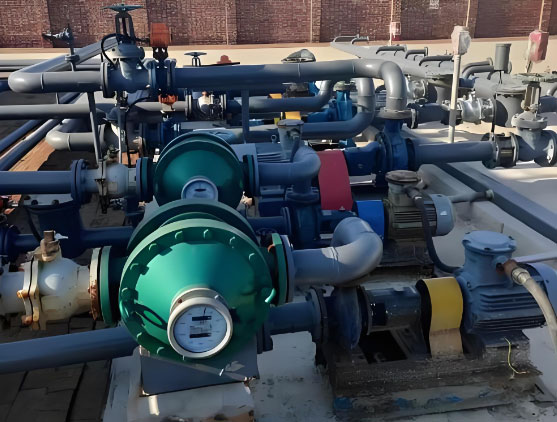
Oval gear flow meter for diesel measurement
In Southeast Asia, palm oil and specialty chemical plants lean on oval gear meters for viscous product transfer, while food and beverage lines increasingly ask for Coriolis on high value ingredients where mass accuracy matters for costing.
Middle East fuel blending and lubricant packaging operations use both technologies side by side, oval gear on diesel transfer, Coriolis on additive injection where dosing accuracy has a direct cost impact.
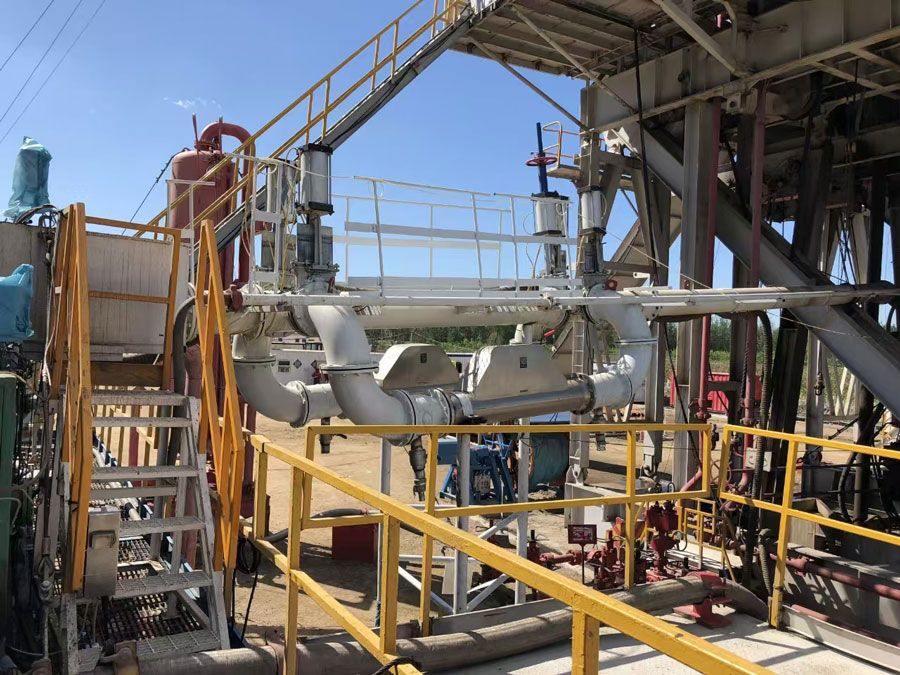
Coriolis flow meter for mining slurry mass flow measurement
In South America and Africa, mining reagent dosing and asphalt or bitumen handling are common oval gear applications, and Coriolis shows up more on mining slurry measurement.
Across Australia and New Zealand, dairy and food processing plants are a steady source of Coriolis inquiries, mainly for mass based batching and recipe accuracy.
This is a pattern we see often, not a specific customer record. A biodiesel blending skid needs to measure both the base fuel and an additive stream. The base fuel runs medium viscosity, moderate value, and high volume, so an oval gear meter on that line keeps upfront cost down and matches the fluid well.
The additive stream is a different story. It runs at a much smaller flow rate, has a real cost per liter, and the blend ratio has to stay tight for the finished fuel to meet spec. That is the kind of line where the extra accuracy and direct mass reading from a Coriolis meter earns back its higher price fairly quickly, since even small dosing errors compound into rejected batches or wasted additive.
Send us your fluid, flow range, and accuracy requirement and we will recommend oval gear, Coriolis, or point out where either would work. Include:
Email sales@silverinstruments.com with these details, or send your P&ID and we will size the right meter for you.
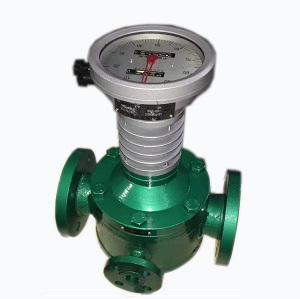 Oval gear flow meter with external heat jacket
LC series oval gear flow meter with external heated measuring loops is suitable for high viscosity fluids measurement, such as asphalt, bitumen or tar flow rate measurement.
VIEW
Oval gear flow meter with external heat jacket
LC series oval gear flow meter with external heated measuring loops is suitable for high viscosity fluids measurement, such as asphalt, bitumen or tar flow rate measurement.
VIEW
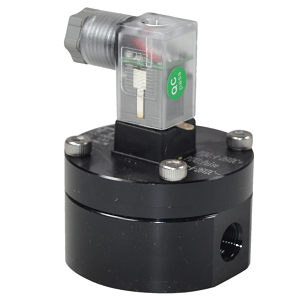 Microfluidic Flow Meter
LC-M Series Micro oval Gear flow meter candetect ultra mini liquid flow as low as 0.5 ml/min, but can still keep accuracyas high as 0.5%F.S, It is a kind of positive displacement flow meter forprecise...
VIEW
Microfluidic Flow Meter
LC-M Series Micro oval Gear flow meter candetect ultra mini liquid flow as low as 0.5 ml/min, but can still keep accuracyas high as 0.5%F.S, It is a kind of positive displacement flow meter forprecise...
VIEW
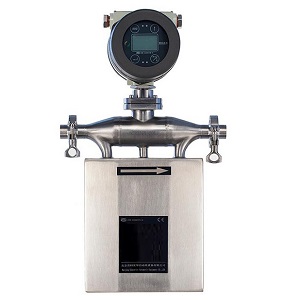 Sanitary and hygienic Coriolis flow meter
Tri-clamp or DIN 11851 end fitting 316L SS wet parts material For wine, molasses, honey, milk, yogurt, chocolate…… for food, dairy, bio-technology, pharmaceutical industry
VIEW
Sanitary and hygienic Coriolis flow meter
Tri-clamp or DIN 11851 end fitting 316L SS wet parts material For wine, molasses, honey, milk, yogurt, chocolate…… for food, dairy, bio-technology, pharmaceutical industry
VIEW
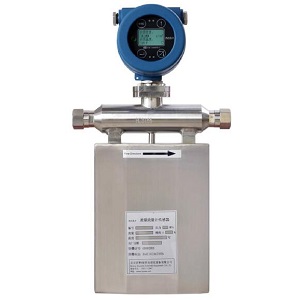 High pressure Coriolis flow meter
Max work on 700 bar high pressure. The high pressure type flow sensor is needed in such as chemical injection or hydrogen fueling station.
VIEW
High pressure Coriolis flow meter
Max work on 700 bar high pressure. The high pressure type flow sensor is needed in such as chemical injection or hydrogen fueling station.
VIEW
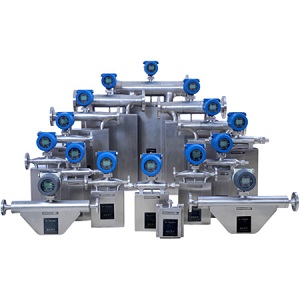 Coriolis Mass Flow Meter
Direct mass flow measurement. High accuracy: 0.1 %~0.2%. Also measure density, temperature, pressure. For all fluids measurement.
VIEW
Coriolis Mass Flow Meter
Direct mass flow measurement. High accuracy: 0.1 %~0.2%. Also measure density, temperature, pressure. For all fluids measurement.
VIEW
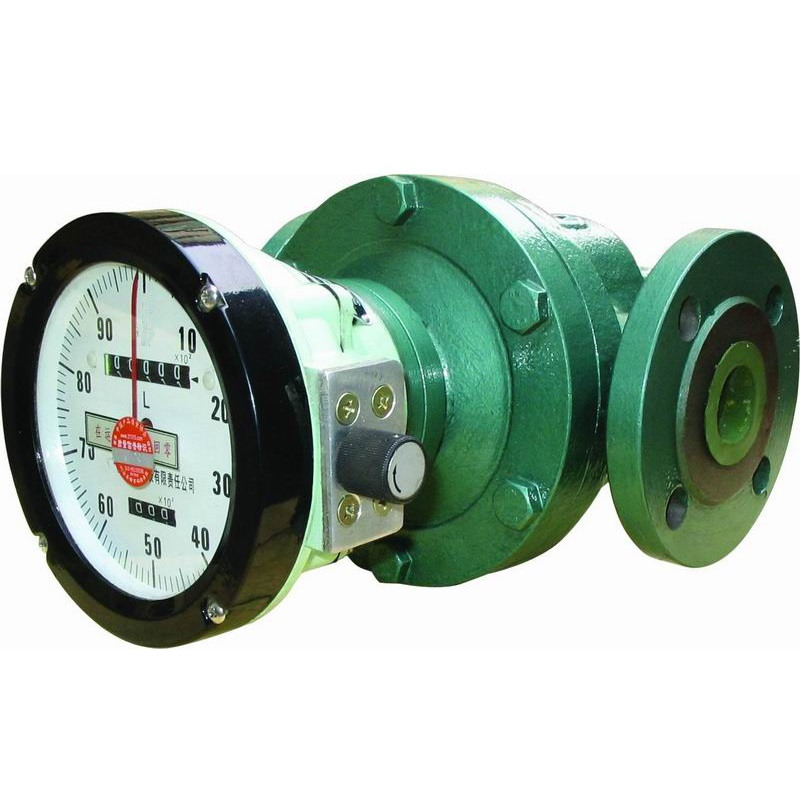 Oval Gear Flowmeter
Oval Gear Flow meter is for diesel, crude oil, resin, fuel, heavy oil flow measurement. PD flow meter is with mechanical register or digital display, Inquiry Price now.
VIEW
Oval Gear Flowmeter
Oval Gear Flow meter is for diesel, crude oil, resin, fuel, heavy oil flow measurement. PD flow meter is with mechanical register or digital display, Inquiry Price now.
VIEW