English
Most ultrasonic level meter faults fall into four groups: blind zone errors, surface interference from turbulence or foam, electromagnetic interference, and installation mistakes. Check the blind zone spec against your tank height first, then work through signal interference and wiring. A wrong probe material under acid or caustic media causes slower, harder-to-diagnose failures.
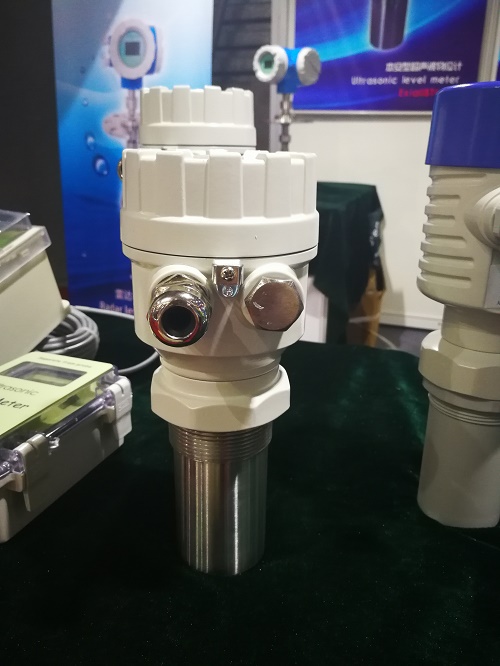
An ultrasonic sensor cannot read the surface right below the transducer face. This dead zone exists because the sensor needs time to stop ringing from its own pulse before it can listen for the echo. If the liquid level enters this zone, the display jumps to full scale or shows a random value.
The blind zone is not a fixed number. It scales with the measuring range, because a longer-range sensor uses a lower frequency and a longer pulse. Silver Instruments HLVT series shows this clearly across six range options.
| Model | Range | Blind Zone |
|---|---|---|
| HLVT4 | 0 to 4 m | 0.25 m |
| HLVT6 | 0 to 6 m | 0.30 m |
| HLVT8 | 0 to 8 m | 0.35 m |
| HLVT12 | 0 to 12 m | 0.55 m |
| HLVT20 | 0 to 20 m | 0.85 m |
| HLVT30 | 0 to 30 m | 1.25 m |
For solids or a liquid surface with strong fluctuation, the usable range drops to about 50% of the stated figure. Size the sensor so the highest expected level stays outside the blind zone, not right at its edge.
Fault: No signal, or the reading fluctuates without settling.
Cause: An ultrasonic level meter is calibrated against a calm surface. A 5 m range sensor actually reaches close to 6 m at the factory, with the extra meter held as margin. Agitation breaks up the reflected signal. On a stirred tank, the echo can drop to less than half its normal strength, and the sensor loses the surface entirely.
Fix:
Fault: The unit keeps searching for an echo, or the display shows a wave-loss or search state.
Cause: Foam absorbs ultrasonic energy instead of reflecting it. Once foam covers roughly 40 to 50% of the surface, the returning signal gets too weak to detect, regardless of how thick the foam layer is. Heat brings a separate problem. Below about 30 to 40°C, most liquids do not generate enough vapor to matter. Above that threshold, vapor and mist attenuate the pulse twice: once going out, once coming back.
Fix:
Fault: The reading jumps around with no pattern, or the display loses signal intermittently near running equipment.
Cause: Variable frequency drives, motors, and welding equipment radiate electrical noise. This noise couples into the probe cable and rides on top of the echo signal, so the transmitter cannot tell real echoes from noise.
Fix:
Food, beverage, and pharmaceutical plants often run ultrasonic level meters on acid, alkali, or salt solutions, sometimes at elevated temperature. A standard wetted probe degrades faster than the failure modes above suggest, and the symptom looks like slow drift rather than a sudden fault.
Match the probe material to the media before installation, not after a failure. For strong acid or caustic service, a PTFE-wetted probe resists attack that would pit a standard housing within months. Silver Instruments HLVT sensors are available with a PTFE wetted section for this reason. Check compatibility against your specific concentration and temperature, since PTFE has limits too.
Before chasing signal problems, rule out the simple causes.
No display, no output at all: Check the supply voltage at the terminal, then check for loose or reversed wiring at the junction box.
Display shows a value but the output does not track reality: Confirm the sensor is aimed straight down at the media, not angled toward a wall or a tank fitting. On an empty container with an uneven or domed bottom, the near-empty reading can be unstable. This is normal for the geometry, not a sensor fault, and it usually falls inside the blind zone anyway once the tank is nearly empty.
Send us your tank height (m), the range you need, the media type (liquid, solid, or slurry), and whether foam, vapor, or agitation is present at the installation point. We will match a blind zone and probe material to your application.
Email: sales@silverinstruments.com
WhatsApp: +86 18936759191
Browse our full line of level measurement instruments if ultrasonic is not the right fit for your tank.